


Analysis · StrikeOrbit | 2026
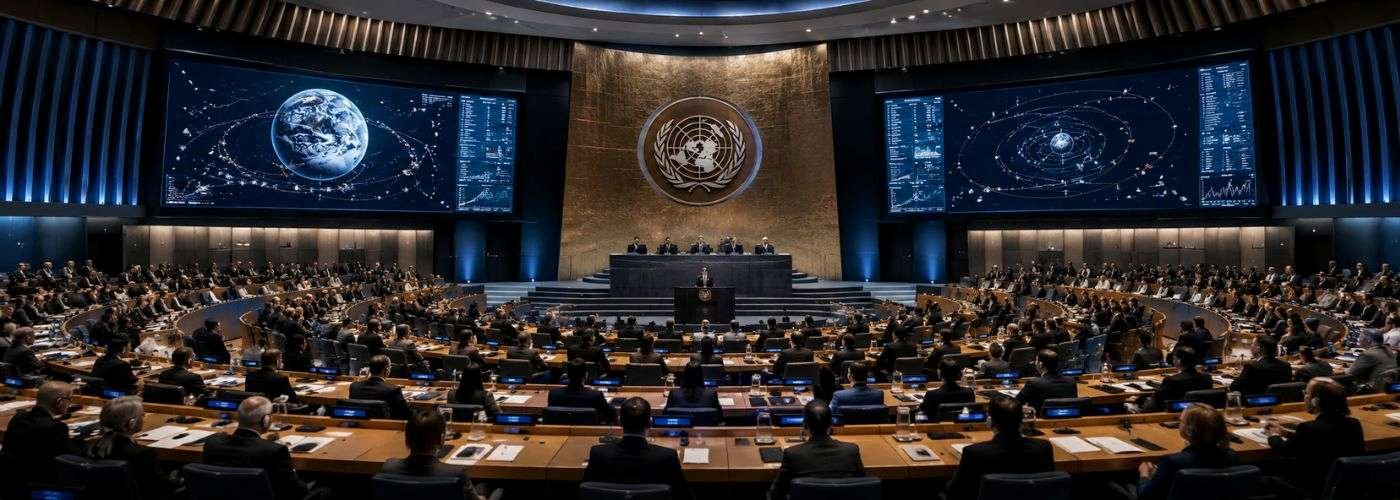
The Outer Space Treaty of 1967 is simultaneously the foundational legal instrument governing human activity in space and one of the most consequential examples of an arms control framework being overtaken by the military competition it was designed to prevent.
Negotiated during a period when space was accessible only to two superpowers, signed before the first reconnaissance satellite had been publicly acknowledged, and ratified into a legal architecture that assumed space would remain a domain of symbolic competition rather than operational warfare.
The treaty has governed the orbital environment for nearly six decades without being updated, amended, or supplemented with binding obligations that address the counterspace weapons, co-orbital systems, and electronic warfare capabilities that now define military competition in space.
The full text of the treaty is maintained by the United Nations Office for Outer Space Affairs as the authoritative depositary of the legal framework governing space activities.
The treaty’s core prohibitions — no nuclear weapons or weapons of mass destruction in orbit, no national appropriation of celestial bodies, no military installations on the Moon — remain in force and continue to provide genuine constraints on the most catastrophic potential forms of space militarisation.
But the gap between what the treaty prohibits and what states are actually developing and deploying has grown to the point where the treaty’s relevance to the contemporary space security environment requires honest analytical examination.
Kinetic anti-satellite missiles are not prohibited. Co-orbital systems with rendezvous and proximity operation capabilities are not prohibited. Electronic warfare against satellite systems is not prohibited. Directed energy weapons are not prohibited. The entire arsenal of counterspace capabilities that defines the current space competition operates within the legal space left unaddressed by the treaty.
As explored in Anti-Satellite Weapons: Capabilities, Systems, and Strategic Implications, the counterspace weapons that Russia, China, and the United States have developed and deployed operate in a legal framework that provides neither clear prohibitions nor clear permissions — only ambiguity that each state interprets in ways that serve its interests.
Understanding why the Outer Space Treaty has this character and what the implications are for the stability of the space domain is essential to understanding the governance challenge that sits beneath every dimension of the current space competition.
The broader transformation of space from a scientific environment into a contested military domain is examined in What Is Orbital Warfare? How Space Became a Contested Military Domain.
The Outer Space Treaty Was Designed for a Different Strategic Environment
The treaty emerged from a specific historical moment.
The 1957 launch of Sputnik had demonstrated that ballistic missile technology capable of delivering nuclear warheads across continents was equally capable of placing objects in orbit. The immediate concern of both superpowers was whether the other would attempt to place nuclear weapons in orbit — a capability that would provide a first-strike advantage by reducing warning times and bypassing terrestrial missile defense systems.
The United Nations General Assembly passed a resolution calling for the peaceful use of space in 1963, and negotiations toward a binding treaty proceeded rapidly once both Washington and Moscow recognized that banning orbital nuclear weapons served both their interests — neither wanted the other to weaponize space in this specific way.
The negotiating context shaped the treaty’s character profoundly. Both superpowers were willing to prohibit nuclear weapons in orbit precisely because neither considered orbital deployment superior to their existing land-based and submarine-based nuclear forces.
The treaty prohibited what neither side wanted to do anyway. What neither side was willing to prohibit was the continued use of space for intelligence collection, communications relay, navigation, and early warning — the satellite functions that had already proven strategically indispensable.
Article IV’s requirement that space be used for peaceful purposes was therefore negotiated with the explicit understanding by all parties that reconnaissance satellites and military communications satellites were for peaceful purposes. The word peaceful in the treaty’s text means non-aggressive, not non-military.
The Soviet Union was particularly concerned that any verification regime would require inspection of its military satellite programs — a transparency it was unwilling to accept. The result was a treaty with no verification provisions whatsoever.
There is no inspection regime, no challenge mechanism, no monitoring body, and no enforcement mechanism. Compliance depends entirely on national self-reporting and the political costs of being caught in violation — costs that, as subsequent decades have demonstrated, are manageable for major powers willing to accept diplomatic criticism.
The Liability Convention of 1972 and the Registration Convention of 1976 supplemented the treaty framework, providing mechanisms for compensation when space objects cause damage and requiring states to register objects launched into space with the United Nations. Neither convention addressed weapons or counterspace capabilities.
The Moon Agreement of 1979, which would have extended the peaceful purposes requirement and prohibited weapons near Earth orbit, was never ratified by any major spacefaring power and remains legally irrelevant to the states with the capabilities that matter.

What the Treaty Prohibits and What It Does Not
The treaty’s most significant substantive provision is Article IV, which prohibits placing nuclear weapons or any other kinds of weapons of mass destruction in Earth orbit, on the Moon, or elsewhere in space. This prohibition remains the treaty’s most consequential contribution to space stability — the prevention of nuclear weapons in orbit removes the specific first-strike advantage that orbital nuclear deployment would create.
As of 2026, no state has deployed nuclear weapons in orbit in violation of this prohibition — though Russia’s development of a nuclear-capable anti-satellite weapon, publicly disclosed by American intelligence in February 2024, represents the most direct challenge to this provision in the treaty’s history.
What the treaty does not prohibit is everything else.
Conventional weapons in orbit are not prohibited.
Kinetic anti-satellite missiles launched from Earth are not prohibited.
Co-orbital spacecraft with rendezvous and proximity operation capabilities that can approach and disable other satellites are not prohibited.
Directed energy weapons — lasers and high-powered microwave systems — are not prohibited.
Electronic warfare against satellite systems including jamming, spoofing, and cyber intrusions against ground infrastructure are not prohibited.
Intelligence collection from orbit is explicitly permitted. Military command-and-control satellites are explicitly permitted.
The treaty’s silence on conventional counterspace capabilities was not an oversight. It was a deliberate choice reflecting the negotiating reality that neither superpower was willing to foreclose the military uses of space they were already developing.
The Soviet Union’s co-orbital ASAT program — the IS system — was already under development when the treaty was negotiated. The United States was developing its own ASAT capabilities. Both sides chose to prohibit nuclear orbital deployment while leaving the rest of the space weapons question unaddressed.
The dual-use problem compounds the conventional weapons gap.
As analysed in Space Situational Awareness: Tracking and Securing the Orbital Domain, a spacecraft capable of conducting proximity operations to inspect another satellite is technically identical to one capable of conducting a co-orbital ASAT attack against that satellite.
A ground-based missile system capable of intercepting an incoming ballistic missile is technically identical to one capable of intercepting a satellite in low Earth orbit — the PDV Mark-II interceptor used in India’s Mission Shakti test was derived directly from India’s ballistic missile defense program.
The treaty provides no mechanism for distinguishing the defensive from the offensive application of these dual-use capabilities. That ambiguity is not accidental. It is the space where the most consequential military competition currently operates.
The Arms Control Association maintains the most concise and authoritative open-source summary of what the treaty’s key arms control provisions actually require of states-parties.
Russia’s Nuclear ASAT Program Has Directly Challenged the Treaty’s Core Prohibition
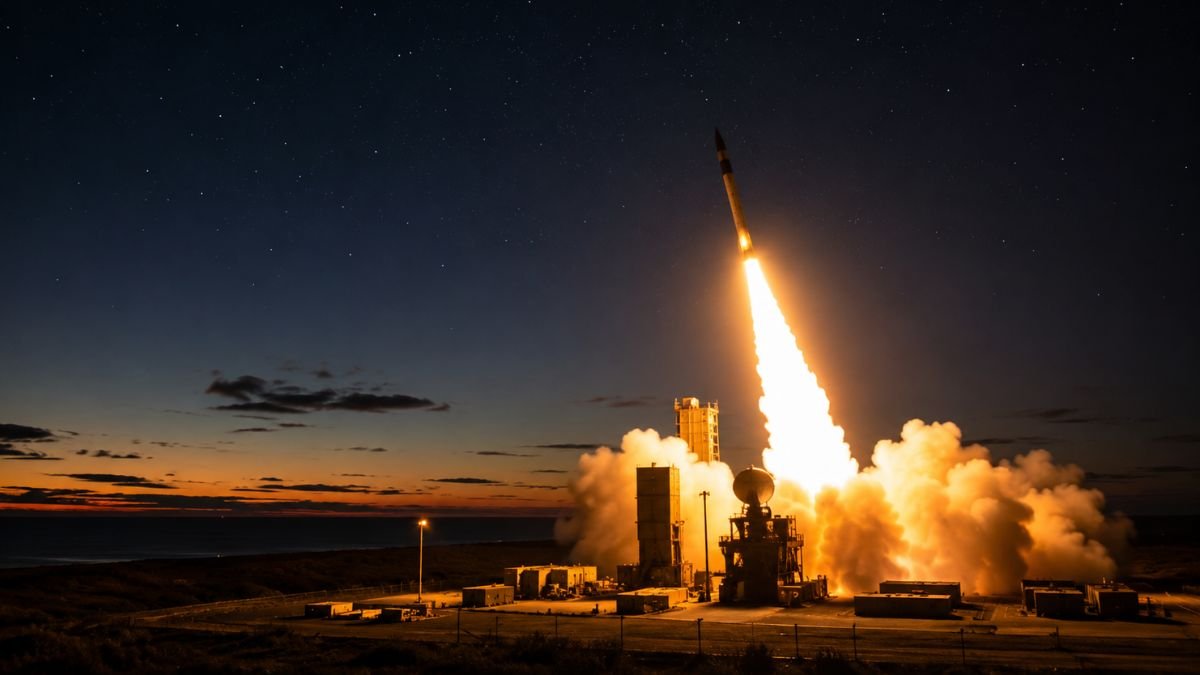
The most acute legal challenge to the Outer Space Treaty in its nearly six decades of existence emerged in February 2024 when American intelligence officials disclosed that Russia was developing a nuclear-capable anti-satellite weapon — a system designed to use a nuclear explosion in space to generate electromagnetic pulse effects that would disable or destroy satellites across a wide area.
If deployed in orbit as publicly assessed, such a system would likely constitute a violation of Article IV’s prohibition on placing nuclear weapons in Earth orbit.
The diplomatic consequences were immediate and revealing.
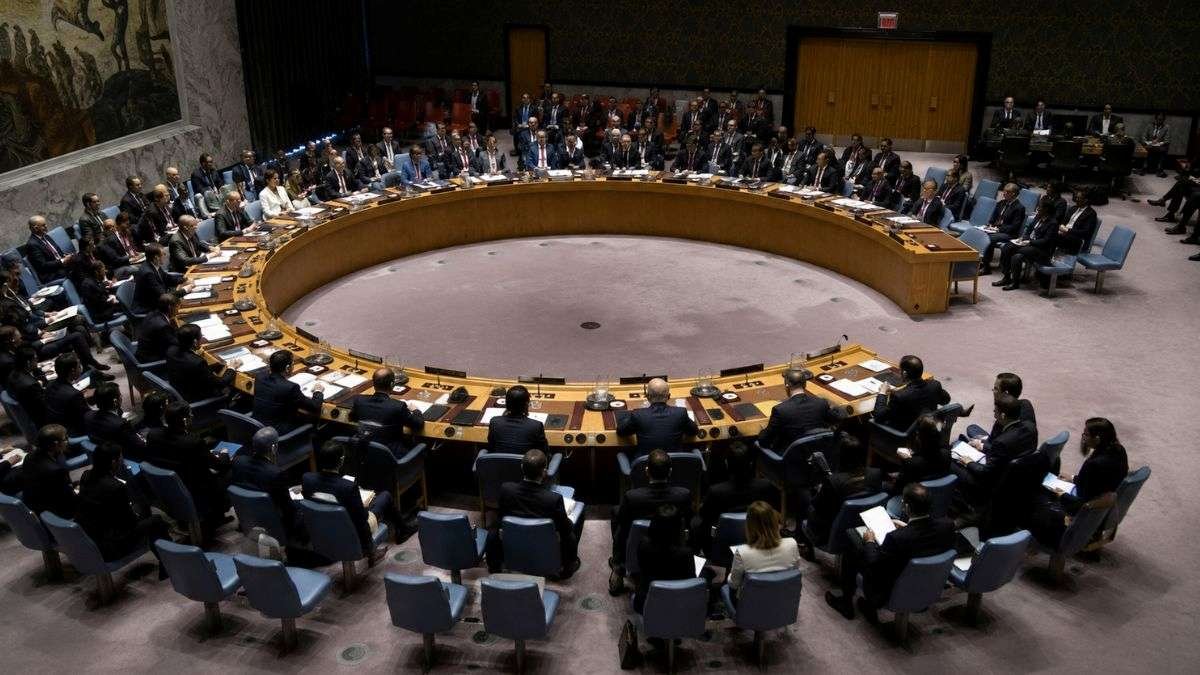
The United States and Japan sponsored a United Nations Security Council resolution on 24 April 2024 that called on all states to reaffirm their obligation under the Outer Space Treaty not to place nuclear weapons in space. The resolution attracted support from thirteen of the fifteen Security Council members.
Russia vetoed it — the only negative vote. China abstained.
Russian Ambassador Vassily Nebenzya called the resolution a dirty spectacle and a cynical ploy.
American Ambassador Linda Thomas-Greenfield responded that there should be no doubt that placing a nuclear weapon into orbit would be unprecedented, unacceptable, and deeply dangerous.
The Arms Control Association directly condemned Russia’s veto, arguing that the resolution was fully compatible with existing treaty obligations and that Russia’s reasoning did not hold water.
Russia subsequently sponsored its own competing Security Council resolution calling on states not to place any weapons in space — deliberately using broader language that would have required the United States to address its own conventional space weapons programs as a condition of any agreement.
The United States rejected the Russian resolution as disingenuous. The Security Council failed to adopt either resolution. The impasse illustrated precisely the problem at the heart of space arms control.
Each major power is willing to prohibit the specific capabilities it considers most threatening to its own interests while protecting the capabilities it considers most valuable.
The December 2024 UN General Assembly resolution on Weapons of Mass Destruction in Outer Space passed with 167 votes in favor — an overwhelming international majority affirming the treaty’s core prohibition. Russia voted against. China abstained.
The pattern of Russia actively challenging the treaty’s nuclear prohibition while China hedges rather than endorses reflects the fragmentation of the international consensus that the treaty’s drafters assumed would sustain it.
The concern has not receded. In March 2026, a senior US Space Force general publicly warned that Russia’s continued development of this capability could enable what he described as a ‘Space Pearl Harbor’ — a sudden, wide-area nuclear detonation intended to disable American and allied satellites simultaneously — language reflecting how seriously US military leadership continues to treat a capability first disclosed two years earlier, even in the absence of any confirmed orbital deployment.
China Exploits Treaty Ambiguity Through a More Sophisticated Dual-Track Strategy
While Russia has mounted a direct challenge to the treaty’s core nuclear prohibition, China has adopted a more sophisticated approach that is in some respects more consequential for the treaty’s long-term relevance.
The contrasting strategic doctrines that shape American and Chinese military space policy are explored in US Space Force Doctrine vs China’s Space Strategy: Competing Visions of Orbital Power.
China consistently supports the Prevention of the Placement of Weapons in Outer Space treaty — the PPWT — which would prohibit orbital weapons while leaving ground-based ASAT systems and directed energy capabilities unrestricted. This position is not coincidental.
China has invested most heavily in precisely the ground-based kinetic ASAT, directed energy, and electronic warfare counterspace capabilities that the PPWT would leave unaddressed. Supporting a treaty that prohibits orbital weapons — where China has invested less — while protecting ground-based capabilities where China has invested most is a strategically coherent position, not a principled one.
Simultaneously, China’s co-orbital satellite program and dual-use inspection activities operate in exactly the treaty’s grey zone.
The Shijian satellite series has conducted rendezvous and proximity operations that American and allied intelligence have assessed as demonstrating co-orbital ASAT capability. At the same time, Beijing characterizes the same operations as civil space technology demonstrations.
China’s satellite refueling capability, demonstrated in geostationary orbit in 2025, provides the operational infrastructure for a sustained co-orbital presence near high-value adversary satellites without taking any action prohibited by the treaty’s text.
The treaty’s silence on co-orbital systems was not designed to accommodate Chinese strategy, but Chinese strategy has been designed to fit within it. The result is a state that simultaneously advocates for strengthening one dimension of the treaty’s authority and exploits another dimension’s silence.
That combination is harder to challenge diplomatically than Russia’s blunt violation, and its long-term effect on the treaty’s relevance may prove more erosive.
The CSIS Space Threat Assessment 2025 documents Chinese and Russian satellite maneuvering behavior in both LEO and GEO with increasing operator proficiency in tactics that can be used for space warfighting.
The Conference on Disarmament Has Failed Because Every Major Power Wants to Constrain the Other Side
The institutional forum for space arms control has been deadlocked for over four decades — not because states disagree that space weapons are dangerous, but because each major power defines the danger as the other side’s capabilities while defining its own capabilities as legitimate military tools.
The broader geopolitical incentives driving this pattern of selective restraint are examined in Strategic and Geopolitical Intelligence: Understanding the New Global Power Balance.
Russia and China have jointly proposed the Prevention of the Placement of Weapons in Outer Space treaty repeatedly since 2008, with updated drafts in 2014.
The proposal prohibits orbital weapons but does not address ground-based ASAT systems, electronic warfare, or directed energy weapons — which are precisely the counterspace capabilities that Russia and China have invested most heavily in developing.
The United States has rejected the PPWT on these grounds, arguing that a treaty prohibiting orbital weapons while leaving ground-based and non-kinetic counterspace capabilities unrestricted would constrain American freedom of action in space without meaningfully limiting adversary programs.
The American position is analytically sound but diplomatically immovable — the comprehensive, verifiable space arms control treaty the United States requires as the condition for participation is precisely the treaty that Russia and China have no interest in negotiating.
This impasse has persisted for over four decades because each major space power prefers the current unregulated environment, in which it can develop counterspace capabilities freely, to a treaty that constrains those capabilities in ways that limit its own competitive advantage.
The Conference on Disarmament operates by consensus — any single member can block progress indefinitely, which means the deadlock requires only one state’s continued opposition to persist forever.
Transparency and confidence-building measures have been discussed as a partial substitute for binding arms control. The Long-Term Sustainability Guidelines adopted by COPUOS in 2019 address debris mitigation and operational safety.
The American-led moratorium on destructive ASAT testing, announced in 2022 and endorsed by over thirty states, represents a voluntary restraint on the most environmentally costly counterspace action. None of these measures creates legally binding obligations. None addresses the development or deployment of counterspace systems.
They are norms, not law — and as with all norms, their constraining power depends on the political costs of violating them, which diminish when the strategic incentives for violation are sufficiently high.
The Norms Debate Has Not Produced Consensus
The failure of formal arms control negotiations has shifted the focus of space governance efforts toward norm-building — the development of shared expectations about responsible behavior in space that constrain state conduct without requiring formal treaty commitments.
The United Kingdom-led open-ended working group on reducing space threats, which ran from 2022 through 2023, produced a report identifying responsible behaviors and potential norms. It did not produce consensus on which behaviors were irresponsible, because the major military space powers declined to characterize their own counterspace programs as threatening.
The fundamental obstacle is the same dual-use problem that prevents formal arms control.
A norm against threatening co-orbital proximity operations cannot be defined without first defining what a threatening proximity operation is, which requires distinguishing it from a legitimate space situational awareness operation, a debris removal mission, or a satellite servicing operation. All three involve the same technical capability.
The state conducting the approach characterizes it as benign. The state owning the approached object characterizes it as threatening. There is no agreed framework for resolving this dispute, and creating one requires exactly the kind of verification and transparency measures that the states with the most capable co-orbital systems are least willing to accept.
The norms debate also intersects with the broader geopolitical competition in ways that prevent depoliticised technical progress.
Russian and Chinese proposals consistently seek to characterize American satellite systems as weapons or dual-use systems that should be restricted.
American proposals focus on Russian and Chinese ASAT systems and co-orbital programs.
Each side’s norm proposals are designed not to establish genuine mutual restraint but to constrain adversary capabilities while protecting its own.
As discussed in Commercial Satellites as Military Infrastructure: Dependency, Control, and Strategic Risk, the line between commercial and military space infrastructure is sufficiently blurred that any norm regulating military space systems creates enormous definitional problems for commercial constellations providing militarily relevant services.
What a Credible Space Governance Framework Would Require
Despite four decades of failed negotiations, there is broad agreement on what a credible space governance framework would actually need — the problem is not the destination but the political will to reach it.
Verification capability is the foundational requirement.
The Outer Space Treaty was negotiated without verification provisions because neither superpower trusted the other to permit the inspection that meaningful verification would require. Advances in space situational awareness technology have substantially changed the technical feasibility of monitoring orbital behavior.
Even so, monitoring orbital activity is not the same as proving intent, and distinguishing legitimate servicing missions from hostile operations remains one of the central verification challenges for any future agreement.
As the Bulletin of the Atomic Scientists argued in September 2025, existing and emerging SSA capabilities make monitoring treaty compliance for at least some categories of space weapons more technically feasible than it was in 1967.
The political impediments to verification — states’ unwillingness to accept the transparency obligations that effective monitoring requires — remain. But the technological obstacles are diminishing.
Definitional consensus is the second foundational requirement.
Any treaty prohibiting space weapons must define what a space weapon is — a task that has defeated every previous attempt, given the dual-use character of the most strategically significant space capabilities.
Possible definitional approaches include capability-based definitions that focus on demonstrated technical capability for attack rather than declared purpose, behavior-based definitions that regulate specific types of orbital maneuvers rather than specific systems, and intent-based definitions that require demonstrated hostile intent before triggering treaty obligations.
Each approach has analytical merit and practical limitations.
A phased approach has been proposed as a politically feasible pathway. Prohibiting nuclear weapons in space at a treaty level with verification provisions would address the most immediate threat the Russian nuclear ASAT program represents while building the verification and compliance infrastructure that more comprehensive coverage would require.
Extending the American voluntary moratorium on destructive ASAT testing into a multilateral binding prohibition would address the most environmentally damaging counterspace capability while avoiding the definitional problems that comprehensive space weapons prohibition entails. These limited measures would not solve the space governance problem. They would begin to manage it.

Conclusion
The Outer Space Treaty remains the legal foundation of the space domain precisely because no state has found it in its interests to withdraw from or openly violate its core provisions. That foundation is real.
The treaty has prevented nuclear weapons in orbit for nearly six decades. It has maintained space as a domain governed by international law rather than purely by power. These are not trivial achievements in a world where the strategic incentives for space weaponisation are stronger than at any point since the treaty was drafted.
But the treaty’s limits are equally real. It governs the space environment of 1967 — a world of two superpowers, no commercial space industry, no megaconstellations, no hypersonic weapons requiring space-based tracking, no directed energy counterspace capabilities, and no co-orbital systems capable of conducting proximity operations against operational satellites.
The space environment of 2026 shares almost nothing with that world except the physical laws of orbital mechanics. The legal framework governing it has not changed.
The gap between the treaty’s coverage and the contemporary space security environment is not a technical problem awaiting a technical solution. It is a political problem rooted in the same strategic competition that makes effective governance necessary. States will accept legal constraints on their space activities when the alternative — an unmanaged space weapons competition — is more costly than the constraints.
A governance framework for space will most likely emerge not from the negotiating table but from the wreckage of a crisis that makes the cost of unregulated competition undeniable. The question is how much of the orbital domain survives intact before that lesson is learned.
Frequently Asked Questions
What does the Outer Space Treaty actually prohibit?
The Outer Space Treaty of 1967 prohibits placing nuclear weapons or any other weapons of mass destruction in Earth orbit, on the Moon, or elsewhere in space. It prohibits the establishment of military bases and fortifications on the Moon and other celestial bodies, weapons testing on celestial bodies, and the conduct of military maneuvers on celestial bodies. It establishes space as the province of all humanity, prohibits national appropriation of celestial bodies, and requires states to bear international responsibility for their national space activities. What it does not prohibit is conventional weapons in orbit, kinetic anti-satellite missiles, co-orbital systems with proximity operation capabilities, directed energy weapons, or electronic warfare against space systems.
Why does the Outer Space Treaty not cover anti-satellite weapons?
The Outer Space Treaty was negotiated in 1966 and 1967 with a primary focus on preventing nuclear weapons in orbit — the specific threat both the United States and Soviet Union considered most destabilising at that time. Both sides were already developing co-orbital ASAT capabilities and considered them strategically valuable. Neither was willing to prohibit the military uses of space — reconnaissance, communications, navigation, early warning — that they had already demonstrated were operationally indispensable. The treaty’s silence on conventional counterspace capabilities was therefore a deliberate negotiating choice reflecting the strategic interests of the parties. The treaty prohibited what neither side wanted to do anyway.
What is Russia’s alleged nuclear anti-satellite weapon and why does it matter?
American intelligence disclosed in February 2024 that Russia is developing an anti-satellite system that would use a nuclear explosion in space to generate electromagnetic pulse effects capable of disabling or destroying satellites across a wide orbital area. If deployed as assessed, this would represent a violation of Article IV of the Outer Space Treaty, which prohibits nuclear weapons in orbit. Russia vetoed a UN Security Council resolution on 24 April 2024 that called on states to reaffirm their treaty obligation not to place nuclear weapons in space — the only negative vote among fifteen Security Council members. A subsequent UN General Assembly resolution was passed in December 2024 with 167 votes in favor, with Russia voting against and China abstaining. The program represents the most direct challenge to the treaty’s core prohibition in its history. In March 2026, a senior US Space Force general publicly described the risk in stark terms, warning of a potential ‘Space Pearl Harbor’ if the capability were ever employed.
Why has the Conference on Disarmament failed to produce a space weapons treaty?
The Conference on Disarmament operates by consensus, meaning any single member can block progress indefinitely. Russia and China have repeatedly proposed a Prevention of the Placement of Weapons in Outer Space treaty since 2008 that would prohibit orbital weapons but leave ground-based ASAT systems and electronic warfare unrestricted — preserving precisely the capabilities they have invested most heavily in. The United States has rejected this as insufficient and demanded comprehensive coverage of all counterspace capabilities with effective verification. Neither position is acceptable to the other. This impasse has persisted for over four decades because each major space power prefers the current unregulated environment to a treaty that constrains its own competitive advantage.
What transparency and confidence-building measures exist for space security?
Several non-binding measures address space security without creating legal obligations. The United Nations Long-Term Sustainability Guidelines adopted by COPUOS in 2019 recommend debris mitigation practices and operational safety measures. The United States announced a voluntary moratorium on destructive ASAT testing in 2022, subsequently endorsed by over thirty states. The UN Group of Governmental Experts has produced reports on transparency measures for space activities. These measures constrain the most environmentally damaging counterspace action through political costs rather than legal obligation. They do not address development or deployment of non-kinetic counterspace systems, do not restrict co-orbital proximity operations, and do not limit the electronic warfare and directed energy capabilities that constitute the most active dimensions of the current space competition.
Sources and References
United Nations Office for Outer Space Affairs — Treaty on Principles Governing the Activities of States in the Exploration and Use of Outer Space (Outer Space Treaty, 1967)
Arms Control Association — The Outer Space Treaty at a Glance (2024)
United Nations Office for Disarmament Affairs — Prevention of an Arms Race in Outer Space: Historical Documentation (2024)
United Nations Security Council — Record of Vote on Space Nuclear Weapons Resolution (April 24, 2024)
United Nations General Assembly — Resolution on Weapons of Mass Destruction in Outer Space (December 2024)
United States Mission to the United Nations — Remarks Before the Vote on Russian-Drafted Resolution on Outer Space Security (May 20, 2024)
Secure World Foundation — FAQ: What We Know About Russia’s Alleged Nuclear Anti-Satellite Weapon (Updated September 2025)
Arms Control Association — Security Council Rejects Second Russian Space Resolution (June 2024)
Bulletin of the Atomic Scientists — Modern Arms Control Verification for the Outer Space Treaty (September 2025)
Center for Strategic and International Studies (CSIS) — Space Threat Assessment 2025 (April 2025)
Secure World Foundation — Global Counterspace Capabilities: An Open Source Assessment (2026)
International Institute for Strategic Studies (IISS) — The Military Balance (2025)
United Nations Committee on the Peaceful Uses of Outer Space — Long-Term Sustainability Guidelines (2019)
Arms Control Association — States Should Affirm Support for Outer Space Treaty Despite Russian Veto (April 2024)
U.S. Space Force — Public Statements on Russian Nuclear ASAT Risk (March 2026)
Related Analysis
For analysis of the anti-satellite weapons whose development and deployment the Outer Space Treaty does not prohibit, read Anti-Satellite Weapons: Capabilities, Systems, and Strategic Implications.
For analysis of the orbital debris consequences of ASAT testing that voluntary moratoria are designed to prevent, read Orbital Debris and the Strategic Limits of Space Warfare.
For analysis of the space situational awareness systems that provide the monitoring foundation any future space arms control verification regime would require, read Space Situational Awareness: Tracking and Securing the Orbital Domain.
For analysis of the electronic warfare capabilities against space systems that the treaty does not address, read Electronic Warfare in Space: Jamming, Spoofing, and Satellite Signal Warfare Explained.
For analysis of the commercial satellite infrastructure whose dual-use character complicates any definition of space weapons, read Commercial Satellites as Military Infrastructure: Dependency, Control, and Strategic Risk.
