



Analysis · StrikeOrbit | 2026
Space is no longer a passive domain supporting military operations on Earth. It has become an active arena of strategic competition where the ability to secure, deny, and exploit orbital systems directly shapes outcomes on the ground, at sea, and in the air.
The emergence of the United States Space Force and the rapid expansion of China’s counterspace architecture reflect a deeper structural shift: space is now treated as a contested warfighting environment by both powers.
What makes this competition distinctive is not simply that two major powers are both investing in space. It is that they are investing according to fundamentally opposed strategic logics. The United States is building a defensive, resilient, networked architecture designed to ensure that space-enabled military capabilities survive sustained attack and continue to function.
China is building an offensive, denial-focused counterspace capability designed to degrade, disrupt, and disable those same capabilities at the moment they matter most.
These are not competing versions of the same strategy. They are mirror images of each other — one optimised for persistence under pressure, the other for targeted disruption at decisive moments. Understanding the logic, the programmes, and the implications of each is essential to understanding how the next major conflict will be shaped before the first terrestrial shot is fired.
The competition between the United States and China is rapidly shaping how future conflicts in orbit will be fought, turning space warfare strategy into a central pillar of modern military planning.
As examined in What Is Orbital Warfare? How Space Became a Contested Military Domain, the militarisation of space has produced an environment in which doctrine determines vulnerability as much as capability does.
The United States Frames Space as a Warfighting Strategy Built on Resilience and Integration
The formal establishment of the United States Space Force in December 2019 marked more than an organisational change. It represented the institutional recognition of a strategic reality that had been building for three decades: that space was no longer a benign support environment but a domain where military advantage could be contested, degraded, and lost.
The Space Force’s foundational doctrine, codified in the Space Capstone Publication of 2020, defines space explicitly as a warfighting domain alongside land, sea, air, and cyberspace — the first formal articulation of this position in American military doctrine.
The broader evolution of military competition in orbit and the concepts that underpin modern space conflict are explored in What Is Orbital Warfare? How Space Became a Contested Military Domain, which provides the strategic foundation for understanding these competing doctrines.
The operational logic at the centre of American space doctrine is resilience. The United States spent the Cold War and the post-Cold War decades building an architecture of exquisite, high-value satellites — large, expensive, extraordinarily capable platforms that concentrated enormous military value in a small number of targets. The strategic vulnerability this created was not lost on adversaries.
As China and Russia developed increasingly sophisticated counterspace capabilities, the logic of relying on a small number of irreplaceable platforms became untenable. The response has been a systematic shift toward distributed, proliferated architectures.
The Proliferated Warfighter Space Architecture, or PWSA, is the most significant expression of this shift. Managed by the Space Development Agency, it involves deploying hundreds of smaller satellites in low Earth orbit across multiple orbital planes, distributing communications, missile warning, and data transport functions across a constellation that is far harder to degrade comprehensively than a small number of high-value platforms.
The first operational tranches of PWSA satellites were in orbit by 2024, with deployment continuing through 2025. A constellation of three hundred satellites cannot be neutralised by a single anti-satellite strike, the way a single high-value communications satellite can — and that mathematical reality is the foundation of American resilience doctrine.
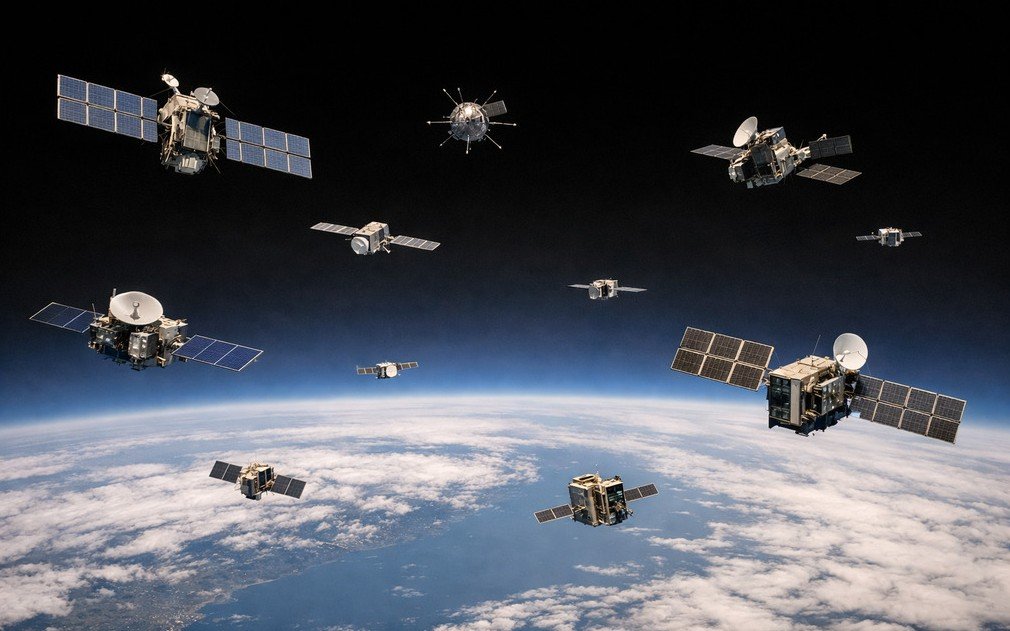
The Geosynchronous Space Situational Awareness Programme, or GSSAP, represents a different dimension of American space doctrine — the offensive and intelligence dimension that receives less public attention. GSSAP satellites are co-orbital systems operating in near-geostationary orbit, used to inspect, characterise, and monitor other states’ high-value satellites.
They represent American investment in the same co-orbital proximity operations that Washington publicly criticises when conducted by Russia and China — a reflection of the dual-use reality of advanced space capabilities across all major powers.
Integration is the second pillar of American space doctrine. The Joint All-Domain Command and Control framework, or JADC2, is designed to connect sensors, decision-makers, and effectors across all warfighting domains through a continuous, data-driven network.
The architecture, operational principles, and strategic significance of this networked command model are examined in JADC2 Explained: How the US Military’s Joint Command Network Works.
In this architecture, satellites are not isolated assets but nodes in a system where information from a space-based sensor can feed directly into a targeting decision executed by a ground force or an aircraft within seconds.
The military value of space systems in this model is not the satellite itself but the data flow it enables — which is why disrupting that data flow, rather than destroying the satellite, is often the more efficient counterspace strategy. As examined in Anti-Satellite Weapons: Capabilities, Systems, and Strategic Implications, the spectrum of counterspace capabilities reflects precisely this understanding.
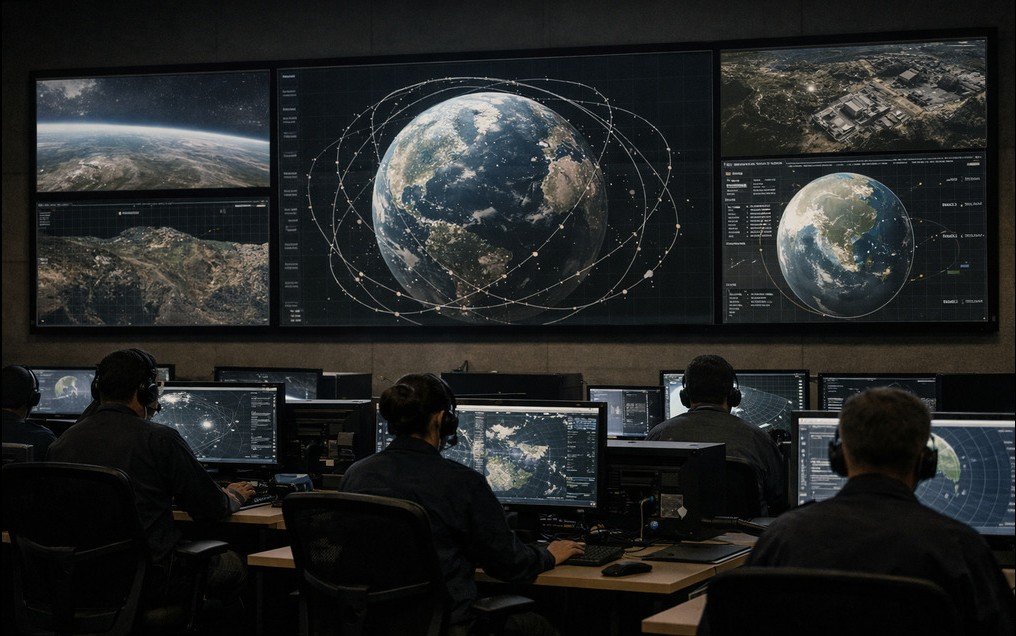
Space domain awareness is the third pillar. The Space Fence radar installation on Kwajalein Atoll in the Marshall Islands, declared operational in 2020, can track objects in low Earth orbit smaller than a softball with unprecedented precision — a capability that underpins both defensive warning and offensive targeting.
The technologies and operational methods behind monitoring satellites, debris, and hostile orbital activity are examined in Space Situational Awareness: Tracking and Securing the Orbital Domain.
The United States Combined Space Operations Center integrates data from multiple sensors into a common operating picture shared, with varying degrees of classification, across allied and partner nations. This shared awareness is itself a form of strategic deterrence — states are less likely to conduct threatening orbital operations when they know those operations are being observed and attributed.
The Congressional Research Service provides a detailed analysis of Space Command’s structure and mission in its Defense Primer.
China’s Space Strategy Prioritises Denial, Disruption, and Strategic Asymmetry
China’s approach to space is shaped by a strategic context fundamentally different from that of the United States. Where American doctrine is built around preserving and extending an existing advantage, Chinese doctrine is built around negating someone else’s.
The PLA’s analysis of American military operations — from the Gulf War in 1991 through the interventions in Kosovo, Afghanistan, and Iraq — produced a consistent conclusion: American conventional military power is inseparable from American space-based infrastructure. Blind the infrastructure, and the power degrades.
This insight drove three decades of Chinese investment in counterspace capabilities and produced the doctrine that guides the PLA today.
The organisational expression of this doctrine was the PLA Strategic Support Force, established in 2015 to consolidate space, cyber, and electronic warfare capabilities under unified command.
The SSF (Strategic Support Force) represented a structural recognition that space, cyber, and information operations were not separate domains but interdependent elements of a unified information warfare capability.
In 2024, the SSF (Strategic Support Force) was restructured and replaced by the PLA Information Support Force — a reorganisation that reflected both lessons learned from observing the Ukraine conflict and a determination to more tightly integrate space operations into joint command architecture.
The new structure places space capabilities even more directly under the command authority of joint theatre commanders, reducing the gap between strategic counterspace planning and operational execution.
China’s counterspace capabilities span the full spectrum of methods. The DN-2 and DN-3 direct-ascent anti-satellite missiles are assessed as capable of targeting satellites in medium Earth orbit and geostationary orbit, respectively — the altitudes where GPS navigation satellites and strategic communications satellites operate.
The 2007 Fengyun-1C test established China’s kinetic intercept capability in low Earth orbit at a cost of more than three thousand trackable debris fragments that remain hazardous to other spacecraft today.

Subsequent testing has been conducted at lower altitudes with reduced debris generation, reflecting an understanding that the environmental costs of kinetic testing impose political and strategic costs that non-kinetic alternatives avoid.
The Shijian satellite series has conducted proximity operations in orbit that Western analysts assess as consistent with co-orbital weapons development. These spacecraft can manoeuvre into close proximity with target satellites, conduct surveillance, and potentially interfere with or damage them through physical, directed energy, or electronic means.
China’s ground-based laser programme is assessed to have reached operational capability for dazzling and damaging optical sensors on imagery satellites in low Earth orbit — a directed energy counterspace capability that achieves sensor degradation without generating debris or providing the visible escalatory signature of a kinetic attack.
China’s electronic warfare capabilities are extensive and increasingly tested in operational environments. GPS jamming and spoofing operations have been documented across multiple regions, and the lessons from Russia’s sustained electronic warfare campaign in Ukraine — observed closely by PLA analysts — have informed Chinese development of mobile, networked electronic warfare systems designed for theatre-wide application.
Cyber operations against satellite ground infrastructure represent a further dimension, with Chinese state-affiliated actors assessed to have conducted persistent intrusion campaigns against commercial and government space systems across multiple countries.
The Guowang constellation — a state-backed commercial LEO communications network planned at over twelve thousand satellites and currently in active deployment — serves a dual purpose. It provides China with a communications infrastructure independent of Western-controlled systems, reducing PLA dependence on vulnerable geostationary communications satellites, and it establishes a large-scale on-orbit presence with inherent dual-use potential.
The growing dependence on commercial satellite constellations for military communications and strategic resilience is explored further in Commercial Satellites as Military Infrastructure: Dependency, Control, and Strategic Risk.
China is simultaneously building the resilience it seeks to deny to the United States and developing the counterspace tools designed to undermine American resilience.
For current assessment of Chinese and Russian counterspace developments, see the CSIS Space Threat Assessment 2025.
Doctrine Shapes Capability: Defensive Resilience vs Offensive Counterspace Systems
The contrast between American and Chinese space doctrine becomes most analytically significant when examined through the lens of what it produces — not in abstract strategic statements but in concrete programmes, investments, and operational concepts. Doctrine is not separate from capability. It determines what gets built, how it gets deployed, and what targets it is designed to address.
American doctrine’s emphasis on resilience produces a specific set of investment priorities. Proliferated constellations reduce the value of any single target. Rapid launch capabilities — including the ability to reconstitute lost satellites within days rather than months — reduce the strategic return on successful counterspace strikes.
Hardening of satellite electronics against directed energy and electromagnetic interference raises the cost of non-kinetic attacks. Ground-based backup systems for navigation and communications reduce the operational impact of satellite degradation. Each of these investments is a direct response to the counterspace threat, and each one imposes additional costs on an adversary attempting to deny American space access.
Chinese doctrine’s emphasis on denial produces a different set of priorities. Investment in kinetic ASAT missiles provides a credible threat against high-value American satellites in multiple orbital regimes. Co-orbital systems provide persistent proximity threat against specific high-priority targets. Electronic warfare capabilities provide theatre-wide disruption of GPS-dependent precision strike.
Cyber capabilities provide low-attribution interference with ground control infrastructure. Directed energy provides reversible sensor degradation without debris generation. Taken together, these capabilities provide multiple independent pathways to the same operational objective — degrading American space-enabled military effectiveness at a critical moment of conflict.
The interaction between these two doctrinal approaches creates a strategic dynamic that neither side can fully resolve.
American investment in proliferated constellations raises the cost and complexity of Chinese denial operations — instead of targeting one satellite, a denial campaign must now degrade hundreds. But Chinese investment in electronic warfare and cyber capabilities means that a proliferated constellation can be partially degraded without kinetic attack, through signal interference applied across the constellation’s ground infrastructure or user terminals.
The Viasat attack model — targeting ground infrastructure rather than satellites — represents precisely this logic applied at operational scale, as examined in Anti-Satellite Weapons: Capabilities, Systems, and Strategic Implications.
The competition is self-reinforcing, and both sides understand that. Resilience does not eliminate vulnerability. It redistributes it. Each investment in resilience creates an incentive for a corresponding investment in more sophisticated denial. Each investment in denial creates an incentive for a further investment in resilience.
The question is not which side wins but which side can sustain the competition longer and at lower cost relative to its overall military investment priorities.
The Secure World Foundation’s Global Counterspace Capabilities report provides the most comprehensive open-source assessment of these competing investments annually.
Space Systems Are Now Central to Joint Military Operations on Earth
The strategic significance of the US-China space competition is ultimately determined by what space systems enable on the battlefield.
The theoretical argument about doctrine and capability translates into practical consequences through the dependence of modern military operations on orbital infrastructure — a dependence that the war in Ukraine has demonstrated at sustained operational scale more comprehensively than any previous conflict.
Ukrainian forces have relied on commercial satellite imagery from Planet Labs and Maxar Technologies for near-real-time battlefield intelligence, enabling targeting and operational planning at a speed and resolution that would not have been possible through organic military intelligence assets alone.
SpaceX’s Starlink constellation provided communications resilience across the front lines throughout the conflict, adapting continuously to Russian electronic warfare interference through software updates that demonstrated both the flexibility of commercially operated distributed systems and the intensity of the electronic warfare competition being waged in parallel.
The autonomous systems proliferating across that battlefield, examined in Drone Warfare and Autonomous Systems in Modern Conflict, depended on the same satellite communications and positioning infrastructure that counterspace operations targeted.
Russian operations provided the counterpoint — a live demonstration of what a state with sophisticated counterspace capabilities attempts when space-enabled military operations are being used against it.
GPS jamming across wide areas of the operational theatre degraded Ukrainian precision navigation. The Viasat attack at the outset of the invasion targeted communications infrastructure. Electronic warfare interference with drone navigation and control links forced continuous tactical adaptation.
The PLA drew detailed lessons from both Ukraine’s use of commercial space capabilities and Russia’s attempts to counter them. Those lessons are reflected in current Chinese counterspace development priorities and in the design parameters of the Guowang constellation.
For the United States, Ukraine validated both the strategic importance of space-enabled military power and the vulnerability that dependence creates. American military planners are now formalising what happened informally in Ukraine, building commercial space integration into doctrine, acquisition, and operational planning in ways that will shape the force structure of the next decade.
The hypersonic weapons reshaping global strike balances, examined in Hypersonic Weapons and the Emerging Global Strike Balance, are in part designed to operate in environments where space-based tracking and guidance may be degraded — a direct response to the counterspace threat that both the United States and China are developing against each other.
Escalation Risks Emerge From Misinterpretation and System-Level Vulnerability
The most dangerous dimension of the US-China space competition is not the capabilities being developed but the escalation dynamics that those capabilities create in a crisis. Space operations are characterised by a degree of ambiguity that has no equivalent in terrestrial military domains.
A satellite that manoeuvres into proximity with another satellite may be conducting routine inspection operations or positioning for an attack. An interference with communications or navigation may be caused by a technical malfunction, commercial interference, or deliberate hostile action. The target state may not be able to determine which with the certainty required for a proportionate response in the time available for decision.
This ambiguity is structurally destabilising. In a crisis between the United States and China — over Taiwan, the South China Sea, or any other flashpoint — both sides would have strong incentives to degrade the other’s space-based intelligence, communications, and early warning capabilities in the opening phase of conflict. Both sides would also be watching their own space systems for signs of degradation that might indicate imminent attack.
The combination of offensive incentives and defensive anxiety in a domain characterised by ambiguity creates conditions for preemptive escalation that are structurally similar to the instabilities of Cold War nuclear doctrine — a use-it-or-lose-it dynamic applied to orbital assets rather than nuclear forces.
The nuclear connection is direct and serious.
American and Chinese early warning satellites that detect ballistic missile launches within seconds of ignition are foundational to nuclear deterrence on both sides. If those satellites were degraded or destroyed in a conventional conflict — deliberately or as collateral damage — the state that lost them would face compressed warning times and degraded confidence in its ability to characterise an incoming attack.
These strategic early warning architectures and their role in nuclear deterrence are examined in Missile Warning Satellites and Early Warning Systems Explained.
The pressure to use nuclear weapons before losing the ability to do so becomes acute precisely when clarity is most needed.
An ASAT attack on early warning architecture, conducted for conventional military purposes, could trigger a nuclear response. Managing this risk requires a degree of crisis communication and tacit restraint that currently has no institutional framework in the US-China relationship.
The scale of the orbital debris environment, tracked continuously by the European Space Agency, adds a further layer of irreversibility to any kinetic counterspace exchange.
The long-term operational and strategic consequences of debris generation are examined in Orbital Debris and the Strategic Limits of Space Warfare.
Future Space Competition Will Be Defined by Persistence, Not Dominance
The trajectory of current developments points toward a space competition defined not by decisive victory but by sustained operation under contested conditions.
Neither the United States nor China can achieve permanent dominance in orbit — the domain is too vast, too accessible to multiple actors, and too dependent on shared physical infrastructure to be controlled in the way that terrestrial territory can be. What both sides can achieve is relative advantage in specific scenarios, maintained through continuous investment and adaptation.
The United States has committed to this logic through its resilience architecture. The Proliferated Warfighter Space Architecture, the Space Development Agency’s transport layer, and the integration of commercial constellations into military planning all reflect a doctrine of persistence — the ability to continue operating despite disruption, absorb losses, and reconstitute capability faster than an adversary can impose it. This is not a doctrine of dominance. It is a doctrine of endurance.
China’s trajectory points toward a parallel investment in its own resilience alongside its counterspace capabilities.
The Guowang constellation, the BeiDou navigation system providing global coverage independent of GPS, and the development of hardened military communications satellites all reflect an understanding that the denial strategy China applies to American space infrastructure will eventually be applied to Chinese infrastructure as well.
China is not building a counterspace capability in isolation. It is building the resilience to survive a counterspace competition while simultaneously developing the tools to conduct one.
The commercial space sector will increasingly shape this competition in ways that neither military establishment fully controls.
The integration of commercial constellations into military operations — demonstrated comprehensively in Ukraine — means that the boundary between civilian and military space infrastructure is effectively gone. Future conflict will involve commercial satellites as targets, as tools, and as contested assets whose legal status and appropriate protection remain unresolved in international law.
The legal questions surrounding civilian-owned space infrastructure in conflict are also closely tied to The Outer Space Treaty and Its Limits in the Age of Orbital Warfare, which examines where current international law remains insufficient.
The obligations of private companies operating commercial constellations in a conflict zone, the right of states to defend commercial infrastructure that has become functionally military, and the legal thresholds for targeting such infrastructure are questions that the pace of commercial space development has made urgent and that the pace of legal and normative development has not addressed.

Conclusion
The United States and China are constructing competing visions of orbital power that reflect not just different capabilities but different theories of how space shapes the outcome of conflict. American doctrine bets on resilience — on the ability to absorb attacks, distribute vulnerability, and maintain operational continuity under sustained pressure.
Chinese doctrine bets on denial — on the ability to degrade the opponent’s space-enabled advantages at a critical moment and shift the balance of conventional military power.
Neither bet is certain. Resilience architectures can be overwhelmed by sufficiently sophisticated and sustained denial operations. Denial strategies can be defeated by sufficiently distributed and rapidly reconstituting resilience architectures. The competition between the two will continue to drive investment, innovation, and risk on both sides for the foreseeable future.
Space will not decide wars alone. But it will decide how wars are fought — and that distinction is now the central fact of modern space warfare competition.
Frequently Asked Questions
What is the US Space Force and what does its doctrine say about space warfare?
The United States Space Force, established in December 2019, is the first new military service branch since 1947 and represents a formal shift in how the United States conceptualises space. Its foundational doctrine, codified in the Space Capstone Publication of 2020, defines space as a warfighting domain alongside land, sea, air, and cyberspace. The doctrine places particular emphasis on resilience — the ability to maintain space-enabled capabilities under sustained attack — through distributed satellite architectures, rapid reconstitution, and integration with joint military operations through frameworks such as JADC2. This reflects a broader recognition that space superiority can no longer be assumed and must be actively defended and continuously sustained.
How does China’s military approach space warfare differently from the United States?
China’s approach to space warfare is shaped by the strategic objective of offsetting American conventional military advantages that depend heavily on space infrastructure. Rather than attempting to match the United States system-for-system, Chinese doctrine focuses on selectively degrading adversary space capabilities at critical moments through a layered spectrum of counterspace tools. These include kinetic anti-satellite missiles, co-orbital systems capable of proximity operations, electronic warfare, directed energy systems, and cyber operations targeting ground infrastructure. This asymmetric approach reflects a deliberate prioritisation of denial over dominance, aiming to disrupt the space-enabled foundation of American military power at decisive points in a conflict.
Which country currently has stronger space military capabilities?
The United States maintains the most extensive, technologically advanced, and operationally integrated military space architecture of any state, with clear advantages in space domain awareness, communications resilience, and the breadth of space-enabled military functions. China, however, has developed the most comprehensive and rapidly expanding counterspace programme, with demonstrated capabilities across kinetic, electronic, cyber, and directed energy domains. Rather than a simple comparison of strength, the more meaningful question is how these capabilities perform in specific operational scenarios. The balance depends on whether resilience or denial proves more effective under real conflict conditions — an outcome that remains uncertain.
Can space warfare escalate into nuclear conflict?
The risk of escalation from space warfare into nuclear conflict is real and structurally significant. Early warning satellites, which detect ballistic missile launches within seconds, are central to nuclear deterrence for both the United States and China. If these systems were degraded or destroyed — even as part of a conventional counterspace operation — it could be interpreted as preparation for a nuclear first strike. This misinterpretation risk is compounded by the ambiguity inherent in space operations, where intent is difficult to assess in real time. The absence of established norms, attribution mechanisms, and crisis communication frameworks between major powers means that this escalation pathway remains largely unmanaged compared to Cold War-era nuclear safeguards.
Sources and References
U.S. Space Force — Space Capstone Publication (2020)
U.S. Space Force — Spacepower: Doctrine for Space Forces (2020)
U.S. Space Force — FY2025 Budget Request: Space Domain Awareness and Counterspace Programmes (2024)
Space Development Agency — Proliferated Warfighter Space Architecture Programme Documentation (2024)
Congressional Research Service — Defense Primer: Military Use of Space (2023)
Congressional Research Service — Space Force and Space Command: Issues for Congress (2023)
Centre for Strategic and International Studies (CSIS) — Space Threat Assessment (2025)
Secure World Foundation — Global Counterspace Capabilities: An Open Source Assessment (2024)
RAND Corporation — Space as a Warfighting Domain: Implications for National Security
International Institute for Strategic Studies (IISS) — The Military Balance (2025)
NATO — Allied Joint Doctrine for Space Operations (2022)
United Nations Office for Outer Space Affairs — Outer Space Treaty (1967)
European Space Agency — Space Debris by the Numbers (2025)
Related Analysis
For analysis of the foundational concepts and capabilities that define the orbital warfare environment in which US and Chinese strategies compete, read What Is Orbital Warfare? How Space Became a Contested Military Domain.
For analysis of the full spectrum of anti-satellite weapons that both powers are developing and deploying, read Anti-Satellite Weapons: Capabilities, Systems, and Strategic Implications.
For analysis of the precision strike systems whose effectiveness depends on the space infrastructure both powers are contesting, read Precision Strike Weapons and Modern Warfare.
For analysis of autonomous and unmanned systems whose operational dependence on satellite connectivity makes them central to the space warfare competition, read Drone Warfare and Autonomous Systems in Modern Conflict.
For analysis of hypersonic weapons and their relationship to space-based tracking, warning, and guidance architecture, read Hypersonic Weapons and the Emerging Global Strike Balance.
