


Analysis · StrikeOrbit | 2026
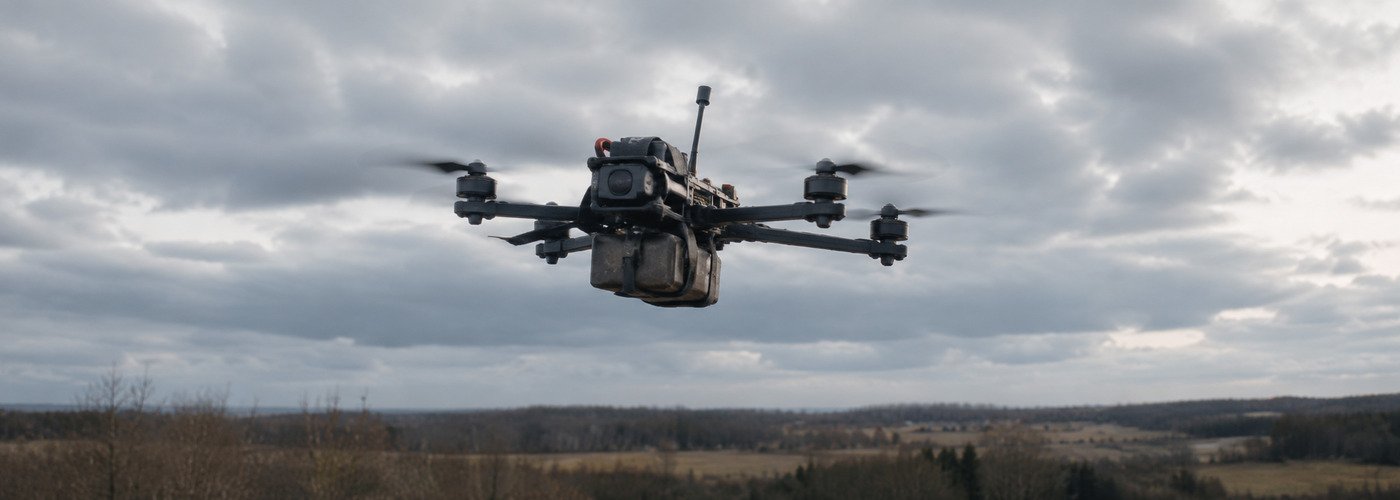
On June 1, 2025, Ukraine’s Security Service executed Operation Spiderweb — smuggling first-person-view attack drones deep into Russian territory concealed inside modified truck containers, then launching them simultaneously against multiple strategic bomber bases thousands of kilometres from the front line.
Ukraine’s SBU claimed 41 aircraft destroyed or damaged, causing an estimated $7 billion in losses; Admiral Pierre Vandier, NATO’s Supreme Allied Commander Transformation, offered a lower estimate of 10 to 13 aircraft completely destroyed, with additional planes damaged.
Satellite imagery analysed by the Associated Press and other outlets corroborated destruction at multiple sites, though the full scope remains difficult to verify independently. The operation relied on small FPV attack drones launched from concealed positions inside Russia, with human operators retaining control rather than the systems conducting fully autonomous target selection.
That single operation captures why drone warfare has become the defining feature of contemporary conflict rather than a supporting one.
A relatively small number of operators, using inexpensive FPV platforms and an elaborate covert support architecture, achieved an effect against strategic military assets that would once have required a dedicated air campaign.
Drone warfare and autonomous systems are no longer emerging capabilities but central components of modern military operations, shaping reconnaissance, strike missions, battlefield adaptation, and force structure across the world’s major armed forces.
This article examines how that transformation happened, what current conflicts reveal about the real state of autonomy versus remote piloting, and why the industrial capacity to mass-produce these systems has become as strategically important as the technology inside any individual drone.
Ukraine Has Industrialised Drone Warfare at a Scale With No Historical Precedent
The raw production numbers from Ukraine’s drone industry are difficult to overstate. Ukraine produced an estimated 4 to 4.5 million drones in 2025 alone, more than 2 million of them small FPV strike drones, according to reporting from the Carnegie Endowment and GIS Reports Online.
The number of Ukrainian drone manufacturers grew from 41 companies in 2022 to 183 by 2024, with the largest firms now producing several thousand units per day.
The strategic consequence of this industrial scale-up is significant, though it needs to be stated with real care. Ukrainian officials have increasingly attributed a large majority of Russian battlefield losses to drones, with estimates varying sharply by period, unit, and methodology.
President Volodymyr Zelenskyy and other officials have cited figures above 80 percent in some recent contexts, while Ukrainian reporting placed the share as high as 96 percent for March 2026.
Independent Ukrainian analysts, including Razumkov Center co-director Oleksiy Melnyk, have offered lower estimates in the 70-to-80-percent range.
These figures are not independently verifiable and should not be treated as directly comparable to one another, since they may reflect different time periods, geographic sectors, or methods of counting — but their consistency in direction points to the growing centrality of drones in Ukraine’s combat system, alongside the roughly 20 percent share of frontline personnel that drone units themselves represent.
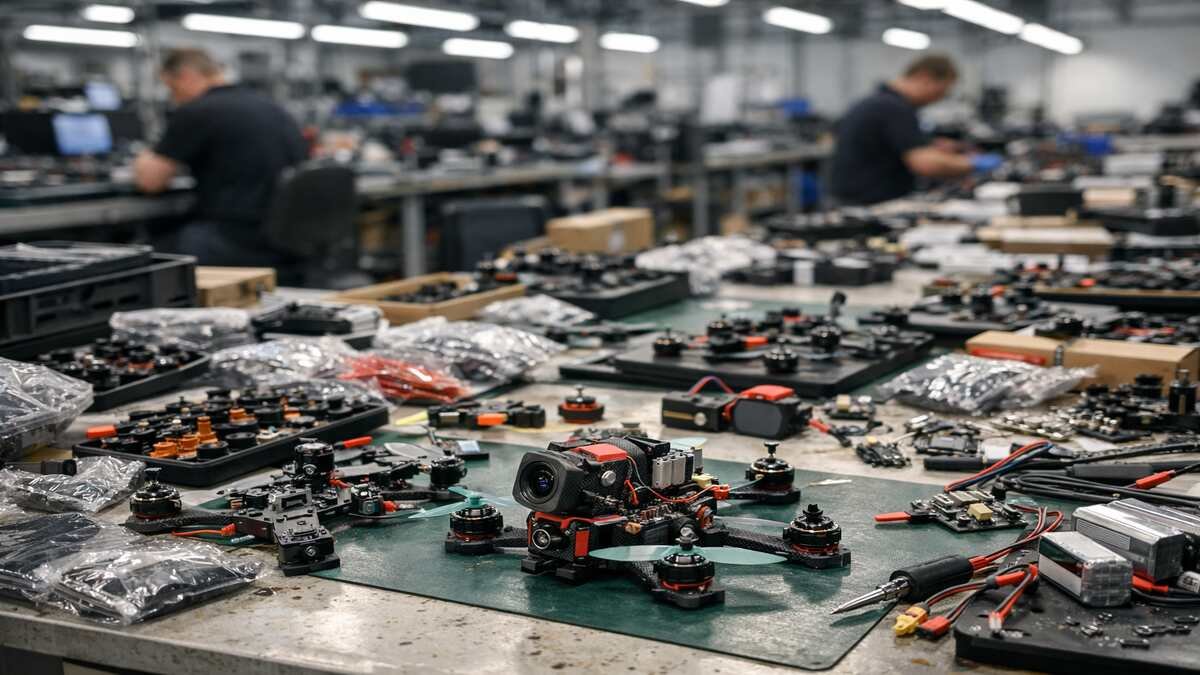
This industrialisation has produced a genuine platform ecosystem rather than a single weapon type. As CSIS analyst Samuel Bendett has described it, a basic FPV airframe has become a universal chassis — the same core drone becomes a bomber, an ISR platform, or a communications relay depending entirely on which module is attached to it.
Drone sizes have grown correspondingly, from the seven-inch airframes common in 2022 to thirteen-inch platforms by 2024 and 2025, specifically to carry the additional payload these expanded roles require.
For the broader precision strike context within which these systems operate, see Precision Strike Weapons and Modern Warfare.
Fiber-Optic Guidance Has Become the Battlefield’s Answer to Electronic Warfare
The single most consequential tactical adaptation of the past two years has been the shift toward fiber-optic-guided FPV drones — systems that abandon radio control entirely in favour of a physical cable connecting the drone to its operator.
This is a direct countermeasure to the intensive electronic warfare environment both Russia and Ukraine have built: because the command link travels through a physical fiber rather than a radio-frequency connection, conventional RF jamming cannot sever that control channel the way it can disrupt a radio-controlled FPV drone.
Russia began fielding fiber-optic tethered drones in mid-2024, and by early 2026 they had proliferated across the Ukrainian battlefield on both sides, according to reporting compiled by SOF News and CEPA.
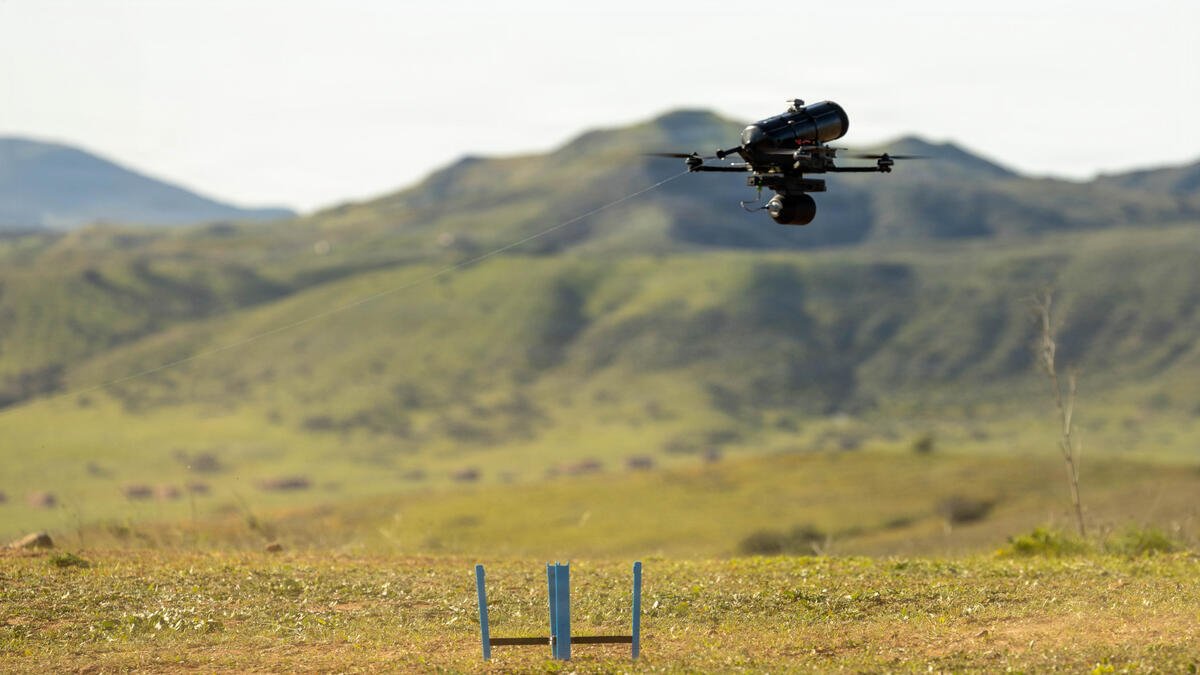
The trade-off is real: fiber-optic drones carry the weight and drag of the spool itself, which affects handling and can constrain range and manoeuvrability compared to radio-controlled systems, in exchange for resistance to the jamming and spoofing that have degraded GPS-guided precision munitions elsewhere in the conflict, examined in Precision Strike Weapons and Modern Warfare.
This has created a battlefield in which some of the most jamming-resistant weapons are frequently the cheapest and technically simplest ones — a genuinely counterintuitive outcome that has reshaped how both militaries think about the relationship between cost and survivability.
Autonomy Is Advancing Unevenly, and Genuine Full Autonomy Remains Rare
Public discussion of drone warfare frequently collapses the distinction between remotely piloted systems and genuinely autonomous ones, and the actual battlefield evidence from Ukraine shows that distinction matters enormously in practice.
The overwhelming majority of drones in current combat use, including those employed in Operation Spiderweb, remain manually piloted by a human operator for most or all of their flight.
What has changed is the introduction of AI-assisted functions layered onto that human-piloted core — optical target recognition that helps an operator identify a target faster, navigation assistance for the final approach, and increasingly, terminal guidance systems that take over automatically once a human operator has already selected and approved a target.
As Bendett has explained, this terminal guidance capability carries a specific tactical advantage beyond simple accuracy: once a drone’s onboard system takes over for the final approach, the operator-to-drone control link that a jammer would otherwise target is no longer active, removing that particular vulnerability during the terminal phase.
Genuine autonomous target selection — a system choosing and engaging a target without a human approving that specific engagement — remains the exception rather than the rule.
Kate Bondar, a CSIS research fellow and former Ukrainian government policy advisor, has offered a calibrated assessment worth taking seriously: full autonomy for aerial drones in good weather conditions is likely two to three years away, but militaries will keep a human in the decision loop for years beyond that specifically because of the unpredictable situations autonomous systems cannot yet reliably handle, with genuinely reduced reliance on human oversight not expected for another decade or more.
Ukrainian drone-swarming software developed by the company Swarmer has been tested in more than 100 operations, coordinating groups of three to twenty-five drones that can redistribute tasks if one unit is lost — a meaningful technical advance, but one that Ukrainian officials themselves describe as still in the early-experiment phase rather than mature, reliable swarm warfare.
For the broader ethical and legal dimensions of this distinction, see Autonomous Weapons and the Ethics of Lethal Autonomy.
Ground and Maritime Uncrewed Systems Are Expanding the Same Logic Beyond the Air
Aerial drones have received the most attention, but uncrewed ground vehicles and maritime systems are following a similar trajectory of rapid adoption, mostly still human-directed rather than autonomous.
Thousands of ground robots now operate along the front line in eastern Ukraine; according to IEEE Spectrum’s on-the-ground reporting, the large majority perform logistics resupply and casualty evacuation rather than direct combat roles.
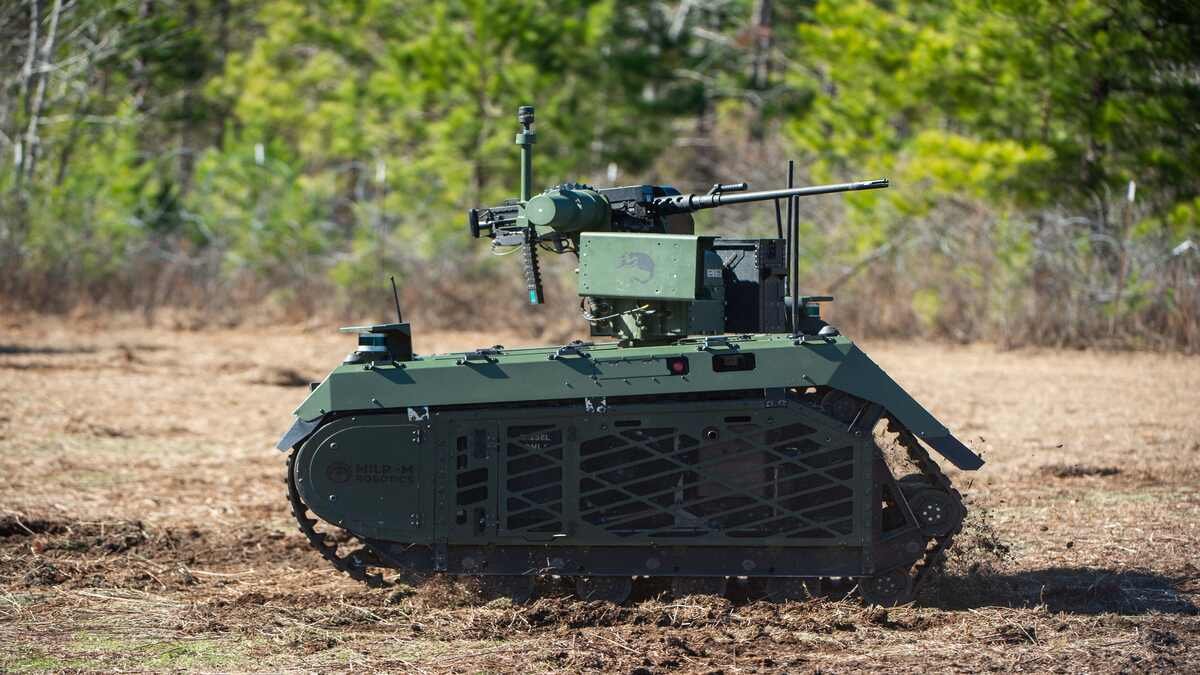
A smaller number of armed ground robots, fitted with remotely operated machine guns, have also been fielded and used in direct engagements — including, according to Ukrainian military footage released in February 2026, at least one documented case of a ground robot’s thermal camera detecting and engaging an enemy soldier at night.
Ukrainian forces have also conducted what officials describe as the first unmanned assault operations combining ground and aerial systems, including instances resulting in enemy prisoners of war captured without direct infantry engagement.
At sea, Ukraine’s uncrewed surface vessels have destroyed or damaged approximately a dozen Russian naval vessels, forcing a meaningful portion of Russia’s Black Sea Fleet to relocate away from its traditional operating areas.
NATO has taken direct notice: the alliance’s BALTOPS 2026 exercise in the Baltic Sea specifically incorporated a new US Navy unmanned surface vessel division, alongside a newly created Robotics Warfare Specialist rating — a concrete institutional signal that uncrewed maritime systems are moving from experimental status into permanent force structure.
Countermeasures Are Racing to Keep Pace, With Mixed Results
The proliferation of cheap, mass-produced drones has forced a parallel and equally urgent race in counter-drone technology, and the results so far are genuinely mixed rather than clearly favouring either offence or defence.
Ukraine’s Merops interceptor system, developed by the US startup Project Eagle, has reportedly downed more than 1,000 Russian Shahed-type one-way attack drones using AI-assisted interception, according to IEEE Spectrum, though the precise degree of autonomous versus operator-supervised engagement in the system has not been independently detailed.
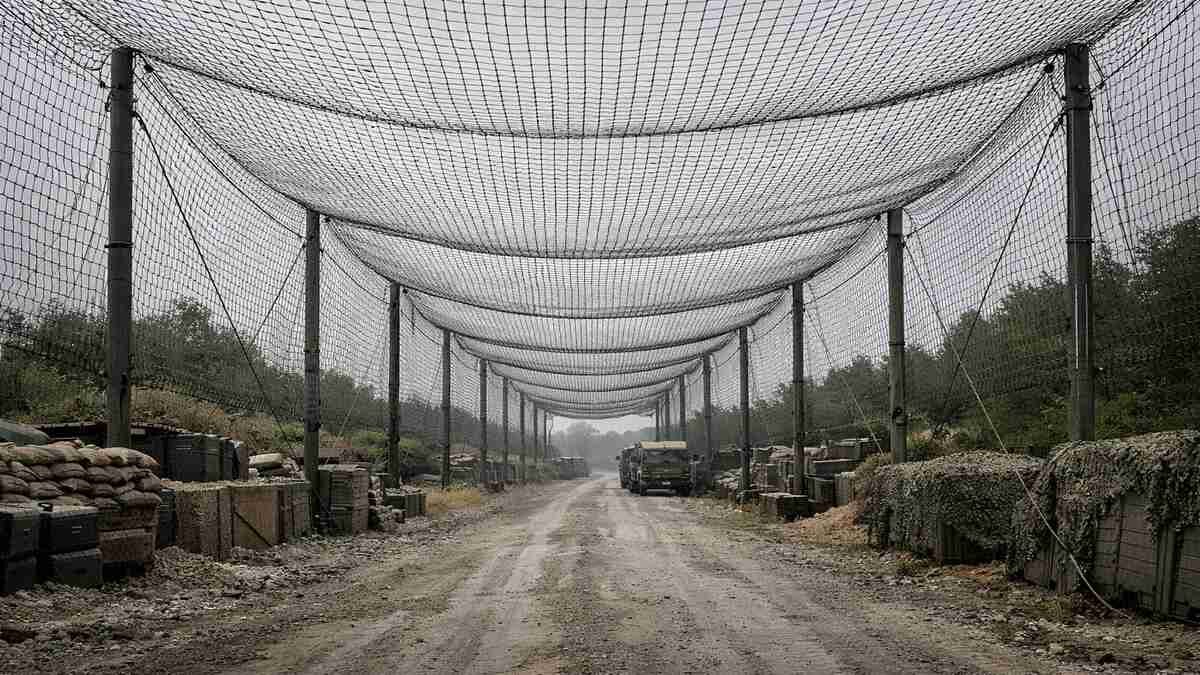
Physical countermeasures have also returned in force: anti-drone netting has been installed above key supply roads in contested areas specifically to protect vehicles from FPV strikes, a low-technology solution to a high-technology threat that illustrates how uneven this contest remains.
Against fiber-optic drones specifically, conventional electronic warfare has limited effect, since there is no radio signal to disrupt — Ukrainian and Russian forces have both reported that physical destruction, including small-arms fire, is currently among the more reliable countermeasures against a tethered drone once it is inbound.
This asymmetry has not gone unnoticed by European militaries watching the war closely.
In February 2026, France, Germany, Italy, Poland, and the United Kingdom announced the Low-Cost Effectors and Autonomous Platforms initiative, explicitly designed to jointly manufacture affordable air defence systems and autonomous drones drawing directly on Ukrainian battlefield expertise.
Separate industrial partnerships — including a joint venture between German manufacturer Quantum Systems and Ukrainian company Frontline Robotics, and an 800 million euro production agreement between Ukrainian firms and manufacturers in Denmark and Lithuania under the Build with Ukraine programme — reflect a broader recognition that Ukraine’s accumulated production expertise, not just its technology, has become something European states are actively seeking to import.
The Proliferation Risk Extends Well Beyond State Militaries
The technology driving battlefield drone warfare is not confined to state military programmes, and that proliferation carries consequences extending far beyond Ukraine and Russia.
Commercially derived FPV components — inexpensive, widely available, and requiring no specialised industrial base to assemble — have already spread to non-state armed groups, with reporting from IEEE Spectrum documenting their use by armed groups in parts of Africa and by criminal organisations in Mexico.
China’s own drone development trajectory adds a distinct dimension to this proliferation picture.
Chinese military planners are reported to be developing swarm-capable drones, autonomous targeting systems, and long-range maritime uncrewed platforms specifically intended for contexts beyond the kind of proxy conflicts where drone warfare has so far been concentrated, according to CEPA’s analysis — a signal that the lessons of Ukraine’s drone war are being studied and adapted by militaries with far larger industrial bases than Ukraine’s own.
The strategic risk this proliferation creates is not limited to any single battlefield. As the underlying technology — small, cheap, difficult to detect, increasingly capable of some autonomous function — becomes accessible to a far broader range of state and non-state actors, the operational lessons of Ukraine’s drone war become a template that is far easier to replicate than the far more exclusive precision-guided munitions and stealth aircraft that defined military technological advantage in previous decades.
Conclusion
Drone warfare’s transformation of modern conflict rests less on any single technological breakthrough than on the convergence of three trends examined throughout this article: industrial-scale production that has made attritable systems available in the millions rather than the hundreds, guidance approaches like fiber-optic control that have found genuinely effective countermeasures to electronic warfare, and a slow but real advance toward autonomy that remains, for now, concentrated in terminal guidance and navigation assistance rather than full autonomous target selection.
What Operation Spiderweb demonstrated is not that autonomous killer robots have arrived. It is that a small, determined actor with sufficient production capacity and tactical creativity can now achieve strategic effects using technology that costs a fraction of what conventional precision strike capability requires — a lesson that European militaries, Chinese military planners, and non-state actors alike are all absorbing simultaneously, each drawing different conclusions about what it means for the wars they expect to fight next.
Frequently Asked Questions
What was Operation Spiderweb and why does it matter?
Operation Spiderweb was a June 1, 2025 Ukrainian Security Service operation in which first-person-view attack drones, smuggled deep into Russian territory and launched simultaneously against multiple strategic bomber bases, struck Russian aircraft at several airbases thousands of kilometres from Ukraine. Ukraine’s SBU claimed 41 aircraft destroyed or damaged; NATO’s Admiral Pierre Vandier offered a lower estimate of 10 to 13 aircraft completely destroyed, illustrating the gap that often exists between official claims and independently verifiable damage assessments. The operation matters because it demonstrated that a relatively small number of operators, using inexpensive FPV platforms and an elaborate covert support architecture, could achieve strategic effects against high-value military assets that would once have required a dedicated air campaign, with human operators retaining control rather than the systems conducting fully autonomous target selection.
Are the drones being used in Ukraine actually autonomous?
Mostly not, in the strict sense of the term. The large majority of drones in current combat use, including those in Operation Spiderweb, are manually piloted by human operators for most or all of their flight. What has genuinely advanced is AI-assisted terminal guidance — systems that take over automatically for a drone’s final approach once a human operator has already selected and approved a target, which also removes the operator-to-drone control link during that final phase. Fully autonomous target selection, where a system chooses and engages a target without human approval, remains rare. CSIS researchers have estimated full autonomy for aerial drones in good weather conditions is likely two to three years away, with meaningfully reduced human oversight still a decade or more out.
Why are fiber-optic drones important in current conflicts?
Fiber-optic FPV drones replace radio control with a physical cable connecting the drone to its operator, making them resistant to the electronic warfare jamming that has significantly degraded GPS-guided munitions and radio-controlled drones throughout the Ukraine conflict, because there is no radio-frequency control link for a jammer to target. Russia began fielding these systems in mid-2024, and they have since proliferated across the battlefield on both sides. The trade-off is the added weight and drag of the physical cable spool, which can constrain range and manoeuvrability compared to radio-controlled drones, but the resistance to jamming has made fiber-optic guidance one of the most significant tactical adaptations of the current conflict.
How much has drone production scaled in Ukraine, and what does that mean strategically?
Ukraine produced an estimated 4 to 4.5 million drones in 2025, more than 2 million of them small FPV strike drones, with the number of domestic drone manufacturers growing from 41 in 2022 to 183 by 2024. Ukrainian officials have increasingly attributed a large majority of Russian battlefield losses to drones, with President Zelenskyy citing figures above 80 percent in recent months and Ukrainian reporting placing the share as high as 96 percent for March 2026, though independent Ukrainian analysts offer somewhat lower estimates around 70 to 80 percent. These figures are not independently verifiable and vary by period and methodology, but their consistent direction reflects a genuine restructuring of how Ukraine generates combat power around low-cost, mass-produced systems.
How are European militaries responding to what they have observed in Ukraine’s drone war?
European states have moved to directly incorporate Ukrainian production expertise and battlefield lessons alongside their own capability-development efforts. In February 2026, France, Germany, Italy, Poland, and the United Kingdom announced the Low-Cost Effectors and Autonomous Platforms initiative to jointly manufacture affordable drones and air defence systems drawing on Ukrainian expertise. Separate industrial partnerships, including a German-Ukrainian joint venture and an 800 million euro production agreement between Ukrainian and Nordic manufacturers under the Build with Ukraine programme, reflect a broader recognition among European militaries that they had fallen behind in exactly the kind of low-cost, mass-produced drone capability the war has proven decisive.
Sources and References
Kyiv Independent — Ukraine’s SBU Releases Fresh Video of Operation Spiderweb (June 2025)
CSIS — How Ukraine’s Operation “Spider’s Web” Redefines Asymmetric Warfare (June 2, 2025)
Kyiv Independent — Why More Russians Are Reportedly Dying in Ukraine Than Ever Before (May 2026)
CSIS — The Russia-Ukraine Drone War: Innovation on the Frontlines and Beyond (February 2026)
IEEE Spectrum — How Autonomous Drone Warfare Is Emerging in Ukraine (April 2026)
CEPA — How Are Drones Changing War? The Future of the Battlefield (November 3, 2025)
SOF News — Drone Monthly Update, June 2026
Related Analysis
For the precision strike systems and guidance technologies operating alongside these drones, read Precision Strike Weapons and Modern Warfare.
For the ethical and legal governance questions raised by advancing autonomy, read Autonomous Weapons and the Ethics of Lethal Autonomy.
For the broader systems-integration architecture connecting sensing, precision, and unmanned systems, read Military Modernization in the 21st Century: Precision Strike, Autonomy, and Network-Centric Warfare.
