


Analysis · StrikeOrbit | 2026
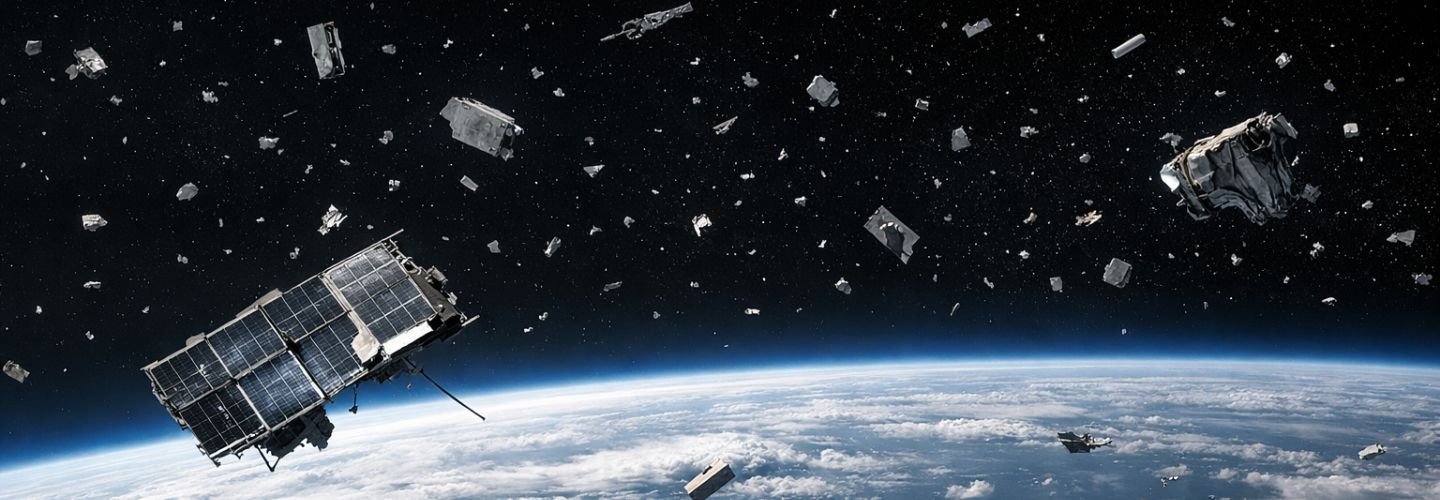
Every kinetic action in orbit leaves a permanent consequence. Unlike warfare on land, at sea, or in the air — where the physical environment recovers, battlefields are cleared, and the domain returns to something approaching its pre-conflict state — warfare in space generates debris that persists for years, decades, or centuries depending on the altitude at which it is created.
A missile that destroys a satellite does not simply eliminate a military asset. It creates a field of fragments travelling at orbital velocities that threatens every other object in the same orbital regime — friendly satellites, adversary satellites, commercial constellations, crewed spacecraft, and the future operational environment of the state that fired the missile.
In space, the weapon and the environment in which it operates are inseparable. Every counterspace action reshapes the domain itself.
This physical reality imposes a constraint on space warfare that has no equivalent in any other military domain.
States can devastate terrestrial environments and eventually rebuild them. States can sink fleets and eventually construct new ones. States cannot un-generate orbital debris. Once created, debris fragments circulate in their orbital planes, degrading slowly through atmospheric drag at lower altitudes and persisting for centuries at higher ones.
A debris cascade triggered at a critical altitude band could render that band unusable for all actors — permanently, on any strategically relevant timescale. The state that triggers a cascade does not gain control of that orbital regime. It destroys access to it for everyone, including itself.
Understanding orbital debris — its origins, its current scale, its risk mechanics, and its military implications — is therefore not a technical footnote to the analysis of space warfare. It is the central physical constraint within which all space warfare must operate, and it shapes every counterspace decision in ways that have no parallel in the doctrines governing warfare in other domains.
As explored in What Is Orbital Warfare? How Space Became a Contested Military Domain, space is a contested domain with unique physical properties that impose unique operational logic. Orbital debris is where that logic is most consequential and least reversible.
Understanding orbital debris is therefore essential to understanding the future of orbital debris space warfare, military satellite operations, and long-term access to the orbital environment.
The Orbital Debris Environment Has Been Created by Decades of Space Activity
The orbital debris environment that militaries must now navigate was not created by warfare. It was created by the cumulative activity of the space age itself — rocket stages left in orbit after satellite deployments, defunct satellites that were never deorbited, fragmentation events from accidental explosions of residual propellant in old rocket bodies, and the deliberate destruction of satellites by anti-satellite weapons tests.
Understanding the origins of the current debris environment is essential to understanding both why it has reached its current scale and why it is approaching thresholds that fundamentally change the risk calculation for future space operations.
The first significant contribution to the debris environment came from the early-space-age practice of leaving rocket upper stages in orbit after satellite deployment. In the 1960s and 1970s, the standard practice was to leave launch vehicles in orbit — there was no technical capability for controlled deorbit and no regulatory framework requiring it.
Many of these rocket bodies carried residual propellant that eventually exploded spontaneously, fragmenting into thousands of pieces.
The United States Titan III-C rocket bodies, Soviet Proton upper stages, and numerous other launch vehicle remnants from this era continue to circulate in orbit decades later, generating ongoing fragmentation events as they deteriorate.
Two events dominate the modern debris catalogue and define the current risk environment.
The Chinese anti-satellite test of January 2007, in which a Fengyun-1C weather satellite was destroyed by a kinetic interceptor at 865 kilometres altitude, generated approximately 3,500 trackable fragments and an estimated 35,000 fragments larger than one centimetre — the single largest debris-generating event in the history of spacefaring.
The altitude of the test was particularly consequential: 865 kilometres is within the most densely used orbital band for Earth observation and remote sensing satellites, and the high altitude means the debris will remain in orbit for decades before atmospheric drag causes it to re-enter. As of 2026, the Fengyun-1C debris cloud remains one of the most significant orbital hazards in low Earth orbit.
The accidental collision between Iridium 33 and Cosmos 2251 in February 2009 — the first collision between two intact satellites in history — generated approximately 1,800 trackable fragments from the Iridium satellite and approximately 1,668 from the Cosmos satellite.
The collision occurred at an altitude of 789 kilometres and created two intersecting debris fields that overlap with operational orbital regimes used by multiple satellite operators.
The event was unplanned and unintentional — Cosmos 2251 was a defunct Russian communications satellite abandoned in orbit — but it produced a debris environment comparable in scale to the deliberate destruction of a satellite by an anti-satellite weapon. The distinction between accidental collision and intentional attack is irrelevant to the debris physics.
As of 2026, the orbital debris environment comprises over 27,000 trackable objects larger than ten centimetres, approximately 500,000 objects between one and ten centimetres, and an estimated 100 million objects smaller than one centimetre.
The smaller objects are untrackable with current sensor technology but capable of mission-ending damage to operational satellites — a one-centimetre aluminium sphere travelling at orbital velocity carries kinetic energy equivalent to a hand grenade. The aggregate mass of trackable debris in orbit is estimated at approximately 9,000 metric tonnes. Every satellite launch, every deorbit failure, and every fragmentation event adds to this inventory.
Current debris tracking data and quarterly updates are maintained by the NASA Orbital Debris Program Office, which provides the authoritative open-source catalogue of orbital debris objects. The European Space Agency independently tracks and publishes debris statistics through its Space Debris by the Numbers resource.
The Kessler Syndrome: Physics, Probability, and Military Implications
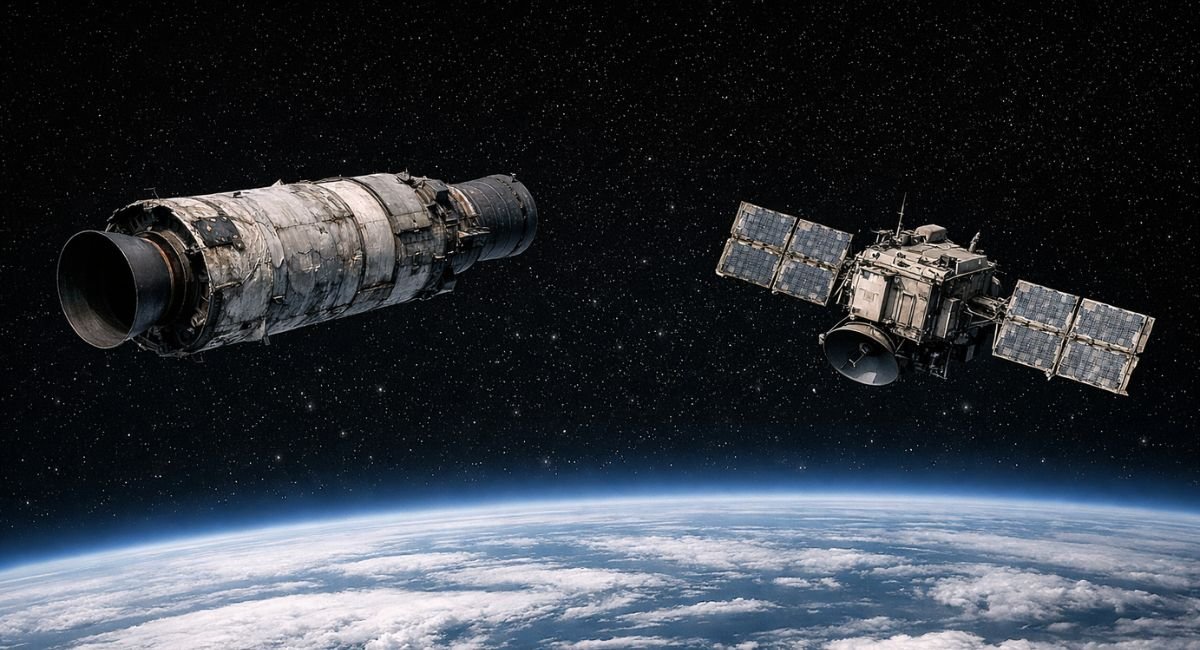
The Kessler Syndrome — named after NASA scientist Donald Kessler, who first described the scenario in a 1978 paper co-authored with Burton Cour-Palais — describes a cascade mechanism in which the density of debris in a given orbital regime reaches a threshold at which collisions between debris objects generate more debris than natural processes remove, creating a self-sustaining chain reaction of fragmentation that progressively renders the orbital regime unusable.
It is not a speculative worst-case scenario. It is a physically deterministic outcome if debris density in critical orbital bands continues to increase at current rates.
The cascade mechanism operates through collision probability arithmetic. As debris density increases, the probability that any given satellite will experience a collision in a given time period increases proportionally. When that probability reaches a level at which collisions are occurring faster than atmospheric drag removes debris from the orbital band, the system crosses a threshold into a self-sustaining cascade.
Each collision generates debris fragments that increase the probability of further collisions — the cascade is autocatalytic, and once triggered it cannot be stopped by any intervention on any operationally relevant timescale.
The orbital regimes most at risk are not evenly distributed across all altitudes. Low Earth orbit, between approximately 700 and 1,000 kilometres, is the most densely populated and the most debris-intensive orbital band, and it is also the altitude range where atmospheric drag is too weak to remove debris on timescales shorter than decades.
This is the band where the Fengyun-1C debris cloud and the Iridium-Cosmos collision debris are concentrated, and it is the band where many of the most militarily valuable Earth observation, signals intelligence, and commercial communications satellites operate.
The Space Development Agency’s Proliferated Warfighter Space Architecture is being deployed largely in this altitude range, which means the very architecture the United States is building for military resilience is being deployed in the orbital band most at risk from debris cascade.
The doctrinal implications of Kessler Syndrome risk for military space operations are profound and asymmetric.
A state that conducts kinetic anti-satellite attacks in the 700 to 1,000 kilometre band risks triggering a cascade that would render that band unusable for decades.
The military advantage gained by destroying an adversary’s reconnaissance satellites would be transient — replaced within years by new commercial imagery constellations at different altitudes or reconstituted military systems.
The debris damage to the orbital environment would be permanent. The rational actor calculus for kinetic counterspace operations in this altitude band is therefore deeply unfavourable, and this physical constraint is one of the primary reasons that major powers have — despite developing extensive kinetic ASAT capabilities — exercised restraint in employing them against operational satellites.
The 2021 Russian Nudol ASAT test against Cosmos 1408 at approximately 480 kilometres altitude was conducted at a lower altitude than the 2007 Chinese test precisely to limit debris persistence — at 480 kilometres, atmospheric drag causes debris to re-enter within months rather than decades.
The altitude selection reflected an understanding of the debris constraint and an attempt to demonstrate capability while minimising the long-term environmental cost. The international condemnation the test attracted — and Russia’s subsequent endorsement of the American-led moratorium on destructive ASAT testing — further illustrated how the debris constraint is now a factor in the political calculus of counterspace operations, not just the physical one.

Active Debris Removal and Mitigation Efforts
The recognition that orbital debris represents an existential long-term threat to space operations has driven investment in both passive mitigation measures — preventing the creation of new debris — and active removal efforts designed to reduce the existing debris inventory. Neither category of effort is yet sufficient to reverse the trajectory of debris accumulation, but both represent significant and accelerating investment.
Passive mitigation guidelines, established through the Inter-Agency Space Debris Coordination Committee and adopted into national space regulations by most major spacefaring nations, require that satellites in low Earth orbit be designed to deorbit within 25 years of the end of mission — either through controlled deorbit burns or through natural atmospheric decay at sufficiently low orbital altitudes.
The 25-year rule has been largely followed by Western commercial operators, but compliance among some national programmes has been inconsistent. The proliferation of large LEO constellations — Starlink, OneWeb, Amazon’s Project Kuiper, China’s Guowang — has made compliance with deorbit guidelines simultaneously more important and more challenging to verify at scale.
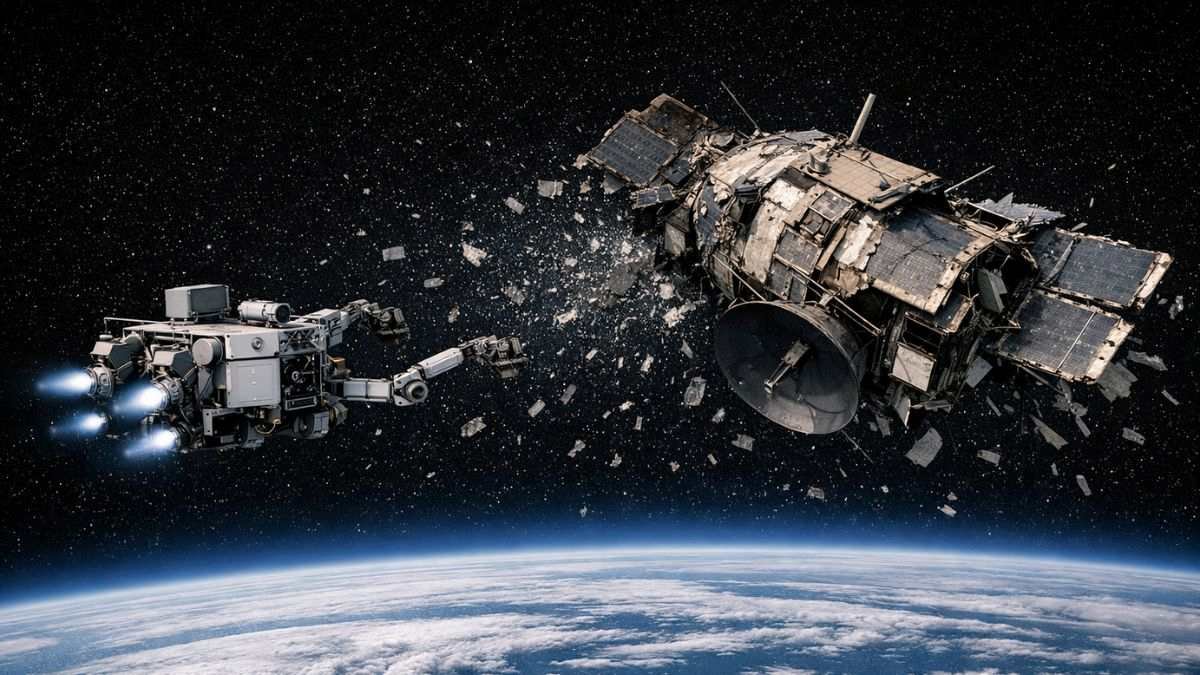
Active debris removal is the more technically demanding and commercially nascent dimension of debris mitigation.
Astroscale, a Japanese company with operations in the United Kingdom, has developed the ELSA-d and ELSA-M spacecraft designed to capture and deorbit defunct satellites using a magnetic docking mechanism. ELSA-d completed a successful rendezvous and capture demonstration in 2022.
ClearSpace SA, a Swiss company selected by the European Space Agency for its first active debris removal mission, is developing a spacecraft to capture and deorbit the VESPA payload adapter left in orbit by an Ariane 5 launch in 2013. The ClearSpace-1 mission was planned for launch in 2026, marking the first dedicated active debris removal mission in history.
The European Space Agency’s ClearSpace-1 programme is intended to demonstrate the feasibility of removing large debris objects from orbit through dedicated active debris removal missions.
The dual-use dimension of active debris removal technology is a source of significant concern. A spacecraft capable of manoeuvring to within metres of a defunct satellite, grappling it, and deorbiting it is functionally identical to a co-orbital anti-satellite weapon capable of the same manoeuvres against an operational satellite.
The technical capability for debris removal and the technical capability for co-orbital ASAT attack are indistinguishable from ground observation. This creates a verification problem: states developing debris removal capabilities for legitimate environmental reasons are simultaneously developing capabilities that adversaries must treat as potential counterspace systems.
As analysed in Anti-Satellite Weapons: Capabilities, Systems, and Strategic Implications, the co-orbital proximity operations that SSA systems track with concern overlap directly with the proximity operations that debris removal requires.
How Debris Shapes Counterspace Strategy and Military Doctrine
The orbital debris constraint does not eliminate kinetic counterspace operations as an option — states have demonstrated that they will accept debris costs when the stakes are sufficiently high. What it does is shape the conditions under which kinetic counterspace operations can be conducted rationally, and it creates strong incentives for the development and prioritisation of non-kinetic counterspace methods that achieve equivalent operational effects without generating debris.
The altitude-dependency of debris persistence creates a tiered targeting calculus for kinetic counterspace operations.
Satellites in very low Earth orbit — below approximately 400 kilometres — generate debris that re-enters the atmosphere within weeks or months. Kinetic attacks at these altitudes are far less environmentally costly than attacks at higher altitudes, which is why both the 2019 Indian Mission Shakti test and the 2021 Russian Nudol test were conducted at lower altitudes than the 2007 Chinese test.
A counterspace campaign targeting very low LEO satellites could theoretically be conducted kinetically without triggering a long-term cascade, at the cost of not targeting the most militarily valuable satellites, which predominantly operate at higher altitudes where debris persistence is measured in decades.
This altitude gradient creates a targeting hierarchy that military planners must navigate.
The satellites most valuable to military operations — Earth observation satellites at 400 to 800 kilometres, communications satellites at 700 to 1,200 kilometres in LEO, GPS navigation satellites at 20,200 kilometres in MEO, and strategic communications and early warning satellites at 35,786 kilometres in GEO — are concentrated at altitudes where kinetic attack debris would persist for years, decades, or centuries.
The strategic role and survivability of these early warning architectures are examined in Missile Warning Satellites and Early Warning Systems Explained.
The satellites most accessible to kinetically clean counterspace attack are the least militarily valuable. As discussed in Space Situational Awareness: Tracking and Securing the Orbital Domain, tracking this debris and assessing conjunction risk is now one of the most operationally demanding tasks in military space operations.
The debris constraint therefore reinforces the preference for non-kinetic counterspace methods — electronic warfare, directed energy, cyber operations — that achieve operational effects without generating debris.
The electronic warfare competition examined in Electronic Warfare in Space: Jamming, Spoofing, and Satellite Signal Warfare Explained is partly a product of this constraint: jamming a GPS signal achieves the same operational effect as destroying a GPS satellite for the duration of the jamming, without generating debris, without the escalation signature of a kinetic attack, and without permanently degrading the orbital environment on which the jamming state also depends.
The debris constraint has made the electromagnetic spectrum the preferred battlespace of counterspace operations precisely because it offers reversibility that kinetic operations cannot.
The commercial satellite proliferation examined across multiple earlier cluster articles creates an additional debris constraint dimension. A kinetic attack on a large commercial LEO constellation would generate debris at an unprecedented scale, affecting all users of the affected orbital altitude band globally and potentially triggering cascade conditions in the most commercially and militarily critical orbital regime on Earth.
The growing military dependence on large distributed constellations is examined in Satellite Constellations and Military Communications in Modern Warfare, where the operational advantages of proliferation are balanced against the long-term sustainability challenges discussed here.
The debris cost of such an attack would be borne by the entire international community indefinitely, creating political and consequential costs that no military advantage could conceivably justify. This physical reality is itself a form of deterrence — not through the threat of retaliation but through the self-defeating consequences of the attack itself.
The Governance Gap: International Law and the Debris Problem
The international legal framework governing orbital debris is one of the most significant governance gaps in the current space environment.
The Outer Space Treaty of 1967 establishes that states bear international responsibility for national space activities and are liable for damage caused by their space objects, but it provides no specific requirements for debris mitigation, no mechanism for enforcing deorbit compliance, and no framework for attributing liability for debris generated by fragmentation events that may have occurred decades in the past.
The UN Committee on the Peaceful Uses of Outer Space has developed voluntary guidelines for the long-term sustainability of outer space activities, adopted in 2019, that address debris mitigation through recommended practices rather than binding obligations. The United Nations Office for Outer Space Affairs maintains documentation of the Long-Term Sustainability Guidelines and tracks state compliance reporting.
The guidelines recommend the 25-year deorbit rule, the passivation of rocket bodies to reduce explosion risk, and the avoidance of intentional debris generation — but compliance is voluntary and enforcement is impossible under current international law.
The liability regime under the 1972 Liability Convention theoretically provides a mechanism for states to claim compensation when space objects cause damage.
The Soviet Union paid Canada compensation under this convention after Cosmos 954 re-entered and scattered radioactive debris across northern Canada in 1978 — the only successful invocation of the convention in its history.
But the practical obstacles to invoking it for orbital debris damage — proving causation in an environment with thousands of contributors, establishing the specific fragment responsible for a specific collision, and navigating the diplomatic complexities of filing a claim against a major power — make the existing liability framework effectively unenforceable for the debris problem as it exists today.
The gap between the scale of the debris problem and the adequacy of the legal framework is growing faster than international governance processes can close it.
The deployment of mega-constellations has introduced a new category of debris risk — the failure of thousands of satellites in large constellations — that existing guidelines were not designed to address. If even a small percentage of a 12,000-satellite constellation like Guowang or a 40,000-satellite expanded Starlink fails to deorbit as planned, the residual debris could significantly affect the long-term sustainability of low Earth orbit for all users.

Conclusion
Orbital debris is the inescapable physical boundary condition of space warfare. It does not prevent conflict in orbit — states have demonstrated repeatedly that they will accept debris costs when operational imperatives demand it — but it shapes every counterspace decision with consequences that no other military domain imposes.
The different ways major powers incorporate these physical constraints into military planning are explored in US Space Force Doctrine vs China’s Space Strategy: Competing Visions of Orbital Power.
The permanence of debris, the self-reinforcing mechanics of potential cascade, and the shared nature of the orbital commons mean that kinetic counterspace operations carry costs that accrue to all actors, not just the target.
Orbital debris turns space warfare into a form of conflict in which victory can permanently damage the domain both sides depend upon.
This constraint has produced a counterspace landscape in which non-kinetic methods — electronic warfare, directed energy, cyber operations — are preferred not only because they are cheaper and more deniable but because they do not permanently degrade the environment that every space-dependent military must continue to operate in after any conflict ends.
The debris constraint is, paradoxically, one of the most powerful restraints on escalation in the space domain — not because states have agreed to be restrained but because the physics of orbit make the most extreme forms of counterspace attack self-defeating for any actor with significant space equities of its own.
The long-term sustainability of space as a military and commercial domain depends on whether the international community can develop governance frameworks that match the scale and urgency of the debris problem before cascade conditions in critical orbital bands become irreversible. That development is underway but not keeping pace with the debris accumulation it is designed to address.
The window for effective governance intervention is narrowing — and in orbit, unlike in most domains, the consequences of failure cannot be undone.
Frequently Asked Questions
What is orbital debris and why does it pose a military threat?
Orbital debris consists of all non-functional human-made objects in Earth’s orbit — defunct satellites, spent rocket stages, fragments from collisions and explosions, and mission-related objects. At orbital velocities of approximately 7 to 8 kilometres per second in low Earth orbit, even small debris fragments carry enormous kinetic energy — a one-centimetre object carries roughly the energy equivalent of a hand grenade. For military space operations, debris threatens the satellites that provide communications, navigation, intelligence, and missile warning. It also constrains counterspace operations by making kinetic attacks environmentally costly — any satellite destroyed by a kinetic weapon becomes a debris field threatening all other objects in the same orbital regime.
What is the Kessler Syndrome and how close is it to occurring?
The Kessler Syndrome describes a self-sustaining chain reaction of satellite collisions in which debris density in a given orbital band becomes high enough that each collision generates debris, causing further collisions faster than natural decay processes remove them. It was first theorised by NASA scientist Donald Kessler in 1978. Current scientific assessments suggest that certain altitude bands in low Earth orbit — particularly between 700 and 1,000 kilometres — may already contain enough debris that a cascade is possible even without further launches or fragmentation events. The 2007 Chinese ASAT test significantly worsened conditions in this altitude band. No cascade has been triggered yet, but the margin for error is narrowing.
Which ASAT tests have generated the most debris?
The Chinese anti-satellite test of January 2007, which destroyed the Fengyun-1C weather satellite at 865 kilometres altitude, was the single largest debris-generating event in spaceflight history, producing approximately 3,500 trackable fragments and an estimated 35,000 fragments larger than one centimetre. The accidental collision between Iridium 33 and Cosmos 2251 in 2009 generated approximately 3,500 additional trackable fragments. The Russian Nudol test of November 2021 against Cosmos 1408 at 480 kilometres altitude generated over 1,500 trackable fragments, though at a lower altitude where atmospheric decay is faster. The US-led moratorium on destructive ASAT testing announced in 2022 was partly motivated by the debris consequences of these events.
Why do states prefer non-kinetic counterspace methods over kinetic attacks?
Non-kinetic counterspace methods — electronic warfare including jamming and spoofing, directed energy weapons, and cyber operations — achieve the same operational objective as kinetic attacks by degrading satellite functionality without generating debris. For any state with significant space equities, kinetic attacks on satellites are self-defeating in the long run because the debris they generate threatens the attacker’s own satellites as well as those of the target. Non-kinetic methods are also more reversible — a jammed satellite resumes function when jamming stops — and more deniable, avoiding the escalation signature of a confirmed kinetic strike. The debris constraint has therefore made the electromagnetic spectrum the preferred medium for counterspace operations across all major space powers.
What international agreements govern orbital debris?
The primary legal instruments governing space activities — the Outer Space Treaty of 1967 and the Liability Convention of 1972 — address space debris only indirectly through general principles of state responsibility and liability for damage caused by space objects. No binding international treaty specifically requires states to mitigate debris generation or imposes enforceable consequences for ASAT testing. The UN Committee on the Peaceful Uses of Outer Space adopted voluntary long-term sustainability guidelines in 2019 that recommend the 25-year deorbit rule and other mitigation measures, but compliance is voluntary. The American-led moratorium on destructive ASAT testing announced in 2022 has been endorsed by over thirty states but remains politically rather than legally binding.
Sources and References
NASA Orbital Debris Program Office — Orbital Debris Quarterly News (2025)
NASA Orbital Debris Program Office — History of On-Orbit Satellite Fragmentations (2024)
European Space Agency — Space Debris by the Numbers (2026)
European Space Agency — ClearSpace-1 Active Debris Removal Mission (2026)
United Nations Committee on the Peaceful Uses of Outer Space — Long-Term Sustainability Guidelines (2019)
Congressional Research Service — Space Debris and US Government Response (2024)
Centre for Strategic and International Studies (CSIS) — Space Threat Assessment (2025)
Secure World Foundation — Handbook for New Actors in Space: Debris Mitigation (2024)
Astroscale — ELSA Active Debris Removal Programme Documentation (2024)
International Institute for Strategic Studies (IISS) — The Military Balance (2025)
Stimson Centre — Orbital Debris and Space Sustainability (2024)
United Nations Office for Outer Space Affairs — Outer Space Treaty (1967)
Related Analysis
For analysis of the foundational orbital warfare context within which debris operates as the primary physical constraint on counterspace operations, read What Is Orbital Warfare? How Space Became a Contested Military Domain.
For analysis of the anti-satellite weapons whose use generates the debris fields this article examines, read Anti-Satellite Weapons: Capabilities, Systems, and Strategic Implications.
For analysis of the space situational awareness systems that track debris and assess conjunction risks for operational satellites, read Space Situational Awareness: Tracking and Securing the Orbital Domain.
For analysis of the electronic warfare methods that states prefer over kinetic attack, precisely because they avoid debris generation, read Electronic Warfare in Space: Jamming, Spoofing, and Satellite Signal Warfare Explained.
For analysis of the commercial satellite infrastructure whose scale and distribution makes it simultaneously a debris risk and a resilience asset in the orbital environment, read Commercial Satellites as Military Infrastructure: Dependency, Control, and Strategic Risk.
