



Analysis · StrikeOrbit | 2026
The thirty seconds between a ballistic missile launch and the moment a national command authority must decide whether to respond is not a margin for deliberation. It is a margin for survival.
The satellite systems that detect ballistic missile launches within seconds of ignition — before the missile has cleared its launch facility’s airspace — are not supporting infrastructure for nuclear deterrence. They are its foundation. Without reliable early warning, the second-strike capability that prevents nuclear war from being rational cannot be credibly maintained. Without the confidence that a detected launch is real and not a false alarm, the pressure to respond immediately to ambiguous data becomes catastrophic.
Missile warning satellites are the systems that make nuclear deterrence function in practice rather than in theory.
The strategic significance of these systems extends well beyond the nuclear domain. As conventional precision strike capabilities have proliferated — hypersonic weapons, ballistic missiles, and cruise missiles operating at increasingly extended ranges — the early warning architecture originally designed for nuclear attack detection has become equally critical to conventional military operations.
Detecting a hypersonic glide vehicle launch in time to cue defensive systems, warning naval forces of incoming anti-ship ballistic missiles, and providing theatre commanders with the real-time launch detection data needed to make targeting decisions — all of these depend on the same satellite infrastructure that underpins nuclear deterrence.
As examined in What Is Orbital Warfare? How Space Became a Contested Military Domain, space is not separate from modern warfare. It is the domain through which the most consequential decisions in modern warfare are made.
The missile warning satellite architecture is also among the most sensitive targets in any counterspace campaign. Degrading or destroying early warning satellites does not simply blind a military force to incoming missiles. It compresses decision timelines to the point where rational response becomes impossible and where the pressure to launch nuclear weapons before losing the ability to do so becomes structurally acute.
Understanding how missile-warning satellites work, who operates them, and what their vulnerabilities mean for strategic stability is essential to grasping the most dangerous dimension of the space competition currently underway.
Missile Warning Satellites Became the Foundation of Nuclear Deterrence During the Cold War
The requirement for space-based missile warning emerged directly from the nuclear competition of the early Cold War. Ground-based radar systems could detect incoming ballistic missiles but only after they had risen above the radar horizon — providing warning times measured in minutes rather than the tens of minutes that space-based detection from launch could provide. The difference between three minutes of warning and twenty-five minutes of warning is the difference between a nuclear force that can respond and one that cannot.
The United States began developing the first dedicated missile warning satellite program — the Missile Defense Alarm System, or MIDAS — in the late 1950s.
MIDAS used infrared sensors to detect the heat signature of ballistic missile rocket plumes against the cold background of space, a detection principle that remains the foundation of missile warning satellite technology to this day. Early MIDAS satellites experienced technical difficulties, and the program was eventually superseded by more capable systems, but the fundamental concept it validated — infrared detection of rocket plumes from geostationary orbit — has defined missile warning architecture for six decades.
The Program 647 satellite, later redesignated as the Defense Support Program or DSP, became the operational backbone of American missile warning capability from the early 1970s onward.
DSP satellites operated in geostationary orbit approximately 35,786 kilometres above Earth’s surface, where their fixed position relative to the ground provided continuous coverage of specific regions and allowed persistent monitoring of potential launch areas.
A DSP satellite detected the heat signature of a ballistic missile launch within seconds of ignition, transmitted that data to ground stations, and provided the first warning that would trigger the entire nuclear command and control response chain — all before the missile had completed its boost phase.
The Soviet Union developed parallel early warning satellite capabilities through its Oko program, which placed satellites in highly elliptical Molniya orbits that provided extended dwell time over the northern hemisphere where American ICBM fields were located.
The Molniya orbit approach reflected a different set of design choices — optimised for coverage of specific geographic areas rather than global geostationary persistence, but it served the same fundamental strategic function. Both superpowers understood that their nuclear deterrence postures depended on the credibility of their early warning systems, and both invested accordingly.
The most consequential test of Cold War missile warning architecture came not from an actual launch but from a false alarm.
In September 1983, Soviet early warning satellite operator Stanislav Petrov received an indication that the United States had launched five ICBMs. Petrov, acting against protocol, judged the alert to be a malfunction rather than a real attack — correctly, as it turned out, since the system had misidentified sunlight reflected from clouds as missile plumes. His decision not to report the alert up the chain of command almost certainly prevented a nuclear exchange.
The incident did not illustrate individual heroism. It illustrated structural fragility — a warning system whose false alarm rate was high enough that a single operator’s judgment stood between a satellite malfunction and nuclear war. That fragility is precisely what decades of subsequent investment in more reliable warning systems have been designed to eliminate.
Modern Missile Warning Architecture Evolved From DSP to SBIRS and Next Generation OPIR
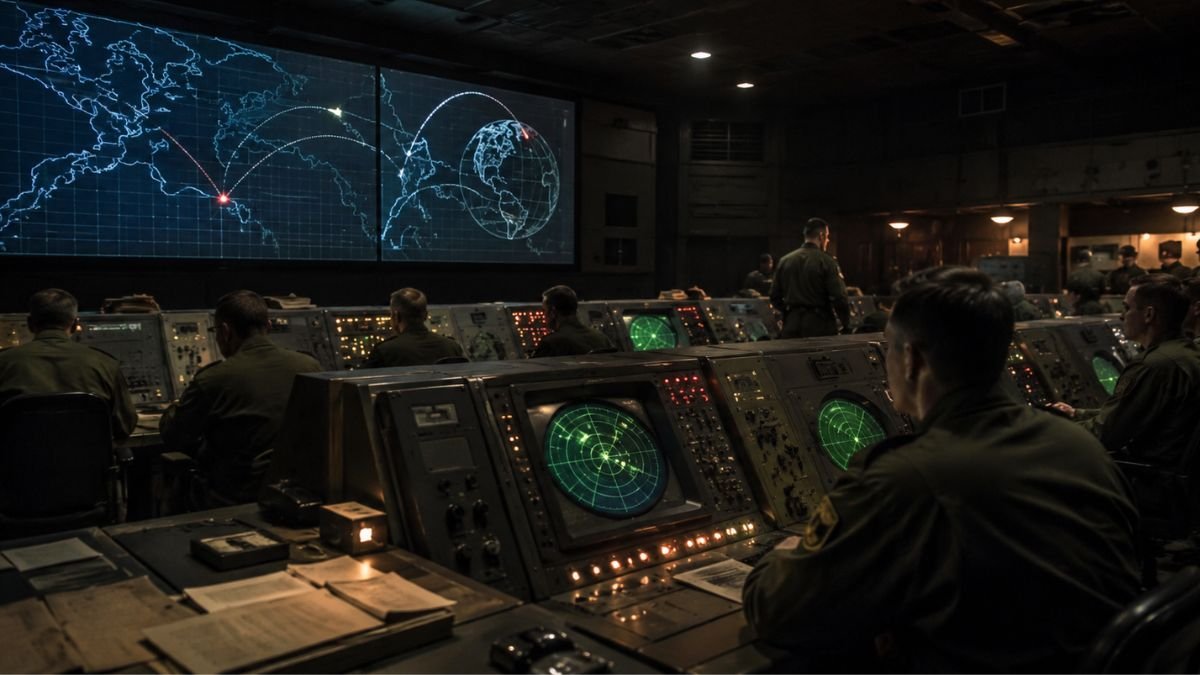
The Defense Support Program satellites that formed the backbone of American missile warning capability through the Cold War and post-Cold War decades were eventually succeeded by the Space-Based Infrared System, or SBIRS.
The SBIRS program represented a generational improvement in missile warning capability — faster detection, greater sensitivity, broader coverage, and the ability to detect not just large ICBM launches but smaller tactical ballistic missiles and, critically, hypersonic vehicles whose signatures differ from traditional ballistic missiles.
SBIRS consists of satellites in both geostationary and highly elliptical orbits, providing global persistent coverage with multiple layers of redundancy.
The geostationary satellites provide continuous wide-area coverage, while the highly elliptical orbit satellites provide enhanced sensitivity over polar regions — the trajectories most relevant to Russian ICBM launches aimed at the continental United States. The final SBIRS geostationary satellite was launched in 2022, completing the constellation and replacing the last DSP satellites in the operational architecture.
The Next Generation Overhead Persistent Infrared program, or Next Gen OPIR, is the current development effort that will eventually replace SBIRS.
Next Gen OPIR is designed specifically for the threat environment of the 2030s and beyond — one in which adversaries have developed sophisticated means of jamming, spoofing, and degrading satellite systems, and in which hypersonic weapons require detection and tracking capabilities that SBIRS was not designed to provide.
The program includes both geostationary satellites and, for the first time, a polar orbit component — the Polar Overhead Persistent Infrared program — that provides enhanced detection coverage for trajectories passing over the poles.
The first Next Gen OPIR geostationary satellite, delayed from an original 2025 target due to sensor payload development issues, is now scheduled to launch no earlier than March 2026, with Raytheon delivering the program’s second missile-warning sensor payload to Lockheed Martin in April 2026 and full constellation capability still expected by the end of the decade.
The CSIS Missile Defense Project maintains the most comprehensive open-source database of global missile systems and defense programs, including current Next Gen OPIR and SDA tracking layer documentation.
The broader orbital awareness architecture that enables these missile warning systems to operate continuously is explored in Space Situational Awareness: Tracking and Securing the Orbital Domain.
The Missile Defense Agency’s Space Tracking and Surveillance System, or STSS, and its successor programs provide a complementary layer of missile tracking capability — following detected missiles through their mid-course phase and providing the precise tracking data needed to cue ground-based interceptors.
While SBIRS and Next Gen OPIR focus on launch detection, STSS-class systems focus on tracking the missile through its flight to the target, providing the data chain that connects early warning to active missile defense.
The integration of missile warning data into the broader joint command network has been a central investment priority.
As analysed in JADC2 Explained: How the US Military’s Joint Command Network Works, missile warning satellite data feeds directly into the JADC2 network, providing the launch detection data that initiates the entire sensor-to-shooter sequence for both nuclear and conventional response options.
The speed at which warning data reaches decision-makers — measured in seconds from detection to command authority notification — is a function of the data links connecting satellite sensors to ground processing systems to command networks, and that entire chain has been continuously refined to reduce the latency between detection and decision.

Russia and China Are Developing Competing Early Warning Architectures
The United States does not hold a monopoly on space-based missile warning capability. Both Russia and China have invested substantially in their own early warning satellite programs, driven by the same strategic logic that drove American investment — that nuclear deterrence requires confidence in the ability to detect an incoming attack with sufficient warning time to respond.
Russia’s early warning satellite program evolved from the Cold War Oko system into the current Tundra constellation, also known by its GRAU designation as the Unified Space System or EKS.
The EKS program deploys satellites in highly elliptical Molniya orbits and geostationary orbit, providing continuous coverage of the northern hemisphere approach corridors most relevant to detecting American ICBM launches.
The first EKS satellite was launched in 2015, and the constellation has been progressively expanded since.
The Bulletin of the Atomic Scientists’ Nuclear Notebook provides the most authoritative open-source accounting of Russian and Chinese nuclear force structures and their supporting early warning requirements.
Russian military officials have publicly described EKS as providing detection capabilities superior to its Oko predecessor, with faster data processing and improved discrimination between actual launches and false alarms — a capability improvement clearly influenced by the 1983 Petrov incident and subsequent false alarm events in the Soviet and Russian warning systems.
China’s missile warning satellite development has accelerated significantly over the past decade alongside the broader expansion of Chinese military space capabilities.
China has deployed infrared surveillance satellites that Western analysts assess have missile-warning capabilities, though Beijing has not publicly acknowledged a dedicated missile-warning satellite program.
The dual-use nature of Chinese satellite programs — where commercial remote sensing and meteorological satellites may incorporate military sensing payloads — makes precise assessment of China’s early warning capability difficult from open sources.
In late 2025, a research unit of the state-owned China Electronics Technology Group Corporation published a paper outlining a proposed ‘distributed early-warning detection’ system intended to fuse space-based sensors, satellites, and ground and airborne radar into a single nationwide network — a response, at least in framing, to the United States’ own Golden Dome missile-defense initiative, and a rare instance of Chinese state-affiliated research describing early-warning ambitions in explicit, public terms.
What is clear is that China’s development of its own nuclear deterrence posture, including the expansion of its ICBM force documented in recent Pentagon annual reports on Chinese military power, creates a strong strategic imperative for a reliable missile-warning capability. A nuclear force without early warning cannot credibly threaten retaliation, which means China’s expanding nuclear posture necessarily drives investment in supporting warning infrastructure.
The broader strategic competition shaping these national military space architectures is explored in US Space Force Doctrine vs China’s Space Strategy: Competing Visions of Orbital Power.
France operates the SPIRALE and subsequent IRES infrared surveillance satellite programs that provide missile warning capability in support of the French independent nuclear deterrent.
The United Kingdom relies on shared American early warning data through bilateral intelligence sharing arrangements rather than operating independent missile warning satellites.
India has expressed interest in developing an indigenous early warning satellite capability as part of its broader ballistic missile defense program, though no dedicated Indian missile warning satellite has been publicly confirmed as operational.
Israel has developed space-based surveillance capabilities with potential missile warning applications, given its specific threat environment of short-range ballistic missiles that provide extremely compressed warning times.
Theatre Missile Warning Has Become as Strategically Urgent as Nuclear Warning
The missile warning architecture that was designed for strategic nuclear attack detection has become equally critical to conventional military operations as precision ballistic missiles have proliferated across multiple regional powers. Theatre ballistic missiles, shorter-range systems designed for conventional rather than nuclear warheads — present warning challenges that differ significantly from intercontinental ballistic missiles and require different detection and response approaches.
The American Overhead Persistent Infrared coverage provides global monitoring that encompasses theatre ballistic missile launches as well as strategic ICBM launches. But the warning timelines for theatre missiles are dramatically compressed compared to ICBMs — a Scud-class ballistic missile with a range of 300 kilometres may provide only three to five minutes of warning time between launch and impact, compared to the twenty to thirty minutes available for an ICBM.
That compressed timeline places severe demands on the data processing and dissemination chain that carries warning data from satellite sensors to ground commanders.
The Wideband Global Satcom network and other military communications satellites provide the data links that carry early warning information from missile warning satellites to ground processing centers and then to tactical commanders in the field.
As explored in Satellite Constellations and Military Communications in Modern Warfare, the reliability of these communications links under electronic warfare attack is a central concern for military planners — and an adversary that can jam or degrade the communications links carrying missile warning data achieves the functional equivalent of blinding the warning satellites themselves without attacking the satellites directly.
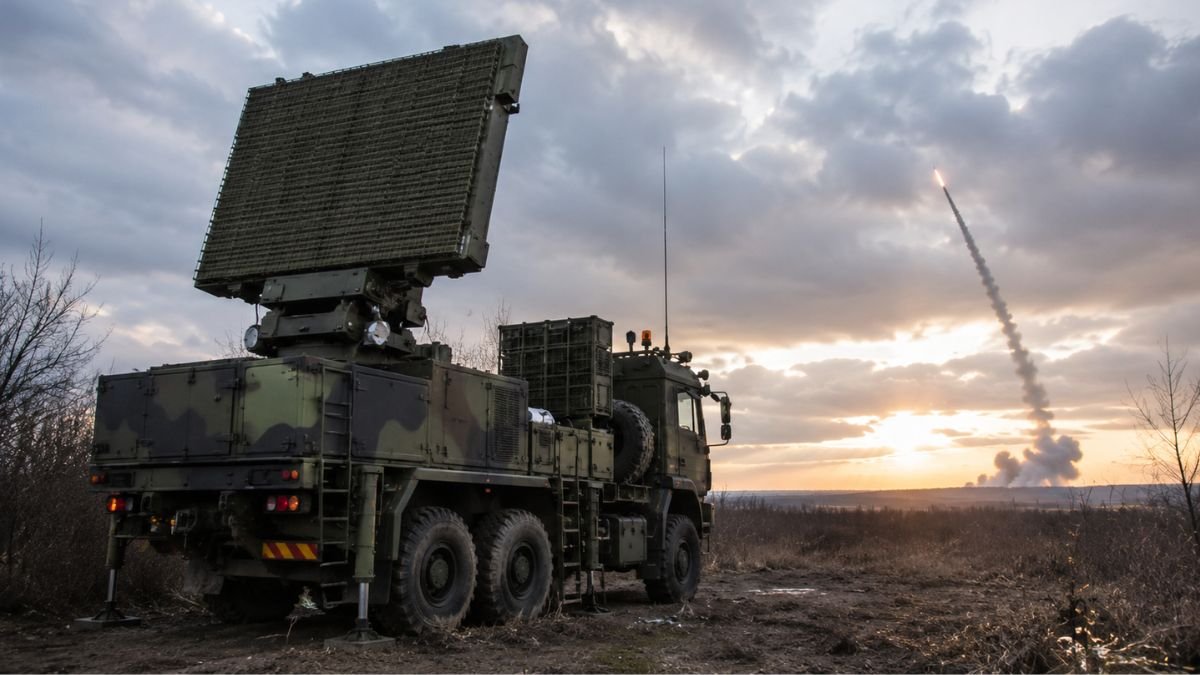
The conflict in Ukraine has demonstrated the operational importance of theatre missile warning in a high-intensity conventional conflict. Ukrainian forces developed procedures for the rapid dissemination of air raid warnings derived from radar and space-based detection of Russian ballistic and cruise missile launches, providing civilian populations and military forces with minutes of warning time before impact.
The integration of commercial satellite data, ground-based radar networks, and allied intelligence sharing into a functioning theatre warning system under active conflict conditions validated both the feasibility and the operational value of persistent missile warning capability in conventional warfare.
The proliferation of hypersonic weapons — examined in depth in Hypersonic Weapons and the Emerging Global Strike Balance creates the most demanding detection and warning challenge that missile warning satellite systems have yet faced.
Hypersonic glide vehicles follow depressed trajectories that may remain below the horizon of ground-based radars for much of their flight, and their maneuvering capability means that trajectory prediction from launch detection is less reliable than for ballistic missiles.
Detecting hypersonic vehicle launches from space, tracking them through their glide phase, and providing sufficient warning time for defensive response requires exactly the kind of persistent, sensitive, low-latency infrared surveillance capability that Next Gen OPIR is designed to provide.
Whether that warning time translates into an actual successful intercept is a separate and much harder question, examined in full in Can Hypersonic Missiles Be Intercepted? Defense Systems, Technology, and the Limits of Current Capability.
The Vulnerability of Missile Warning Satellites and Its Implications for Strategic Stability
The strategic importance of missile warning satellites makes them among the highest-value targets in any counterspace campaign — and their vulnerability creates escalation dynamics that have no equivalent in conventional military domains. The intersection of missile warning satellite vulnerability with nuclear deterrence produces the most dangerous stability challenge in the current space competition.
As discussed in Anti-Satellite Weapons: Capabilities, Systems, and Strategic Implications, both China and Russia have developed direct-ascent anti-satellite missiles, co-orbital systems, directed energy weapons, and cyber capabilities that could be used against missile warning satellites.
A successful attack on early warning satellites would not simply degrade one military capability among many. It would remove the foundation on which nuclear deterrence rests — the confident knowledge that an incoming attack would be detected with sufficient warning time to mount a credible response. A blinded nuclear power becomes a dangerously unstable one.
The escalation logic is both direct and dangerous.
A state that loses its early warning satellite constellation faces a stark and terrible choice: respond immediately based on incomplete information, or risk losing the ability to respond at all if the satellite loss was indeed the precursor to a nuclear strike. That choice — which must be made in minutes — is exactly the scenario that Cold War strategists spent decades trying to prevent through arms control, crisis communication hotlines, and tacit restraints on counterspace operations.
The current absence of agreed norms governing attacks on early warning satellites means that this escalation pathway has no institutional management mechanism.
The foundational legal framework governing space activities — the Outer Space Treaty, maintained by the United Nations Office for Outer Space Affairs — was not designed to address the counterspace threat environment that now endangers missile warning infrastructure.
The United States has responded to this vulnerability through two complementary approaches.
The first is resilience — the transition from a small number of high-value SBIRS satellites to the larger, more distributed Next Gen OPIR constellation that is harder to degrade comprehensively through a limited counterspace campaign.
The second is integration with ground-based radar systems — the AN/TPY-2 transportable radar, the Sea-Based X-Band radar, and the Long Range Discrimination Radar provide complementary detection and tracking capability that could partially compensate for satellite degradation in some scenarios.
Neither approach eliminates the vulnerability. Together, they raise the cost and complexity of a counterspace campaign targeting the warning systems sufficiently to maintain deterrence against all but the most extreme scenarios.

The Future of Missile Warning: Proliferated Sensors and AI-Driven Detection
Missile warning systems are moving away from a handful of exquisite satellites toward distributed constellations designed to survive attack. The Next Gen OPIR program’s inclusion of a polar orbit component alongside its geostationary satellites represents an architectural diversification that reduces the single-point vulnerability of the SBIRS constellation.
The Space Development Agency’s missile warning and tracking layer — part of the broader Proliferated Warfighter Space Architecture — extends detection and tracking into low Earth orbit with hundreds of smaller satellites providing persistent global coverage.
LEO-based missile warning sensors provide tracking coverage that complements geostationary detection — while geostationary satellites excel at launch detection from the bright infrared signature of rocket plumes, LEO sensors can track missiles through their mid-course phase with the geometric precision needed to cue interceptors. The combination of geostationary launch detection and LEO mid-course tracking creates a layered system that is both more capable and more resilient than either layer alone.
The resilient low Earth orbit architectures that increasingly support these distributed warning and tracking capabilities are examined in Satellite Constellations and Military Communications in Modern Warfare.
The Hypersonic and Ballistic Tracking Space Sensor(HBTSS) program illustrates the shift towards a persistent low Earth orbit tracking system designed to detect and maintain custody of ballistic and hypersonic missile threats throughout flight.
Artificial intelligence is becoming central to missile warning data processing in ways that directly address the false alarm problem that has haunted the warning systems since the 1983 Petrov incident.
AI systems trained on the full spectrum of infrared signatures — rocket launches, industrial fires, atmospheric phenomena, solar reflections — can discriminate genuine missile launches from false alarms with greater speed and reliability than human analysts reviewing raw sensor data.
The integration of AI-driven discrimination into the warning data processing chain is designed to reduce both the false alarm rate that creates the risk of accidental nuclear exchange and the time required to process genuine launch detections into actionable warning data for command authorities.
The broader transformation of military decision-making through artificial intelligence is examined in Military AI and the Future of Warfare, where AI’s role across command systems, intelligence analysis, and operational planning is explored in greater depth.
Conclusion
Missile warning satellites occupy a unique position in the structure of modern military power — simultaneously foundational to nuclear deterrence, increasingly critical to conventional military operations, and among the most strategically sensitive targets in any counterspace campaign.
Their destruction or degradation does not simply blind a military force to incoming missiles. It removes the temporal foundation on which rational nuclear response is built, compressing decision timelines to the point where the choice between launching and not launching must be made without the information on which that choice depends.
The competition over missile warning capability — between American investment in Next Gen OPIR and the Space Development Agency’s tracking layer, Chinese development of infrared surveillance satellites, and Russian deployment of the EKS constellation — reflects a shared understanding of this strategic reality.
Every major nuclear power recognizes that its deterrence posture depends on confident, reliable early warning, and every major nuclear power is investing in the space-based infrastructure that provides it.
The vulnerability of that infrastructure to counterspace attack is the most consequential unresolved challenge in the intersection of space competition and nuclear stability. In strategic terms, the systems that provide warning time may matter more than the weapons they are designed to detect.
Frequently Asked Questions
What are missile warning satellites and what do they detect?
Missile warning satellites are space-based infrared surveillance systems that detect the heat signatures of ballistic missile rocket plumes within seconds of launch. Operating primarily in geostationary orbit, they provide continuous monitoring of potential launch areas globally and transmit detection data to ground processing centers and command authorities faster than any ground-based radar system can. Originally designed for nuclear ICBM detection during the Cold War, modern missile warning satellites also detect theatre ballistic missiles, cruise missiles, and increasingly hypersonic weapons, making them critical to both nuclear deterrence and conventional military operations.
How do missile warning satellites support nuclear deterrence?
Nuclear deterrence depends on the credibility of second-strike capability — the assured ability to retaliate even after absorbing a nuclear first strike. That credibility requires sufficient warning time to disperse or launch nuclear forces before they can be destroyed on the ground. Missile warning satellites provide the twenty to thirty minutes of warning time that intercontinental ballistic missiles allow, enabling command authorities to make informed response decisions rather than being forced to launch blindly or not at all. Without reliable early warning, the rational calculus of nuclear deterrence breaks down — which is why these satellites are among the most strategically valuable assets any nuclear power operates.
What is the difference between SBIRS and Next Gen OPIR?
The Space-Based Infrared System, or SBIRS, is the current American missile-warning satellite constellation, completed in 2022, consisting of geostationary and highly elliptical orbit satellites that replaced the Cold War-era Defense Support Program. Next Gen OPIR is its planned successor, designed for the threat environment of the 2030s with enhanced resistance to jamming and electronic warfare, improved sensitivity for detecting hypersonic weapons, and a new polar orbit component that provides enhanced coverage of trajectories passing over the poles. Next Gen OPIR represents a deliberate response to the counterspace threat environment that did not exist when SBIRS was designed. Its first geostationary satellite is now scheduled to launch no earlier than March 2026, after payload development delays pushed the timeline back from an original 2025 target.
Why are missile warning satellites considered strategically destabilizing to an attack?
Attacking missile warning satellites creates an acute escalation risk because their destruction could be interpreted as the precursor to a nuclear first strike — the logical first step for an attacker wanting to blind its adversary before launching. A state that has lost its early warning satellites faces immediate pressure to use its nuclear forces before they can be destroyed, based on the assumption that a strike may be imminent. This creates a catastrophic incentive structure in which a conventional counterspace attack can trigger nuclear retaliation. The absence of agreed international norms governing attacks on early warning satellites means this escalation pathway currently has no institutional management mechanism.
How are hypersonic weapons changing missile warning requirements?
Hypersonic glide vehicles present different detection and tracking challenges than traditional ballistic missiles. Their depressed flight trajectories may keep them below the horizon of ground-based radars for extended periods; their maneuvering capability makes trajectory prediction less reliable, and their infrared signatures differ from the rocket plumes of boost-phase ballistic missiles. These characteristics demand persistent, sensitive infrared surveillance from space throughout the entire flight rather than just at launch detection. The Next Gen OPIR program and the Space Development Agency’s LEO tracking layer are both specifically designed to address hypersonic detection requirements that the existing SBIRS constellation was not built to handle.
Sources and References
U.S. Space Force — Space-Based Infrared System Program Documentation (2022)
Missile Defense Agency — Next Generation Overhead Persistent Infrared Program Overview (2024)
Space Development Agency — Missile Warning and Tracking Layer Documentation (2024)
Congressional Research Service — Space-Based Missile Warning and Defense: Background and Issues (2023)
Congressional Research Service — Hypersonic Weapons and Missile Defense (2024)
Government Accountability Office — Missile Warning Satellites: Program Status and Challenges (2024)
Centre for Strategic and International Studies (CSIS) — Missile Defense Project: Missile Threat Assessment (2025)
Secure World Foundation — Global Counterspace Capabilities: An Open Source Assessment (2024)
Bulletin of the Atomic Scientists — Nuclear Notebook: Russian Nuclear Forces (2025)
International Institute for Strategic Studies (IISS) — The Military Balance (2025)
Arms Control Association — Space and Nuclear Stability Fact Sheet (2024)
United Nations Office for Outer Space Affairs — Outer Space Treaty (1967)
Missile Defense Advocacy Alliance —Hypersonic and Ballistic Tracking Space Sensor(HBTSS)
Related Analysis
For analysis of the foundational orbital warfare context within which missile warning satellites operate as critical strategic infrastructure, read What Is Orbital Warfare? How Space Became a Contested Military Domain.
For analysis of the anti-satellite weapons that directly threaten the missile warning systems described in this article, read Anti-Satellite Weapons: Capabilities, Systems, and Strategic Implications.
For analysis of hypersonic weapons and their relationship to the warning and tracking systems examined here, read Hypersonic Weapons and the Emerging Global Strike Balance.
For analysis of the JADC2 command network into which missile warning data feeds as a primary input, read JADC2 Explained: How the US Military’s Joint Command Network Works.
For analysis of the satellite communications infrastructure that carries missile warning data from sensors to command authorities, read Satellite Constellations and Military Communications in Modern Warfare.
