



Analysis · StrikeOrbit | 2026
The most consequential attacks on space systems in modern conflict have not involved missiles. They have involved signals.
The electromagnetic spectrum that satellites use to communicate with ground stations, relay navigation data to military receivers, and transmit intelligence to battlefield commanders is simultaneously the medium through which those systems provide their value and the surface through which they can be attacked, degraded, and defeated without a single kinetic weapon being fired.
Electronic warfare against space systems — jamming, spoofing, and the full spectrum of signal manipulation techniques that fall between them — represents one of the most operationally active and persistent dimensions of counterspace competition currently underway.
The strategic appeal of electronic warfare against satellite systems is straightforward. Kinetic anti-satellite weapons destroy satellites permanently, generate orbital debris that threatens all actors, and carry escalation risks that constrain their use to the most extreme scenarios.
Electronic warfare can achieve some of the same operational effects — degrading or denying the military capabilities that satellites provide — while remaining reversible, more deniable, cheaper to deploy, and far less likely to trigger the international condemnation or military escalation that physical destruction invites.
A jammed GPS signal looks like a malfunction. A spoofed navigation system produces wrong answers without announcing that it has been compromised. A cyber intrusion against a satellite ground station can disable an entire constellation’s functionality without touching a single object in orbit.
The war in Ukraine has provided the most operationally significant demonstration of space electronic warfare in the history of conventional conflict.
Russian GPS jamming across the operational theatre, sustained Starlink jamming campaigns, and the Viasat cyberattack that disrupted satellite communications across Europe at the invasion’s outset have collectively validated what strategists had theorized for decades — that the electromagnetic attack surface of space-dependent military operations is vast, persistent, and exploitable by any state with the motivation and modest technical capability to do so.
As analysed in What Is Orbital Warfare? How Space Became a Contested Military Domain, space is contested not only through the weapons pointed at it but through the signals that flow through it.
Electronic Warfare Against Space Systems Ranges From Jamming to Cyberattack
Electronic warfare against satellite systems is not a single technique or a single category of effect. It is a spectrum of methods that range from blunt signal interference to sophisticated deception operations, each with different technical requirements, different operational effects, and different escalatory implications. Understanding the full spectrum is essential to understanding both the threat and the responses being developed against it.
Jamming is the most straightforward form of electronic warfare against space systems. It involves transmitting interference signals on the same frequencies that a satellite uses to communicate with ground receivers — overwhelming the legitimate signal with noise and severing the connection between the satellite and its users.
The physics are simple: a sufficiently powerful signal on the right frequency, transmitted from a position close enough to the target receiver, will dominate the legitimate satellite signal and render it unusable. GPS jamming requires relatively low transmit power because GPS signals are inherently weak by the time they reach the ground after travelling from approximately 20,200 kilometers altitude — a ground-based jammer only needs to be locally more powerful than the satellite signal to be effective.
There are two primary categories of jamming based on where in the satellite link chain the interference is applied. Uplink jamming targets the signals transmitted from ground control stations to the satellite — disrupting the commands and data operators send to their spacecraft.
Successful uplink jamming can prevent operators from controlling their satellites, updating their parameters, or maintaining their operational status. Downlink jamming targets the signals transmitted from satellites to ground receivers — the communications, navigation data, and intelligence that users depend on. Downlink jamming is generally easier to conduct because it only needs to overpower the satellite signal at the receiver location rather than at the satellite itself.
Spoofing is a fundamentally different and more insidious form of electronic attack. Rather than blocking satellite signals, spoofing transmits counterfeit signals on the same frequencies that receivers interpret as legitimate.
A GPS spoofing attack does not prevent a receiver from calculating its position — it causes the receiver to calculate an incorrect position while displaying full signal strength and normal operation.
The receiver, and its operator, may have no indication that the data they are receiving is false. This makes spoofing significantly more dangerous than jamming in many operational contexts — a jammed GPS receiver stops providing position data, alerting the operator to a problem.
A spoofed receiver continues providing data, but wrong data, potentially directing precision munitions to incorrect targets, providing military units with false positional information, or misleading aircraft navigation systems while appearing to function normally.
Directed energy weapons occupy a different position in the electronic warfare spectrum — bridging the gap between signal disruption and physical damage. High-powered lasers directed at satellite optical sensors can dazzle them temporarily or damage them permanently depending on power level.
High-powered microwave systems can disrupt or destroy onboard electronics through directed energy at frequencies that penetrate satellite structures. Unlike jamming and spoofing, directed energy attacks against satellites produce physical effects — a dazzled sensor recovers when the laser is removed, but a burned sensor does not.
The line between electronic warfare and physical counterspace attack blurs at the directed energy level, which has implications for how states calibrate escalation thresholds when employing or responding to these capabilities.
Cyber operations against satellite ground infrastructure form a closely related but distinct part of the wider counterspace threat.
The Viasat KA-SAT attack in February 2022 — in which Russian military hackers used the AcidRain malware to wipe the firmware of tens of thousands of satellite modems across Europe — demonstrated that attacking the software and network infrastructure supporting satellite systems can achieve the same operational effect as physical destruction of the satellites themselves, at a fraction of the cost, with greater deniability, and without generating a single piece of orbital debris.
The attack disabled Ukrainian military communications at the critical opening moment of the invasion and disrupted civilian satellite internet across multiple European countries simultaneously. The electromagnetic spectrum is both the medium through which space systems provide their military value and the attack surface through which that value can be denied. Modern military space power depends as much on controlling signals as controlling orbit.
The distinction matters because modern satellite warfare is rarely about the spacecraft alone. A military satellite depends on ground stations, user terminals, control networks, antennas, software, and data links. An adversary can therefore attack different parts of the system without ever physically reaching the satellite.
Detecting, attributing, and monitoring many of these electronic attacks depends on the continuous orbital surveillance capabilities examined in Space Situational Awareness: Tracking and Securing the Orbital Domain.
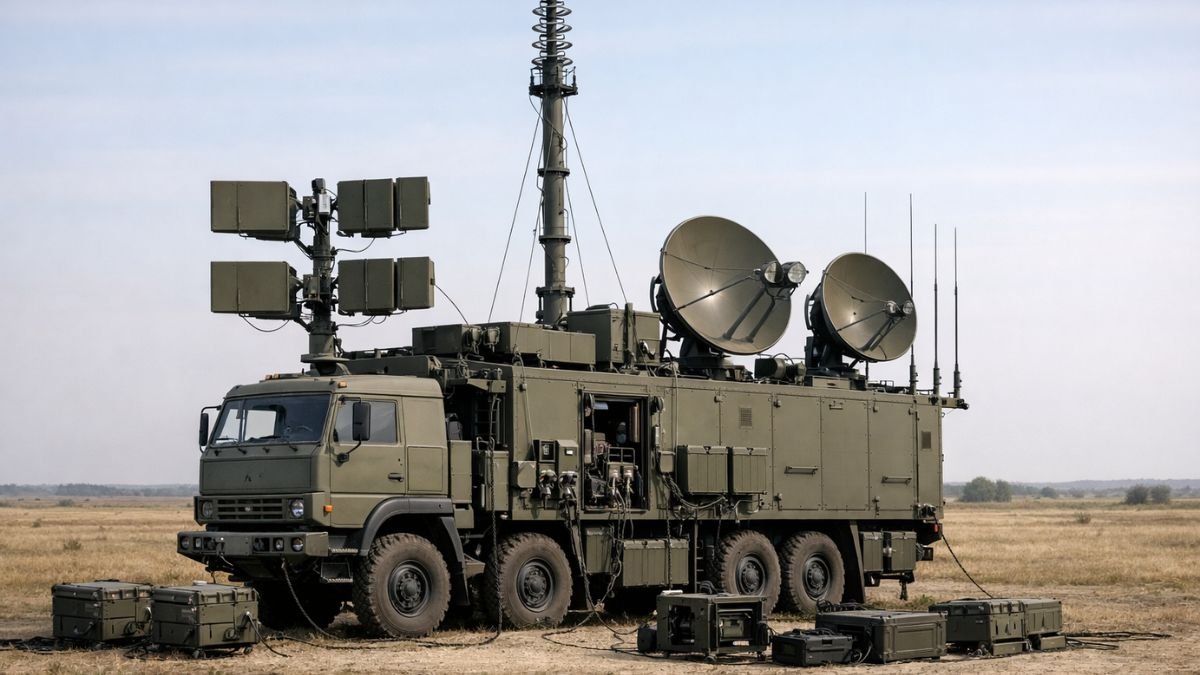
GPS Jamming and Spoofing Have Become Routine Features of Modern Conflict
The Global Positioning System has become the most targeted satellite system in the history of electronic warfare, both because of its extraordinary military utility and because of the structural vulnerability created by the weakness of its signals.
GPS signals arrive at the Earth’s surface at extremely low power after travelling from satellites roughly 20,200 kilometers above Earth, making them vulnerable to locally generated interference. That inherent signal weakness lowers the technical barrier to basic GPS jamming, while more capable systems can provide greater range, selectivity, and resistance to countermeasures.
Russia has conducted the most extensively documented GPS jamming and spoofing operations of any state actor.
In Syria, Russian forces deployed ground-based electronic warfare systems that affected GPS signals across wide areas of the operational theatre, impacting commercial aviation navigating Syrian and adjacent airspace as well as military systems.
In the Baltic region, GPS interference documented by the Finnish Civil Aviation Authority, the Norwegian Civil Aviation Authority, and multiple commercial aviation tracking services has been a persistent feature of the security environment, concentrated around Russian military exercises and escalating significantly following the 2022 invasion of Ukraine.
The European Union Aviation Safety Agency has documented thousands of GPS interference events in Baltic, Black Sea, and Eastern Mediterranean airspace since 2022, with a significant proportion attributable to Russian electronic warfare operations.
The scale has continued to grow sharply: Lithuanian officials told the International Civil Aviation Organization in October 2025 that the country was recording hundreds of GNSS interference incidents every week, roughly twenty times the rate observed in 2024.
EASA’s fourth revision of its GNSS safety bulletin, published in July 2026, incorporated lessons from recent jamming and spoofing incidents and added further operational and training recommendations for aviation.
The European Union Aviation Safety Agency maintains a live monitoring page documenting GPS jamming and spoofing incidents across affected flight information regions globally.
In Ukraine, GPS jamming has been continuous and theatre-wide since February 2022.
Ukrainian drone operators have consistently reported GPS interference as one of the primary operational challenges, requiring the development of alternative navigation methods including visual navigation, inertial navigation systems, and software-defined radio adaptations that allow drone control systems to switch between navigation sources when GPS is degraded.
The broader dependence of autonomous systems on resilient positioning, navigation, communications, and data links is examined in Drone Warfare and Autonomous Systems in Modern Conflict.
The Russian electronic warfare campaign against Ukrainian drone operations has been sophisticated and adaptive — as Ukrainian forces developed countermeasures, Russian systems evolved their jamming techniques in response, creating a live signal contest conducted in real time across an active combat theatre.
GPS spoofing operations have been documented across a wider geographic range than jamming.
Spoofing affecting commercial vessel navigation in the Black Sea — causing ships to report incorrect positions suggesting they were at airports rather than at sea — was documented as early as 2017 and has continued intermittently since. Spoofing affecting commercial aviation navigation near Tel Aviv and across the eastern Mediterranean has been documented by multiple aviation authorities, with the effects including navigation system errors and airspace management complications.
The sophistication of some documented spoofing operations — including coordinated spoofing that moves entire groups of receivers toward a false position simultaneously — indicates state-level actors with substantial technical investment in the capability.
India has invested significantly in GPS jamming capability as part of its electronic warfare modernization program, with systems designed to protect military operations from adversary GPS-guided precision munitions.
China’s electronic warfare program includes extensive GPS jamming and spoofing capabilities, documented through military exercises that have involved deliberate GPS interference in training areas across China.
North Korea has conducted GPS jamming operations affecting South Korean military and civilian systems on multiple occasions, with events in 2010, 2012, 2016, and subsequent years causing disruptions to South Korean aviation, maritime navigation, and military communications.
The Middle East has developed its own distinct jamming environment, with Israel and Iran each disrupting GPS and GNSS signals extensively during 2025 and 2026 to counter adversary drone operations, illustrating that satellite navigation warfare is now a routine feature of conflict in multiple regions simultaneously rather than a phenomenon specific to the Russia-Ukraine theatre.
The proliferation of GPS jamming and spoofing capability across multiple state actors at different levels of technological sophistication reflects both the strategic value of degrading GPS-dependent military systems and the relatively low technical barriers to entry for basic jamming operations.

Satellite Communications Electronic Warfare Is Reshaping Military Operations
Beyond GPS, the satellite communications systems that carry command and control data, intelligence feeds, and operational coordination across military forces have become primary targets for electronic warfare as their military centrality has become undeniable.
The Starlink jamming adaptation cycle in Ukraine represents the most sustained and operationally significant satellite communications electronic warfare confrontation ever conducted against a commercial constellation, and its lessons are reshaping military planning across every major power.
Russia began attempting to jam Starlink terminals shortly after their deployment in Ukraine, using ground-based electronic warfare systems designed to overpower Starlink’s downlink signals in specific geographic areas.
SpaceX responded through software updates that adjusted Starlink’s signal processing, beam steering, and frequency management to counter the interference — developing and deploying countermeasures in days rather than the months that traditional military acquisition processes would require.
Russia adapted its jamming techniques in response. SpaceX adapted again. This iterative adaptation cycle demonstrated both the resilience potential of software-defined commercial communications systems and the ongoing nature of the spectrum struggle — there is no final technical solution, only continuous adaptation.
The contest has continued into 2026. Ukrainian officials and commanders have reported Russian use of the Volna Kupol Garant electronic-warfare system against Starlink terminals supporting Ukrainian drone operations, while Russian state media reported in August that the system had entered mass production.
Janes reported in September that the system was being used from occupied areas of Ukraine and assessed its coverage at roughly 20 square kilometers. The development illustrates the central characteristic of modern space electronic warfare: neither the jammer nor the protected network remains static for long.
The significance goes beyond the performance of a single jammer. A proliferated satellite network changes the economics of electronic attack because disrupting one terminal, one frequency, or one part of the network does not necessarily disable the wider service. The attacker therefore faces a moving problem: the objective is not simply to overpower a signal, but to create enough disruption across enough of the network to produce a meaningful military effect.
As explored in Satellite Constellations and Military Communications in Modern Warfare, the architectural resilience of large distributed LEO constellations provides inherent electronic warfare resistance that small numbers of geostationary satellites cannot match.
A jammer that suppresses Starlink terminals in one geographic area cannot simultaneously suppress terminals across the entire constellation — users in adjacent areas retain connectivity, data can be rerouted through unaffected terminals, and the constellation’s mesh networking capability allows traffic to bypass jammed ground links through satellite-to-satellite laser links that are effectively immune to conventional radiofrequency jamming.
Chinese military doctrine has invested heavily in satellite communications jamming capability as part of its broader approach to denying American space-enabled military advantages.
PLA electronic warfare units are assessed to have developed and deployed systems capable of jamming military satellite communications frequencies used by American forces in the Indo-Pacific theatre — a capability specifically designed to degrade the JADC2 connectivity examined in JADC2 Explained: How the US Military’s Joint Command Network Works under the conditions of a high-intensity regional conflict.
The PLA’s integration of electronic warfare under the Information Support Force — established through the 2024 restructuring of the Strategic Support Force — reflects a doctrinal judgment that electromagnetic spectrum control and space electronic warfare are not separate capabilities but integrated components of a unified information warfare approach.

Every Major Power Now Fields Acknowledged Space Electronic Warfare Systems
The United States Space Force’s electromagnetic warfare portfolio has expanded significantly since the establishment of the service in 2019.
The Counter Communications System, or CCS, is an acknowledged American system designed to jam adversary satellite communications — providing the United States with an offensive electronic warfare capability against hostile satellite systems.
The CCS is ground-based, mobile, and has been deployed in operational contexts, making it one of the few openly acknowledged American offensive counterspace electronic warfare capabilities.
In June 2026, the Space Force formally accepted the latest evolution of this system, named Meadowlands, for operational use under Mission Delta 3 at Peterson Space Force Base. The acceptance provides a publicly acknowledged example of a fielded U.S. capability for disrupting adversary satellite communications.
The Space Operations Command Fact Sheet outlines the U.S. Space Force’s responsibility for space electronic warfare, electromagnetic operations, missile warning, and broader counterspace mission areas including systems such as the Counter Communications System.
The Space Force’s FY2025 budget explicitly referenced investment in systems providing both reversible and non-reversible counterspace effects — language that encompasses electronic warfare alongside directed energy and other non-kinetic counterspace tools.
The strategic importance of protecting missile warning satellites from both kinetic and non-kinetic disruption is explored in Missile Warning Satellites and Early Warning Systems Explained.
Russia’s electronic warfare program is the most extensively combat-tested of any major power.
The Krasukha-4 ground-based electronic warfare system is designed to suppress airborne and space-based radar systems, including synthetic aperture radar satellites.
The Tirada-2 satellite communications jammer is assessed to be capable of disrupting geostationary satellite communications across wide areas.
Russia has also deployed the Murmansk-BN system — a long-range high-frequency jamming system with an assessed range of up to 5,000 kilometers — and the Palantin system, which integrates electronic warfare management across multiple platforms for coordinated spectrum operations.
Ukraine has provided a live operational environment in which many of these systems have been tested, adapted, and refined against real adversary countermeasures for the first time.
China’s electronic warfare modernization has been one of the most significant investments in its military space program. PLA electronic warfare forces are assessed to possess ground-based systems capable of disrupting satellite communications and other space-enabled networks.
The CSIS Space Threat Assessment 2025 provides the most current open-source assessment of Chinese and Russian electronic warfare capabilities targeting satellite systems.
China has also developed highly maneuverable satellite programs whose potential counterspace applications are closely watched by outside analysts. Open-source assessments have identified repeated rendezvous and proximity operations involving several Chinese satellite series, although the specific payloads and operational purposes of many of these missions remain uncertain.
France established its Space Defense Command in 2019 with a doctrine that explicitly includes the right to active defense of French satellites — encompassing electronic warfare responses to jamming attacks.
The French Syracuse military satellite communications system includes anti-jamming capabilities, and France has invested in both defensive and offensive electronic warfare capabilities to support its independent nuclear deterrent and overseas military operations.
The United Kingdom’s Space Operations Centre at RAF High Wycombe coordinates British electronic warfare monitoring and response capability within the Combined Space Operations framework.
Japan’s Self-Defense Forces have invested in electronic warfare capabilities, including systems designed to detect and characterize interference affecting satellite navigation and communications in the Indo-Pacific theatre.
Electronic-warfare capabilities with space applications are no longer confined to the United States, Russia, and China. France, the United Kingdom, Japan, India, Israel, South Korea, and Australia have all developed capabilities or programs relevant to satellite navigation, communications, or spectrum operations.
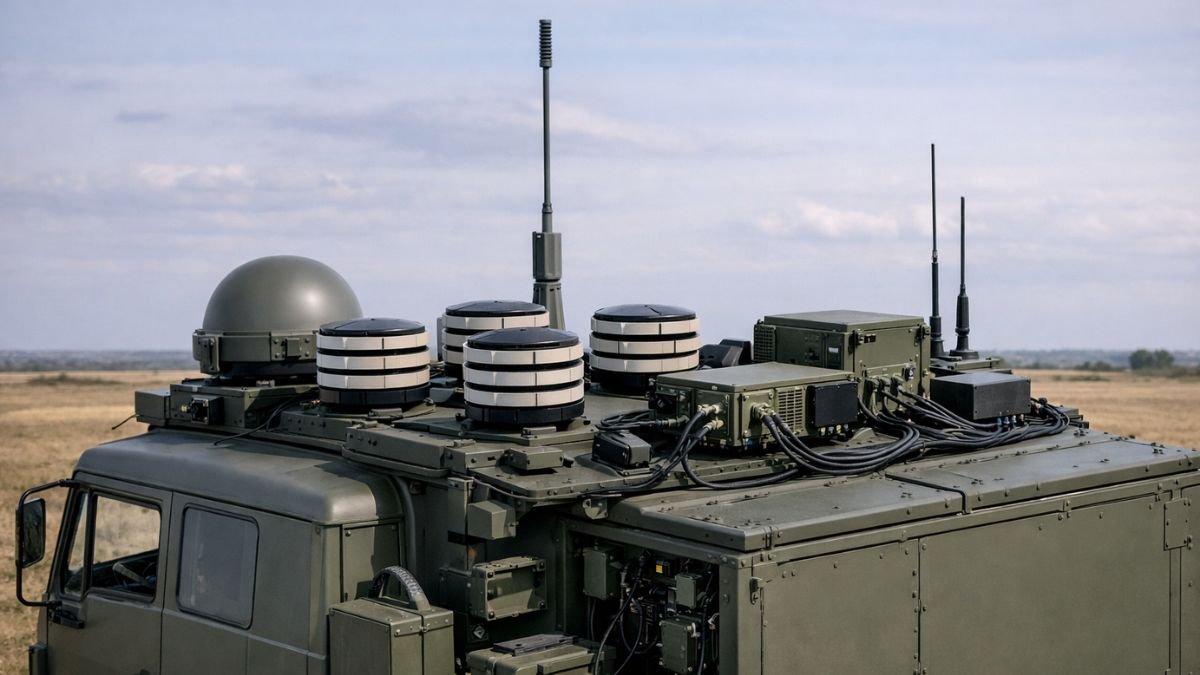
Resilience, Anti-Jam Technology, and the Spectrum Adaptation Cycle
Electronic warfare is therefore not a one-time contest in which one side develops a jammer, and the other side simply loses access. It is an adaptation cycle. New interference techniques produce new protection measures; protected receivers force attackers to improve their methods; and both sides increasingly use sensing, software, and network-level changes to stay ahead of the other.
The response to space electronic warfare threats has driven a generation of investment in anti-jam technology, signal resilience engineering, and frequency management systems across military satellite programs. Understanding these defensive capabilities is essential to understanding why electronic warfare against space systems has not produced the decisive results that its advocates have sometimes claimed — and why the rivalry between jamming and anti-jam technology is likely to remain unresolved for the foreseeable future.
Military GPS receivers have incorporated anti-jam technology since the 1990s, with controlled reception pattern antenna systems — CRPA antennas — providing directional signal reception that can spatially filter out jamming signals while maintaining reception of the legitimate GPS signal.
The M-code GPS signal, transmitted on a separate frequency from the civilian GPS signal and available only to authorized military receivers, uses a higher-power encrypted waveform that is significantly more resistant to jamming than the civilian GPS signal.
The GPS III satellites currently being deployed include a military protection level signal that provides further jamming resistance through spread-spectrum techniques and higher effective transmit power.
Europe has pursued a parallel civilian-side response through its own Galileo constellation. In July 2025, the EU Agency for the Space Program launched Open Service – Navigation Message Authentication.
A free authentication mechanism that lets ordinary receivers cryptographically verify that a Galileo signal is genuine before trusting it — a lower-cost approach to the spoofing problem than the military-grade encryption used in GPS’s M-code, and one aimed at protecting the much larger population of civilian and commercial users that a purely military solution does not reach
GPS World maintains the most comprehensive technical coverage of anti-jam and spoofing detection technology developments across both military and commercial receiver programs.
Alternative positioning, navigation, and timing technologies are reducing military dependence on GPS in high-threat electronic warfare environments.
Inertial navigation systems that do not depend on external signals provide positioning capability that cannot be jammed — though they accumulate positional drift over time.
Laser-based inertial navigation, LIDAR terrain matching, and celestial navigation systems provide GPS-independent positioning for specific applications. The integration of multiple positioning sources into a single navigation solution — fusing GPS when available with inertial and other sensors when GPS is degraded — provides resilience that single-source GPS dependence does not.
The software-defined radio revolution has transformed the ability to develop and deploy electronic warfare countermeasures at the speed of software rather than hardware development.
SpaceX’s rapid Starlink anti-jam updates demonstrated that a software-defined commercial communications system can adapt to jamming faster than a state-level adversary can develop counter-countermeasures using traditional acquisition processes.
Military satellite communications systems are increasingly incorporating software-defined radio architectures that enable similar rapid adaptation — allowing frequency plans, modulation schemes, and signal processing algorithms to be updated over the air in response to emerging electronic warfare threats.
Artificial intelligence is becoming increasingly important in detecting interference patterns, automating spectrum management, and accelerating electronic warfare decision-making, topics explored further in Military AI and the Future of Warfare.
The Royal United Services Institute’s analysis of competitive electronic warfare in modern land operations provides detailed open-source assessment of how jamming, adaptation cycles, and counter-jamming techniques have evolved during the war in Ukraine.
Conclusion
Electronic warfare against space systems is not an emerging threat on the horizon of future conflict. It is the most active dimension of modern counterspace conflict, being waged continuously across multiple theatres by multiple actors against the satellite infrastructure on which modern military operations depend.
The electromagnetic spectrum is both the medium through which space systems provide their military value and the attack surface through which that value can be denied — and every state that depends on satellites for military operations must simultaneously exploit that surface against adversaries and defend against adversaries exploiting it against them.
The rivalry between jamming and anti-jam technology, between spoofing and spoofing detection, between cyber attack and cyber defense in the ground segment — none of these contests has a permanent winner. They are ongoing signal conflicts in which advantage shifts with each cycle of innovation and countermeasure development. These contests form part of the wider electromagnetic battlespace examined in Electronic Warfare and the Future of the Electromagnetic Battlespace.
The states that maintain advantage in this electronic warfare environment will be those that invest in resilient, software-defined, multi-source positioning and communications systems that can adapt faster than adversaries can evolve their jamming capabilities.
In many conflicts, battles fought with signals may shape the effectiveness of space systems before any satellite is physically attacked. The electromagnetic spectrum is one of the most active, consequential, and least visible dimensions of space competition, and understanding it is essential to understanding how modern wars are won and lost before the first kinetic shot is fired.
Frequently Asked Questions
What is electronic warfare against satellites and how does it work?
Electronic warfare against satellites involves using electromagnetic signals to disrupt, deceive, or degrade the satellite systems that military forces depend on. Jamming transmits interference signals on satellite communication or navigation frequencies, overwhelming legitimate signals and severing the connection between satellite and user. Spoofing transmits counterfeit signals that receivers interpret as genuine, producing false navigation data or communications while appearing to function normally. Directed energy weapons use high-powered lasers or microwave systems to damage satellite sensors or electronics. Cyber operations can target the ground infrastructure and software supporting satellite systems, forming a closely related but distinct part of the wider counterspace threat. Each method offers different levels of reversibility, detectability, and escalatory risk.
Why is GPS so vulnerable to jamming and spoofing?
GPS signals are inherently weak by the time they reach Earth’s surface after travelling from satellites approximately 20,200 kilometers above Earth. That makes them vulnerable to locally generated interference: a jammer operating near a receiver can transmit a stronger signal on the same frequency and prevent the receiver from recovering the legitimate navigation signal. Spoofing works differently. Instead of simply overwhelming the genuine signal, an attacker transmits counterfeit signals designed to appear legitimate, causing the receiver to calculate a false position or time. Civilian GPS signals provide less protection against deception than military signals, leaving many civilian receivers more susceptible to spoofing. Military GPS receivers use technologies such as controlled reception pattern antennas and the encrypted M-code signal to improve resistance to jamming and spoofing, while other navigation sources can provide additional resilience when GPS is degraded or denied.
Which countries have the most advanced space electronic warfare capabilities?
Russia has one of the most extensively combat-tested space electronic warfare programs, with ground-based jammers including the Krasukha-4, Tirada-2, and Murmansk-BN deployed in Syria, the Baltic region, and Ukraine, providing operational experience at a scale no other state has matched. China has invested heavily in satellite communications jamming and GPS spoofing capabilities specifically designed to degrade American space-enabled military advantages in a potential Indo-Pacific conflict. The United States operates the Counter Communications System for offensive satellite jamming and has invested significantly in anti-jam technology for GPS and military satellite communications. France, the United Kingdom, Japan, India, Israel, South Korea, North Korea, and Australia all maintain electronic warfare programs with varying degrees of space application capability. In June 2026, the U.S. Space Force publicly acknowledged the operational acceptance of the Meadowlands Counter Communications System, providing a clear example of a fielded U.S. satellite-jamming capability.
What is the difference between GPS jamming and GPS spoofing?
GPS jamming overwhelms legitimate GPS signals with interference, causing receivers to lose signal entirely and cease providing position data. The failure is immediately apparent — the receiver shows no signal or reduced accuracy, alerting the operator to the problem. GPS spoofing transmits counterfeit GPS signals that receivers process as genuine, causing them to calculate and display incorrect positions while appearing to function normally. The operator may have no indication that the data is false. Spoofing is more dangerous in many contexts because it produces confidently wrong answers rather than acknowledged failure — potentially directing weapons to incorrect targets or providing false situational awareness without any warning that the data has been compromised.
How are military systems being made more resilient against space electronic warfare?
Military resilience against space electronic warfare is being built through several complementary approaches. Anti-jam antenna technology for GPS receivers spatially filters out jamming signals while maintaining reception of legitimate satellite signals. Encrypted military GPS signals such as M-code use spread-spectrum techniques and higher transmit power that are significantly more resistant to jamming than civilian signals. Alternative navigation technologies including inertial navigation, LIDAR terrain matching, and celestial navigation provide positioning capability that cannot be jammed. Software-defined radio systems for satellite communications enable rapid adaptation to jamming through over-the-air updates, as demonstrated by SpaceX’s Starlink countermeasure deployments in Ukraine. Multi-source navigation solutions that fuse GPS with other sensors maintain accuracy when GPS is degraded or denied.
Sources and References
U.S. Space Force — Electromagnetic Warfare Portfolio and Counter Communications System Documentation (2024)
U.S. Space Force — Space Operations Command and Electromagnetic Warfare Capabilities (2024)
U.S. Space Force — FY2025 Budget Request: Counterspace and Electromagnetic Warfare Programs (2024)
Congressional Research Service — Space Electronic Warfare: Background and Issues for Congress (2023)
European Union Aviation Safety Agency — GPS Signal Interference and Spoofing Monitoring Reports (2024)
Finnish Civil Aviation Authority — GPS Interference Documentation: Baltic Region (2024)
Centre for Strategic and International Studies (CSIS) — Space Threat Assessment (2025)
Secure World Foundation — Global Counterspace Capabilities: An Open Source Assessment (2024)
RAND Corporation — Electronic Warfare and Space Operations (2023)
International Institute for Strategic Studies (IISS) — The Military Balance (2025)
GPS World — Anti-Jam and Spoofing Detection Technology Review (2024)
Royal United Services Institute (RUSI) — Competitive Electronic Warfare in Modern Land Operations (2025)
United Nations Office for Outer Space Affairs — Long-Term Sustainability of Outer Space Activities Guidelines (2019)
European Union Aviation Safety Agency — GNSS Safety Bulletin, 4th Revision (July 2026)
International Civil Aviation Organization — Assembly Statements on Baltic GNSS Interference (October 2025)
EU Agency for the Space Program (EUSPA) — Open Service Navigation Message Authentication Launch (July 2025)
U.S. Space Force — Meadowlands Counter Communications System Announcement, Mission Delta 3 (June 2026)
Related Analysis
For analysis of the foundational orbital warfare context within which space electronic warfare operates as the most active competitive dimension, read What Is Orbital Warfare? How Space Became a Contested Military Domain.
For analysis of the satellite communications infrastructure that electronic warfare targets as its primary operational objective, read Satellite Constellations and Military Communications in Modern Warfare.
For analysis of the JADC2 command network whose electromagnetic spectrum dependencies make it a primary target for space electronic warfare, read JADC2 Explained: How the US Military’s Joint Command Network Works.
For analysis of the anti-satellite weapons that operate at the kinetic end of the counterspace struggle alongside electronic warfare, read Anti-Satellite Weapons: Capabilities, Systems, and Strategic Implications.
For analysis of the commercial satellite infrastructure that has become both a target and a resilience resource in the electronic warfare environment, read Commercial Satellites as Military Infrastructure: Dependency, Control, and Strategic Risk.
