


Analysis · StrikeOrbit | 2026
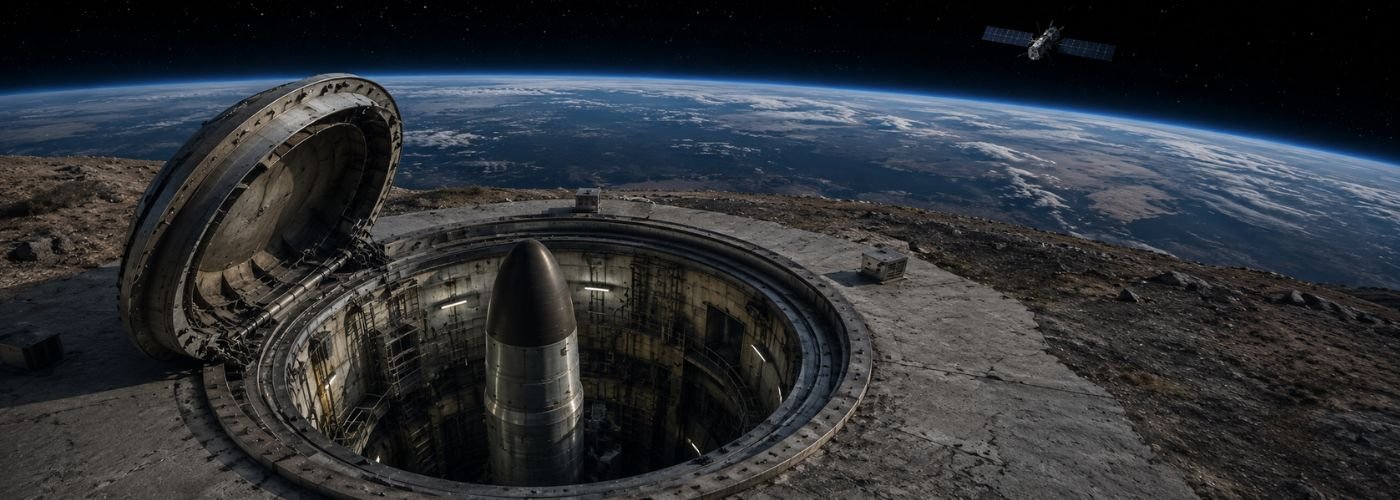
Nuclear deterrence and space operations have been intertwined since the first satellites were launched.
The reconnaissance satellites that gave each Cold War superpower confidence in the other’s force structure, the early warning satellites that provided the minutes of decision time that prevented hair-trigger launch authority from becoming inevitable, and the communications satellites that maintained command and control of nuclear forces through the most severe crisis conditions — all of these are space systems, and all of them are preconditions for nuclear deterrence functioning as its architects intended.
Space is not adjacent to the nuclear balance. It is embedded in it.
What has changed in 2026 is that this embedded relationship has become simultaneously more consequential and more fragile.
The Bulletin of the Atomic Scientists has identified the emergence of the third nuclear age as the top global risk for 2026. Unlike the first nuclear age of superpower bilateral deterrence or the second nuclear age of proliferation concerns, this third age is characterised by the convergence of three developments that have never coexisted before.
These developments include a tripolar nuclear competition without arms control frameworks, the deployment of counterspace weapons designed to degrade the space infrastructure that nuclear deterrence depends on, and the emergence of hypersonic weapons and artificial intelligence that compress the decision timescales within which deterrence must function.
The growing strategic impact of hypersonic missiles and their effect on warning time and escalation dynamics is explored in greater detail in Hypersonic Weapons in 2026: The Real Global Strike Balance.
New START expired in February 2026 with no successor agreement. The Doomsday Clock stands at 89 seconds to midnight — the closest in its history.
Understanding how nuclear deterrence operates in the space age and how the orbital warfare competition examined throughout StrikeOrbit’s Space and Orbital Warfare cluster is changing its fundamental logic requires understanding both the space-nuclear relationship that has always existed and the new threats to that relationship that define the current moment.
Readers seeking a broader introduction to military competition in the orbital domain may first wish to read What Is Orbital Warfare? How Space Became a Contested Military Domain, which explains how space evolved from a support environment into an operational military domain.
As discussed in Missile Warning Satellites and Early Warning Systems Explained, the satellite infrastructure that provides the warning time on which nuclear decision-making depends is now explicitly targeted by the counterspace programs of every major nuclear power. That targeting creates stability risks that Cold War deterrence theory was not designed to manage.
Space Systems Have Always Been Foundational to Nuclear Deterrence Stability
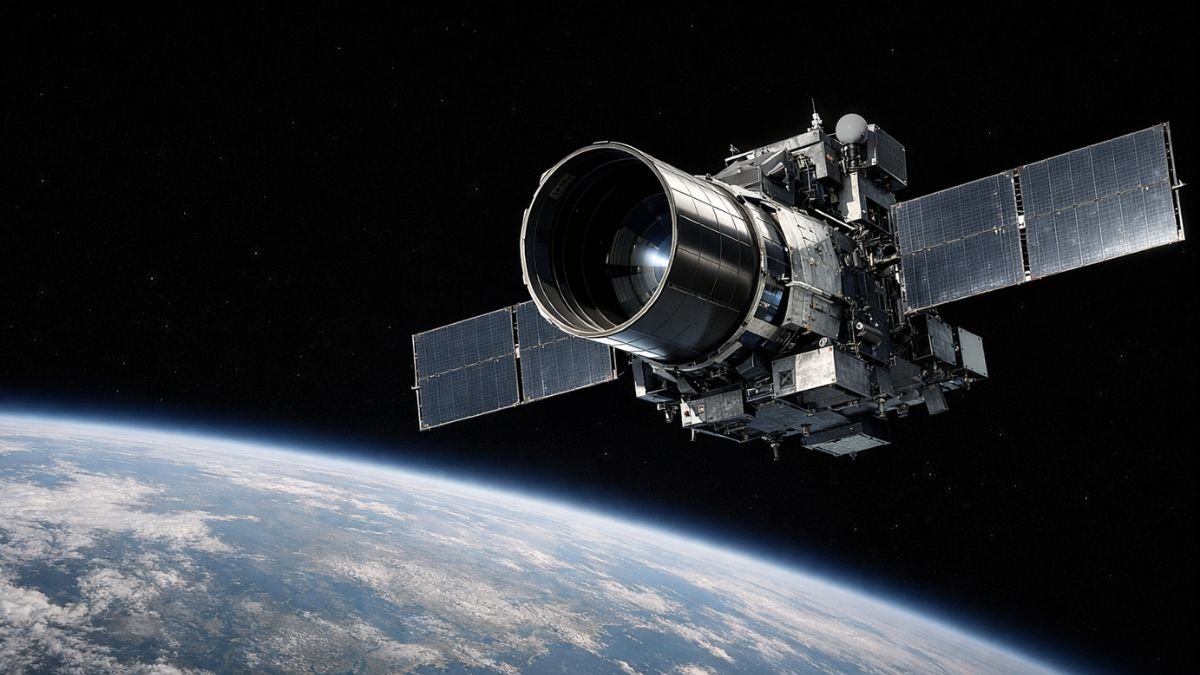
The relationship between space and nuclear deterrence is as old as the space age itself. From the earliest reconnaissance satellites of the late 1950s through to the current generation of persistent surveillance and early warning constellations, space systems have provided the transparency, warning, and command infrastructure without which nuclear deterrence cannot function rationally.
Transparency was the first contribution. Both Cold War superpowers invested in reconnaissance satellite programs — the American Corona and its successors, the Soviet Zenit and its successors — specifically because the alternative to satellite reconnaissance was strategic uncertainty about adversary nuclear force sizes, locations, and readiness.
That uncertainty was itself destabilising — if neither side could know whether the other was preparing a first strike, the incentive to strike first under ambiguous circumstances was dangerously elevated.
Reconnaissance satellites created the mutual transparency that allowed each side to verify the other’s declared force postures, reducing the uncertainty that fuelled worst-case planning.
The Outer Space Treaty negotiations in 1967 explicitly preserved the right to operate reconnaissance satellites as peaceful activities because both superpowers recognised that this transparency was stabilising rather than threatening.
Warning was the second contribution. Space-based infrared surveillance satellites provide the twenty to thirty minutes of warning time between ICBM launch detection and the moment of impact that allows nuclear command authorities to move from peacetime operations to crisis response without being caught by surprise.
That warning time is the foundation of launch under attack options, dispersal of nuclear forces, and the assured destruction posture that makes first-strike rationality implausible. Without reliable early warning, the incentive to launch first rather than absorb a first strike becomes structurally acute — every minute of decision time removed by degraded warning increases the pressure toward launch on warning or even pre-emptive action.
Command and control was the third contribution. The communications satellites that maintain reliable, survivable links between national command authorities and nuclear forces through crisis conditions are essential to the credibility of nuclear deterrence.
A nuclear force that cannot receive authenticated authorisation orders is not a credible second-strike force.
The United States’ Advanced Extremely High Frequency constellation, designed to maintain nuclear command links under the electromagnetic pulse and jamming conditions of nuclear conflict, and Russia’s EKS early warning and communication satellites both represent investment in the space-based command infrastructure that keeps nuclear deterrence credible under the most extreme conditions.
China’s expanding satellite communications architecture serves the same function for its growing nuclear arsenal.
The stability function of these space systems is asymmetric in its implications.
Systems that enhance mutual transparency — reconnaissance satellites — are stabilising because they reduce worst-case uncertainty. Systems that enhance warning — early warning satellites — are stabilising because they reduce the incentive for pre-emptive action under ambiguous circumstances.
Systems that enhance command survivability — communications satellites — are stabilising because they maintain the assured retaliation capability that makes first strikes irrational.
Attacking any of these systems, therefore, has the opposite effect: reducing transparency, compressing warning, and degrading command survivability in ways that make nuclear deterrence less stable rather than more.
This explains why many strategic analysts increasingly describe space infrastructure not as a supporting element of nuclear deterrence but as one of its operational foundations. Modern deterrence depends as much upon preserving the flow of information as upon preserving the survivability of nuclear forces themselves.
The Third Nuclear Age Has Arrived Without the Governance Frameworks to Manage It
The concept of the third nuclear age captures a genuine structural shift in the nuclear security environment that has accumulated across the past decade and crystallised in 2025 and 2026.
The first nuclear age — bilateral US-Soviet deterrence, governed by an elaborate architecture of arms control agreements, crisis management hotlines, and tacit restraints that evolved through near-disasters including the Cuban Missile Crisis and the 1983 Able Archer exercise — ended with the Soviet Union’s collapse.
The second nuclear age — defined by proliferation concerns, rogue state acquisition, and the assumed permanence of American nuclear superiority — ended with China’s rapid arsenal expansion and Russia’s military reassertion beginning in 2014.
The third nuclear age is tripolar, technologically destabilised, and institutionally unmanaged.
Russia’s nuclear arsenal remains the world’s largest — approximately 1,550 deployed strategic warheads as of the final New START data exchange — but New START expired in February 2026 with no successor agreement, removing the last binding limits on Russian and American nuclear force sizes.
Russia’s signalling during the Ukraine conflict — repeated references to nuclear doctrine, the October 2025 claimed test of the Burevestnik nuclear-powered cruise missile, and Russia’s broaching of the possibility of resuming nuclear weapons testing in October 2025 — represents the most direct nuclear coercive signalling by a major power since the Cold War. The potential resumption of nuclear testing would collapse the Comprehensive Nuclear-Test-Ban Treaty moratorium that has underpinned strategic stability since 1996.
Chatham House assessed in December 2025 that alarming events in nuclear proliferation, space security, and hybrid warfare made 2025 a year in which the international security order deteriorated at an accelerating pace, with 2026 presenting crucial tests of whether any stabilising mechanisms remain.
China’s nuclear expansion from approximately 200 warheads a decade ago to a projected 1,500 by 2035 introduces a fundamentally different strategic geometry.
The United States has historically structured its nuclear posture around a bilateral deterrence relationship with Russia, with China’s smaller arsenal treated as a separate and less demanding deterrence requirement.
When China achieves rough numerical parity with American deployed strategic forces in the 2030s, the United States will face a genuine three-way nuclear deterrence problem for the first time — maintaining credible deterrence of two peer nuclear powers simultaneously with a force sized and configured for bilateral deterrence.
The Carnegie Endowment for International Peace has argued that China’s nuclear expansion reflects broader changes in Chinese strategic thinking and has significant implications for U.S.-China nuclear relations, strategic stability, and future deterrence architecture.
The Hudson Institute’s scenario analysis of the tripolar nuclear age concluded that this convergence will have potentially profound implications for deterrence, crisis stability, and extended-deterrence guarantees that no existing American nuclear posture or arms-control framework was designed to address.
India and Pakistan add a secondary tripolar dynamic in South Asia.
North Korea’s expanding nuclear arsenal — with missiles capable of reaching the continental United States — adds a fourth nuclear challenge that exists outside any arms control framework.
The third nuclear age is not simply more nuclear actors than the first two ages managed. It is a qualitatively different strategic environment in which the bilateral deterrence logic, bilateral arms control frameworks, and bilateral crisis management mechanisms of the first nuclear age are insufficient for the multilateral nuclear reality that exists in 2026.
This broader transition from a largely bipolar international system to a more complex multipolar order is examined further in Great Power Competition and the New Global Order.
Counterspace Weapons Have Created a New Pathway to Nuclear Instability
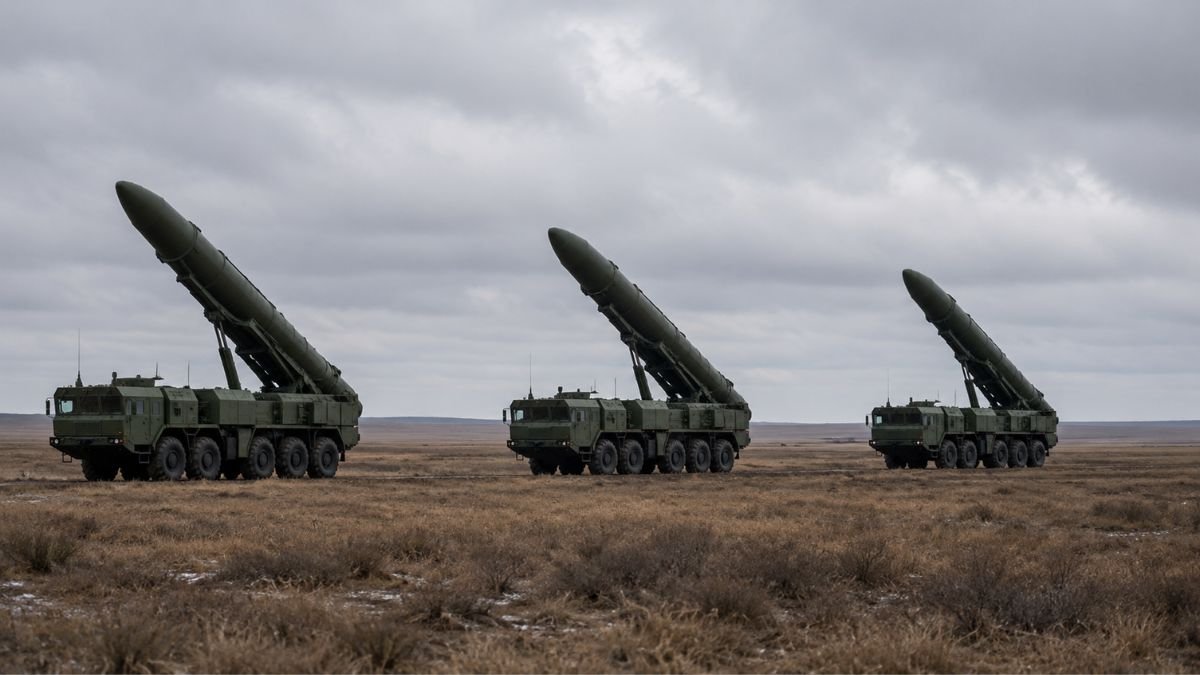
The most dangerous intersection of orbital warfare and nuclear deterrence is the use of counterspace weapons against the space systems that nuclear deterrence stability depends on.
As analysed in Anti-Satellite Weapons: Capabilities, Systems, and Strategic Implications, both China and Russia have developed counterspace capabilities across kinetic, directed energy, electronic warfare, and co-orbital categories that can threaten the early-warning, reconnaissance, and command satellites that underpin nuclear deterrence.
The escalation logic is structurally acute. A counterspace attack on missile warning satellites removes the decision time that nuclear authorities depend on to respond rationally to an incoming attack.
A state that loses its early warning satellites faces a binary crisis: launch immediately on the assumption that the satellite loss is a precursor to nuclear attack, or absorb the risk that the satellite loss was indeed that precursor and that failure to respond will destroy its retaliatory forces.
That choice must be made in minutes, without the warning data that would inform it, in exactly the conditions of maximum uncertainty under which deterrence is most likely to fail.
Russia’s nuclear ASAT development — the system disclosed by American intelligence in February 2024 and assessed through the Cosmos 2553 program — represents the most extreme expression of this intersection.
A nuclear weapon detonated in orbit would not selectively destroy military satellites.
It would generate an electromagnetic pulse and radiation environment that would disable or destroy satellites across entire orbital regimes indiscriminately — early warning satellites, reconnaissance satellites, communications satellites, commercial imagery satellites, and the commercial infrastructure examined in Commercial Satellites as Military Infrastructure: Dependency, Control, and Strategic Risk that modern military operations depend on.
The indiscriminate character of a space nuclear detonation makes it simultaneously the most catastrophic counterspace weapon and the most self-defeating — a state that detonates a nuclear weapon in orbit degrades its own space infrastructure as well as its adversary’s.
This mutual vulnerability illustrates an important continuity with Cold War deterrence. Although the technologies have changed, the underlying strategic logic remains familiar: actions that promise military advantage may simultaneously undermine the stability upon which every nuclear power ultimately depends.
The more immediate concern is not nuclear detonation in orbit but conventional counterspace attack against nuclear-related space infrastructure.
The Foreign Policy Research Institute’s September 2025 analysis of nuclear weapons in space and orbital bombardment argued that the United States should make explicit that any nuclear attack on American-origin satellites would invite retaliation — effectively extending nuclear deterrence to cover space assets.
This proposal reflects a genuine strategic dilemma: if adversaries can degrade American nuclear command and control infrastructure in space without triggering nuclear deterrence, they have found a pathway to nuclear advantage that conventional deterrence cannot close.
But extending nuclear deterrence to conventional counterspace attacks risks lowering the nuclear threshold in ways that could accelerate escalation from conventional space conflict to nuclear exchange.
The Space-Nuclear Nexus Is Reshaping Deterrence Architecture
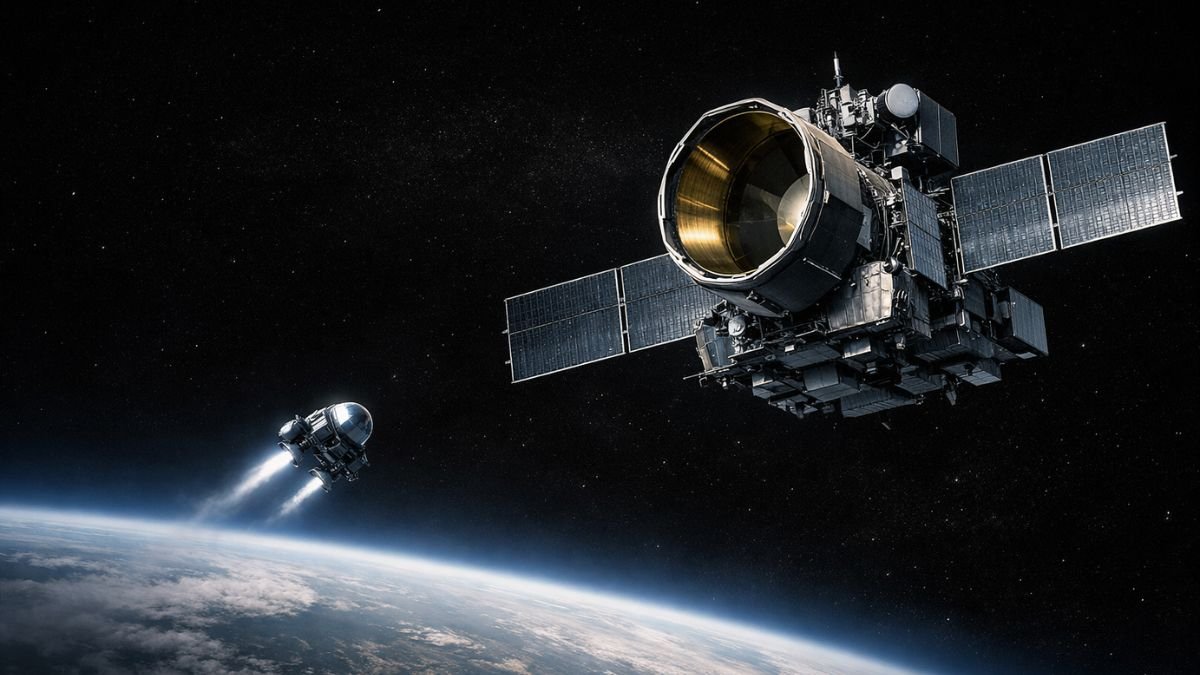
The recognition that space systems are foundational to nuclear deterrence has driven investment in the resilience of that space infrastructure that is now explicitly linked to nuclear stability.
The United States Space Force’s Protected Strategic Communications portfolio — centered on the Advanced Extremely High Frequency satellite constellation — maintains nuclear command links under conditions including directed energy attack, electronic warfare, and nuclear electromagnetic pulse.
The next generation of protected strategic communications satellites is being developed with enhanced survivability features that address the co-orbital threat demonstrated by Russian Nivelir satellites and the directed energy threat posed by Russian Peresvet-class systems.
The Space Development Agency’s Proliferated Warfighter Space Architecture extends the resilience logic from dedicated nuclear communications systems to the broader military space architecture.
As discussed in Satellite Constellations and Military Communications in Modern Warfare, the transition from small numbers of high-value satellites to large numbers of distributed small satellites makes the constellation harder to degrade through any realistic kinetic counterspace campaign.
This architectural resilience serves both conventional military operations and nuclear command stability — a distributed constellation that cannot be comprehensively attacked removes the single-point failure mode that makes concentrated space infrastructure so vulnerable to strategic decapitation.
This shift toward resilient, distributed military architectures reflects a broader transformation in modern warfare examined in Military Modernization in the 21st Century: Precision Strike, Autonomy, and Network-Centric Warfare.
The missile warning architecture is adapting to the same logic.
The Next Generation Overhead Persistent Infrared program was specifically designed for an environment in which adversaries have developed sophisticated means of jamming, spoofing, and degrading satellite systems.
Its multiple orbital regimes — geostationary, highly elliptical, and the SDA’s low Earth orbit tracking layer — provide layered coverage that is harder to degrade comprehensively than a single-regime constellation.
The $3.5 billion SDA Tranche 3 tracking layer contract, awarded in late 2025, covering 72 new satellites planned for launch beginning in 2029, represents continued investment in the distributed architecture that provides both hypersonic tracking and missile warning resilience simultaneously.
China’s parallel investments in nuclear-related space infrastructure reflect the same logic from the adversary perspective.
China’s BeiDou navigation constellation provides GPS-independent positioning and timing for Chinese nuclear forces.
China’s expanding satellite communications architecture maintains command links for the growing PLAN ballistic missile submarine force conducting at-sea deterrent patrols.
China’s missile warning satellite program — assessed as incorporating infrared surveillance capability in dual-use satellites — provides the detection capability that credible nuclear deterrence requires.
As discussed in Russia’s Military Space Program: Doctrine, Systems, and Strategic Intent, Russia’s EKS Tundra constellation performs the same function for Russian nuclear forces, completing a picture in which all three major nuclear powers are simultaneously investing in the space infrastructure that supports their nuclear deterrence posture and in the counterspace weapons that can degrade the adversary’s equivalent infrastructure.
The Absence of Arms Control for Space-Nuclear Intersection Is the Critical Governance Gap
The governance architecture for managing the intersection of space weapons and nuclear deterrence is effectively nonexistent.
The Outer Space Treaty prohibits nuclear weapons in orbit but not conventional counterspace weapons that degrade nuclear-related satellites.
The nuclear arms control architecture — what remains of it after New START’s expiry — addresses nuclear force sizes and certain delivery systems but not the space infrastructure that enables those forces to operate.
There is no treaty, no agreement, and no negotiated framework that specifically addresses the targeting of nuclear-related space systems or establishes rules for the use of counterspace weapons in ways that avoid triggering nuclear escalation.
The UNIDIR’s December 2025 analysis of the long shadow of the nuclear age on space security governance reached a sobering conclusion: the early treaties of the space age created a durable foundation for preventing nuclear conflict in orbit, but that foundation has eroded as the space environment evolved into something their authors could not anticipate.
The governance that remained appropriate to 1967 is not sufficient for 2026.
The practical consequence is that no agreed threshold separates conventional counterspace operations from nuclear-escalatory counterspace operations.
An adversary considering whether to jam American early warning satellites, conduct a co-orbital proximity approach to a nuclear command communications satellite, or attack a ground station that processes both conventional and nuclear early warning data has no authoritative legal or political framework to consult about whether these actions cross a threshold that would trigger nuclear deterrence.
The attacking state must make its own assessment of American tolerance for space-based attacks on nuclear infrastructure — an assessment made under crisis conditions, with incomplete information, and with enormous consequences for miscalculation.

The B-21 Raider and the Nuclear Triad’s Space Dependency
The American nuclear triad’s modernization program illustrates the depth of the space dependency that nuclear deterrence now carries.
The B-21 Raider stealth strategic bomber — with a second aircraft joining flight testing at Edwards Air Force Base in September 2025, and the program receiving an additional $6.1 billion in accelerated funding presented to the Senate Armed Services Committee in April 2026 — relies on space-based navigation, communications, and targeting data in ways that the B-52 and B-2 it will eventually replace, did not when they were designed.
The Columbia-class ballistic missile submarine program, which will replace the Ohio-class SSBNs, is designed to maintain connectivity with nuclear command authorities through space-based and undersea communications links that space-based electronic warfare can threaten.
The Ground-Based Strategic Deterrent — the replacement for the ageing Minuteman III ICBM — uses space-based navigation and communications as integral components of its operational architecture.
The modernization of all three legs of the nuclear triad has deepened their dependency on the space infrastructure that the triad’s architects did not originally design around.
This is not a design failure — it is the consequence of space systems providing such decisive improvements in accuracy, reliability, and command survivability that excluding them from nuclear delivery systems would be strategically irrational. But it does mean that the nuclear triad’s operational effectiveness in a conflict scenario where adversary counterspace operations have degraded space infrastructure is less certain than the triad’s design characteristics alone would suggest.
The absence of New START limits has already prompted senior Air Force leadership to discuss expanding the force beyond treaty-era ceilings — including reopening previously deactivated missile tubes on Ohio-class submarines and increasing planned B-21 production numbers — decisions that would further deepen, not reduce, the triad’s dependence on the space-based navigation and communications infrastructure examined throughout this article.
The Atlantic Council’s March 2026 strategy paper on the great nuclear debates identified this space-nuclear dependency as one of the most consequential unresolved questions in American nuclear posture development — a question that the Biden administration’s Nuclear Posture Review of 2022 addressed incompletely and that the current administration has not yet resolved in doctrine.
Conclusion
Nuclear deterrence in the space age faces a convergence of challenges that its Cold War architects did not anticipate and that the institutional frameworks they built are insufficient to manage.
The third nuclear age — tripolar, technologically destabilised, and institutionally unmanaged — has arrived without the arms control frameworks, crisis communication mechanisms, or escalation management agreements that the first nuclear age developed through decades of near-disasters.
Space systems are more central to nuclear deterrence than at any previous point in history.
The counterspace weapons threatening those systems are more capable than at any previous point in history. And the governance architecture for managing the intersection is thinner than at any previous point in the nuclear age.
The central challenge is therefore no longer limited to preventing nuclear war itself. It increasingly includes preserving the orbital infrastructure that allows deterrence, communication, warning, and strategic decision-making to function before a crisis escalates beyond political control.
The space domain examined throughout StrikeOrbit‘s orbital warfare cluster is not a separate arena of competition from the nuclear balance. It is the connective infrastructure through which the nuclear balance functions. Degrading it degrades nuclear deterrence. Threatening it creates escalation pressures that deterrence theory was not designed to manage at this technological level and in this multipolar nuclear geometry.
The most consequential question in nuclear security in 2026 is not how many warheads each state possesses. It is whether the space infrastructure that makes those warheads a credible deterrent rather than a hair-trigger threat can be protected, governed, and kept sufficiently resilient to maintain the stability that nuclear deterrence, at its best, has always promised and never permanently delivered.
For a broader assessment of how technological competition, military modernization, and geopolitical rivalry are reshaping international security, read Strategic & Geopolitical Intelligence: Understanding the New Global Power Balance.
Frequently Asked Questions
What is the third nuclear age and why does it matter in 2026?
The third nuclear age refers to the current nuclear security environment characterised by three developments that have never previously coexisted: a tripolar nuclear competition between the United States, Russia, and China without arms control frameworks to manage it, the deployment of counterspace weapons that can degrade the space infrastructure nuclear deterrence depends on, and hypersonic weapons and artificial intelligence that compress the decision timescales within which deterrence must function. The Bulletin of the Atomic Scientists identified the third nuclear age as the top global risk for 2026. New START expired in February 2026, removing the last binding limits on US and Russian nuclear force sizes. China’s arsenal is growing from approximately 200 warheads a decade ago to a projected 1,500 by 2035. No arms control framework addresses this three-way nuclear dynamic.
How do space systems support nuclear deterrence stability?
Space systems contribute to nuclear deterrence stability through three primary functions. Reconnaissance satellites provide the transparency that allows each nuclear power to verify adversary force postures, reducing the worst-case uncertainty that fuels pre-emptive thinking. Early warning satellites provide the twenty to thirty minutes of decision time between ICBM launch detection and impact that allows rational response rather than panicked pre-emption. Communications satellites maintain the survivable command links between national command authorities and nuclear forces that preserve assured retaliation capability under crisis conditions. Together these functions make nuclear deterrence credible rather than fragile — and their degradation through counterspace attack reverses each of these stability contributions simultaneously.
Why does attacking space systems threaten nuclear stability?
Attacking the space systems that support nuclear deterrence — early warning satellites, reconnaissance satellites, nuclear command communications satellites — creates acute escalation pressure because it degrades the information environment within which nuclear decisions must be made. A state that loses its early warning satellites cannot verify whether the satellite loss is a precursor to nuclear attack or a conventional counterspace operation. It must decide enormous consequences — whether to launch nuclear forces immediately or risk their destruction in a first strike — with degraded information, in minutes, under maximum uncertainty. This is precisely the decision-making environment in which rational deterrence is most likely to fail and inadvertent nuclear escalation is most likely to occur.
What is Russia’s nuclear anti-satellite weapon and how does it affect deterrence?
Russia has been developing a nuclear anti-satellite weapon — assessed through the Cosmos 2553 program disclosed by American intelligence in February 2024 — designed to detonate a nuclear warhead in orbit to generate electromagnetic pulse and radiation effects capable of destroying satellites across entire orbital regimes. This system would represent a direct violation of the Outer Space Treaty’s prohibition on nuclear weapons in orbit. Its strategic significance for nuclear deterrence is profound: a nuclear space detonation would indiscriminately destroy early warning, reconnaissance, communications, and commercial satellites simultaneously, removing the space-based infrastructure that nuclear deterrence depends on from all actors at once. Unlike conventional counterspace attacks, its effects cannot be limited to specific target satellites.
How is American nuclear modernisation addressing space vulnerabilities?
American nuclear modernization is addressing space vulnerabilities through resilient architecture rather than attempting to eliminate space dependency. The Advanced Extremely High Frequency satellite constellation maintains nuclear command links under electronic warfare and electromagnetic pulse conditions. The Next Generation Overhead Persistent Infrared program provides missile warning across multiple orbital regimes that are harder to comprehensively degrade than single-regime constellations. The Space Development Agency’s Proliferated Warfighter Space Architecture distributes capability across hundreds of small satellites rather than concentrating it in a few high-value targets. The $3.5 billion Tranche 3 tracking layer contract, awarded in late 2025 for 72 new satellites, represents continued investment in this distributed architecture. The B-21 Raider program itself received accelerated funding of $6.1 billion in April 2026 specifically to speed production of a bomber whose targeting and navigation systems depend heavily on the same space architecture. However, none of these investments address the absence of governance frameworks for managing counterspace attacks on nuclear-related space infrastructure.
Sources and References
Bulletin of the Atomic Scientists — Doomsday Clock Statement and Third Nuclear Age Risk Assessment (January 2026)
Chatham House — Global Security Continued to Unravel in 2025: Crucial Tests Are Coming in 2026 (December 2025)
Foreign Policy Research Institute — Nuclear Weapons in Space: Orbital Bombardment and Strategic Stability (September 2025)
UNIDIR — The Long Shadow of the Nuclear Age on Space Security Governance (December 2025)
Hudson Institute — Lighting the Path Ahead: Scenario-Based Planning in the Tripolar Nuclear Age (2025)
Atlantic Council — Strategy for a New Nuclear Age: Great Nuclear Debates (March 2026)
Global Security Review — Understanding the Third Nuclear Age: Why 2026 Matters (March 2026)
Carnegie Endowment for International Peace — Political Drivers of China’s Changing Nuclear Policy: Implications for U.S.-China Nuclear Relations and International Security (July 2024)
Defense News — Space Warfare in 2026: A Pivotal Year for US Readiness (January 2026)
Center for Strategic and International Studies (CSIS) — Space Threat Assessment 2025 (April 2025)
Secure World Foundation — Global Counterspace Capabilities: An Open Source Assessment (2026)
Congressional Research Service — US Nuclear Weapons Policy and the New START Treaty (2024)
Arms Control Association — The Nuclear Arms Control Landscape in 2026 (2026)
Army Recognition — U.S. Accelerates B-21 Raider Deployment to Strengthen Nuclear Strike Deterrence (May 2026)
Related Analysis
For analysis of the missile warning satellites that provide the decision time nuclear deterrence stability requires, read Missile Warning Satellites and Early Warning Systems Explained.
For analysis of the anti-satellite weapons that threaten the space infrastructure nuclear deterrence depends on, read Anti-Satellite Weapons: Capabilities, Systems, and Strategic Implications.
For analysis of the Outer Space Treaty provisions governing nuclear weapons in space and the governance gap that Russia’s nuclear ASAT program exploits, read The Outer Space Treaty and Its Limits in the Age of Orbital Warfare.
For analysis of Russia’s nuclear ASAT program and co-orbital counterspace capabilities that most directly threaten nuclear deterrence stability in space, read Russia’s Military Space Program: Doctrine, Systems, and Strategic Intent.
For analysis of China’s nuclear arsenal expansion that is driving the tripolar nuclear dynamic described in this article, read China’s Military Modernization: Force Structure, Technology, and Strategic Ambition.
