


Analysis · StrikeOrbit | 2026
China’s military modernization is the most consequential force development program in the world today. Not because the People’s Liberation Army has already surpassed the United States military- it has not – but because no military in history has expanded its capabilities at this pace, across this many domains simultaneously, with this degree of sustained political will and industrial capacity behind it.
Since Xi Jinping became General Secretary of the Chinese Communist Party in 2013, China’s announced defense budget has nearly doubled.
The PLA has restructured its command architecture, fielded new generations of nuclear, naval, air, missile, and space capabilities, and integrated artificial intelligence and military-civil fusion into the institutional fabric of its modernization in ways that are still being fully understood by the intelligence communities that track it.
The DoD’s 2025 Annual Report to Congress on Military and Security Developments Involving the People’s Republic of China — the 25th edition of an assessment that has tracked PLA development for a quarter century — reached a conclusion that would have been extraordinary a decade ago and has become almost routine: despite extensive leadership purges and disciplinary investigations across China’s military and defense industry.
China continues to make progress toward Xi Jinping’s 2027 Centennial Military Building Goal and associated warfighting capabilities.
The 2027 goal — transforming the PLA into a fully mechanised, informatised, and intelligentised force by the centennial of the PLA’s founding — has driven the pace, priorities, and resource allocation of Chinese military development for a decade and now sits approximately twelve months away.
Understanding China’s military modernization requires understanding both what it has already achieved and what it is still building toward.
The PLA of 2026 is not the PLA of 2013.
It is a fundamentally different force, larger in some dimensions, more capable in nearly all others, and oriented around a strategic vision of defeating the United States in a high-intensity regional conflict over Taiwan in ways the PLA of a decade ago could not credibly threaten.
As analysed in Great Power Competition and the New Global Order, the US-China competition is the defining strategic contest of the current era. China’s military modernization is the primary material expression of that competition.
The 2027 Centennial Goal Has Driven a Decade of Accelerated Military Development
The 2027 Centennial Military Building Goal serves as the organising framework for understanding Chinese military modernization over the past decade.
First articulated by Xi Jinping in 2017 and elaborated in subsequent Party documents and military publications, the goal requires the PLA to complete the mechanization of its forces, achieve major progress in informatization — the integration of digital information systems into military operations — and begin the process of intelligentisation, the integration of artificial intelligence into military command and operations.
The goal is not simply about fielding new equipment. It is about transforming the PLA from a large conventional force with pockets of advanced capability into an integrated joint force capable of conducting precision warfare at speed against the world’s most capable military.
The organizational and doctrinal foundations of this transformation are examined in greater comparative detail in US Space Force Doctrine vs China’s Space Strategy: Competing Visions of Orbital Power.
This distinction is important because Chinese military modernization is frequently misunderstood as an equipment program rather than an institutional transformation. The PLA’s reforms seek to integrate doctrine, organization, training, industrial capacity, and technology into a single warfighting system rather than modernizing each service independently.
The 2027 milestone carries symbolic weight that reinforces its operational urgency.
The PLA was founded in 1927 following the Nanchang Uprising — its 2027 centennial has been identified by Xi Jinping as the first of three major centennial milestones, followed by China becoming a moderately developed socialist country by 2035 and achieving full national rejuvenation by 2049.
Military readiness for Taiwan contingencies is understood to be a specific objective for 2027 — not a commitment to use force in that year, but a commitment to having the capability to do so credibly and successfully if the political decision is made.
The Pentagon’s 2025 report assessed that China’s repeated omission of peaceful unification language in high-profile statements in 2024 and 2025, combined with China’s substantial military operations around Taiwan in both years, indicate that Beijing is seeking to compel Taipei’s unification through a concerted pressure campaign.
Justice Mission 2025 — the PLA exercises conducted in December 2025 that encircled Taiwan with naval and air assets in the most extensive blockade rehearsal in the strait’s history — was not a demonstration of existing capability. It was a rehearsal of the operational plan that the 2027 goal is designed to make executable.
China’s 15th Five-Year Plan for 2026 to 2030, approved at the March 2026 National People’s Congress, continues and extends this trajectory. The plan systematises Military-Civil Fusion as the primary mechanism for defense modernization — requiring civilian technology companies and research institutions to integrate their development activities with military requirements, thereby accelerating the transfer of advanced commercial technology into military systems.
The Diplomat published a detailed analysis in October 2025 of how the 15th Five-Year Plan is expected to reshape military innovation through deeper Military-Civil Fusion integration and the expansion of the AI-Plus framework across China’s defense ecosystem.
The plan’s emerging framework includes an AI-Plus initiative that seeks to embed artificial intelligence across every dimension of PLA operations, and early demonstrations of quantum sensing and counter-hypersonic technologies are expected around the 2027 centennial to signal the program’s direction even where full operational capability has not been reached.
The PLA Navy Has Become the World’s Largest by Hull Count
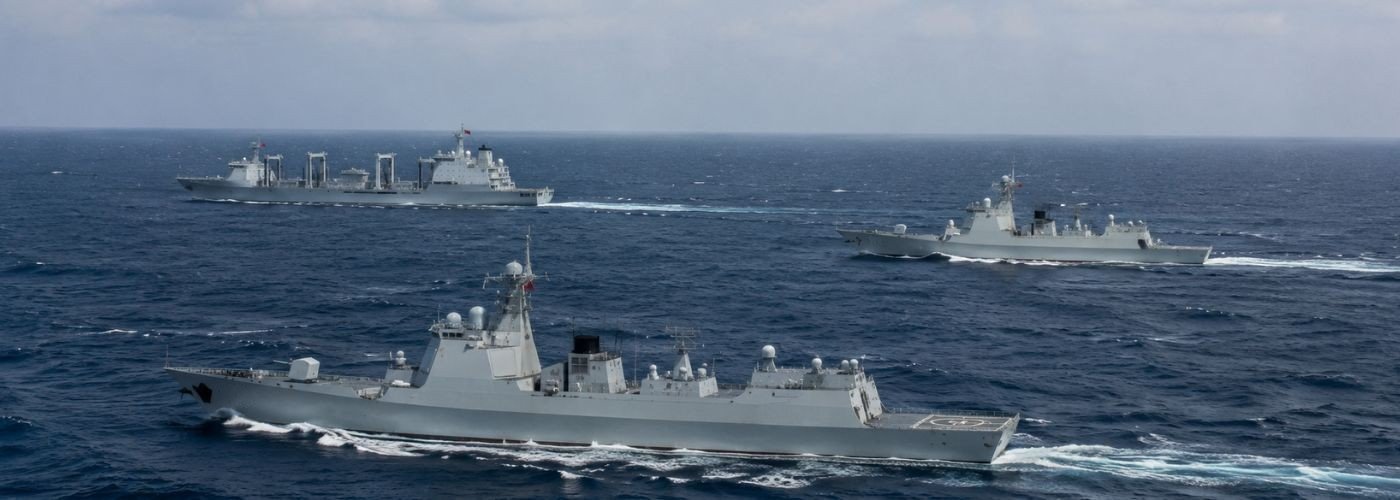
The People’s Liberation Army Navy has transformed more dramatically and rapidly than any naval expansion in the post-Cold War era. From a coastal defense force with limited blue-water capability in the 1990s, the PLAN has built itself into the largest navy in the world by hull count — surpassing the United States Navy in total vessels in 2020 and extending that lead progressively since.
The PLAN’s surface fleet now includes advanced destroyers comparable in capability to the best Western surface combatants.
The Type 055 Renhai-class cruiser — twelve of which have been commissioned or are in various stages of construction — is assessed as the most capable surface combatant in the Indo-Pacific outside the United States Navy and represents a quantum leap in Chinese naval capability over the preceding Type 052D destroyer.
Hull numbers alone, however, do not determine naval power. Sustained operational experience, logistics, overseas basing, carrier aviation proficiency, and joint maritime command remain areas where the United States continues to retain significant advantages despite the PLAN’s remarkable expansion.
With displacement exceeding 13,000 tones, 112 vertical launch system cells, advanced phased array radars, and integration of China’s HHQ-9B long-range surface-to-air missile and YJ-18 anti-ship cruise missile, the Type 055 provides the PLAN with a genuine area air defense and anti-surface warfare capability that previous Chinese surface combatants could not approach.
The carrier program has advanced from a refurbished Soviet hull to indigenous production with cutting-edge technology in less than fifteen years.
The Liaoning, commissioned in 2012, was a rebuilt Soviet Kuznetsov-class carrier with a ski-jump ramp.
The Shandong, commissioned in 2019, was China’s first domestically built carrier but still used a ski-jump design limiting aircraft payload and sortie generation rates.
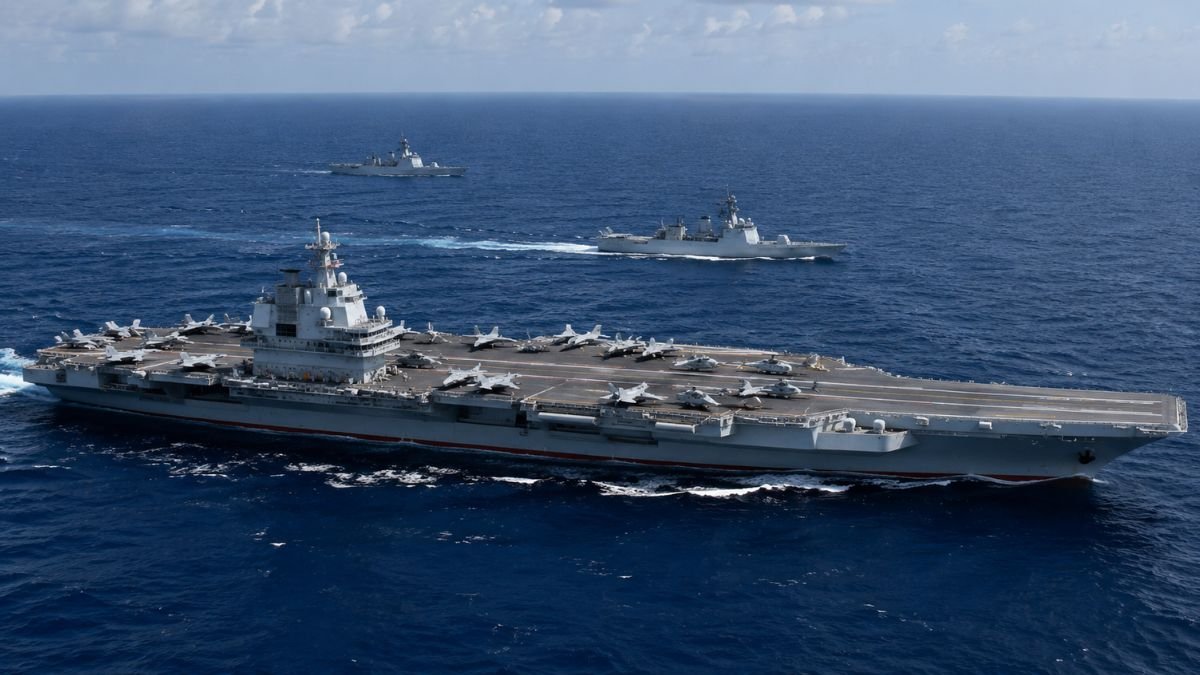
The Fujian — Type 003 — represents a generational leap.
Launched in 2022 and put through sea trials in 2025, the Fujian was formally commissioned into PLAN service on 5 November 2025, making China only the second country after the United States to operate an EMALS-equipped carrier. The catapult system allows the Fujian to launch heavier aircraft with fuller fuel and weapons loads than ski-jump carriers can manage, and to sustain higher sortie generation rates during sustained operations.
A fourth carrier, the Type 004, has progressed well beyond assessment-stage construction: satellite imagery from May 2026 showed a hull roughly 286 meters long under construction at Dalian, with US testimony in March 2026 assessing the vessel as likely nuclear-powered based on apparent reactor containment structures.
A development that, if confirmed, would give China a carrier larger than the Fujian and potentially rivaling the size of America’s Gerald R. Ford-class ships. The Pentagon’s most recent assessment projects China building toward a nine-carrier fleet by 2035.
The submarine fleet remains one of the most consequential elements of Chinese naval expansion.
The PLAN operates approximately six Jin-class Type 094 nuclear-powered ballistic missile submarines — each capable of carrying twelve JL-3 submarine-launched ballistic missiles with sufficient range to target the continental United States from protected patrol areas in the South China Sea — alongside a growing force of Shang-class Type 093 nuclear-powered attack submarines and a large force of conventionally-powered Song and Yuan-class diesel-electric submarines.
The Jin-class SSBN force represents a qualitative shift in China’s nuclear deterrence posture — moving from a historically minimal deterrence posture based on land-based ICBMs toward a second-strike capability based on continuous at-sea deterrent patrols that is more survivable against a first strike.
The PLA Rocket Force Holds the Most Diverse Missile Arsenal in the World
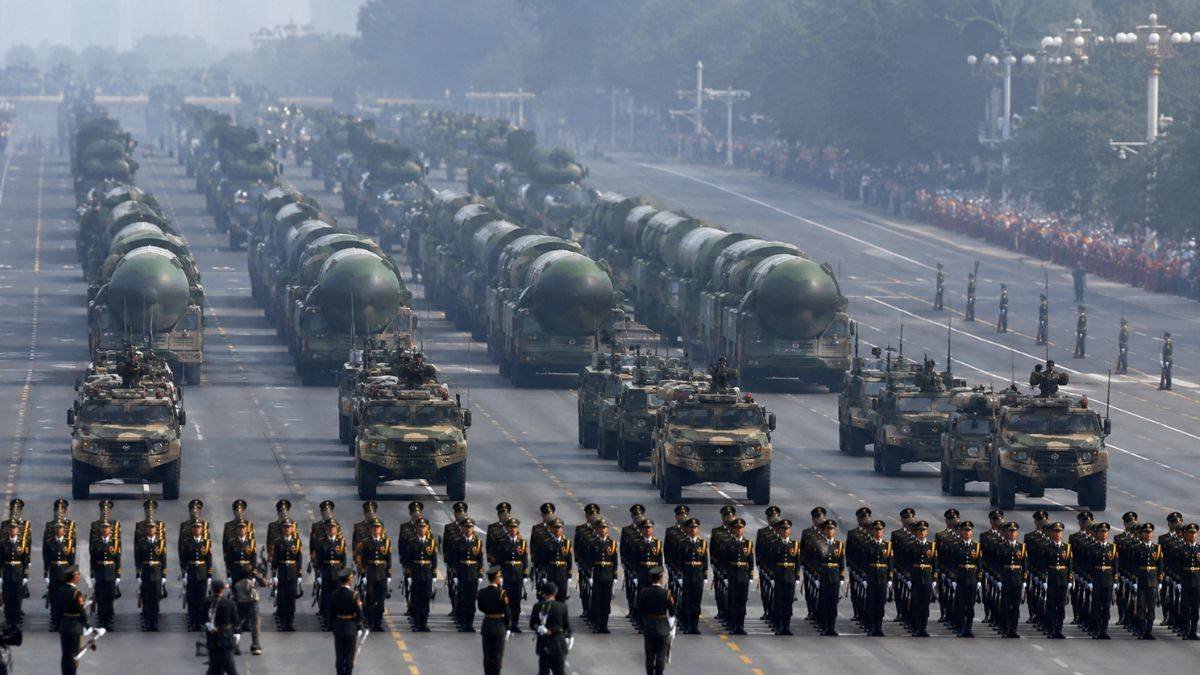
The People’s Liberation Army Rocket Force — established as a separate service in 2015 from the former Second Artillery Corps — has built the most diverse and rapidly expanding ballistic and cruise missile arsenal of any military in the world.
The Rocket Force’s arsenal encompasses every range band from short-range ballistic missiles targeting Taiwan and US bases in Japan, through medium-range missiles targeting US carrier strike groups across the first and second island chains, to intercontinental ballistic missiles targeting the US homeland. The breadth of this arsenal and the pace at which it is expanding represent the most direct military challenge to American conventional and nuclear deterrence in the Indo-Pacific.
The DF-21D anti-ship ballistic missile — the world’s first operational anti-ship ballistic missile — has given China a capability to threaten American carrier strike groups at ranges exceeding 1,500 kilometers with a weapon travelling at hypersonic terminal velocity that existing naval air defense systems were not designed to intercept.
The DF-26 — a dual conventional and nuclear capable intermediate-range ballistic missile with ranges assessed at 3,000 to 5,000 kilometres — can strike Guam from mainland China, extending China’s anti-access capability to the second island chain and directly threatening the major American military hub that any Taiwan contingency would depend on for logistics and air support.
The hypersonic dimension of China’s Rocket Force arsenal has been examined in detail in Countries With Operational Hypersonic Missiles: Global Status 2026.
The DF-17 with its DF-ZF hypersonic glide vehicle, the DF-ZF tested in fractional orbital trajectory configurations in 2021, and the YJ-21 naval hypersonic anti-ship missile together give China a strike capability against time-sensitive and hardened targets across the Indo-Pacific that no existing missile defense architecture can reliably intercept.
The Rocket Force has fielded multiple brigades equipped with DF-17 and is assessed to be producing all major systems at accelerated rates to meet both deterrence and warfighting requirements.
China’s nuclear arsenal expansion represents the most significant change in its strategic posture in the nuclear age. The Pentagon’s 2025 report assessed that China’s operational nuclear warhead stockpile exceeded 600 warheads as of May 2024 and is expected to grow to approximately 1,000 warheads by 2030 and 1,500 by 2035.
This trajectory — from approximately 200 warheads a decade ago to a projected 1,500 by 2035 — represents the most rapid nuclear build-up by any state since the Cold War and will produce a Chinese nuclear arsenal roughly equivalent in size to the current American deployed strategic force within a decade.
The PLA Air Force Is Building a Credible Stealth and Long-Range Strike Capability
The People’s Liberation Army Air Force has transformed from a force built primarily around Soviet-era fourth-generation fighters toward one incorporating fifth-generation stealth capability, advanced long-range strike systems, and the beginnings of a strategic bomber modernization that will provide China with a genuine nuclear triad.
The J-20 Mighty Dragon is China’s first operational fifth-generation stealth fighter and the only operational non-American stealth fighter in the world. Achieving initial operational capability around 2017, the J-20 has since been produced in growing numbers and is now deployed across multiple PLAAF bases.
Its configuration — a large stealth fighter with substantial internal fuel capacity and weapons bays designed for beyond-visual-range missile engagement — reflects a design philosophy oriented around defeating American air superiority assets and long-range strike missions rather than the close-combat dogfighting that characterized earlier Chinese fighter design priorities.
The J-20’s operational numbers remain classified but are assessed to have reached several hundred aircraft across all variants by 2026, with production continuing at Chengdu Aircraft Corporation.
The H-20 stealth strategic bomber remains in development but represents perhaps the most strategically significant near-term addition to China’s air power. Designed to provide a stealthy long-range strike capability to complete China’s nuclear triad — alongside land-based ICBMs and submarine-launched ballistic missiles — the H-20 would give China the ability to conduct nuclear strikes against targets across the Pacific from Chinese territory without the range limitations of current H-6 bombers.
The Pentagon has indicated the H-20 may achieve initial operational capability within the current decade. When it does, China will possess a genuine nuclear triad with modern delivery systems across all three legs for the first time.
The WZ-7 and other high-altitude long-endurance unmanned aerial vehicles have given China a persistent ISR capability over contested maritime areas, including the South China Sea and the Taiwan Strait. China’s drone programs span every operational category from loitering munitions used at the tactical level to Wing Loong and CH-5 systems comparable to American Predator and Reaper platforms for persistent strike and surveillance.
Operation Sindoor Provided the First Real Combat Assessment of Chinese Military Equipment
The most significant real-world assessment of Chinese military equipment performance came not from Chinese operations but from Pakistan’s employment of Chinese weapons systems during Operation Sindoor — India’s military strikes against terrorist infrastructure in Pakistan in May 2025 and Pakistan’s military response.
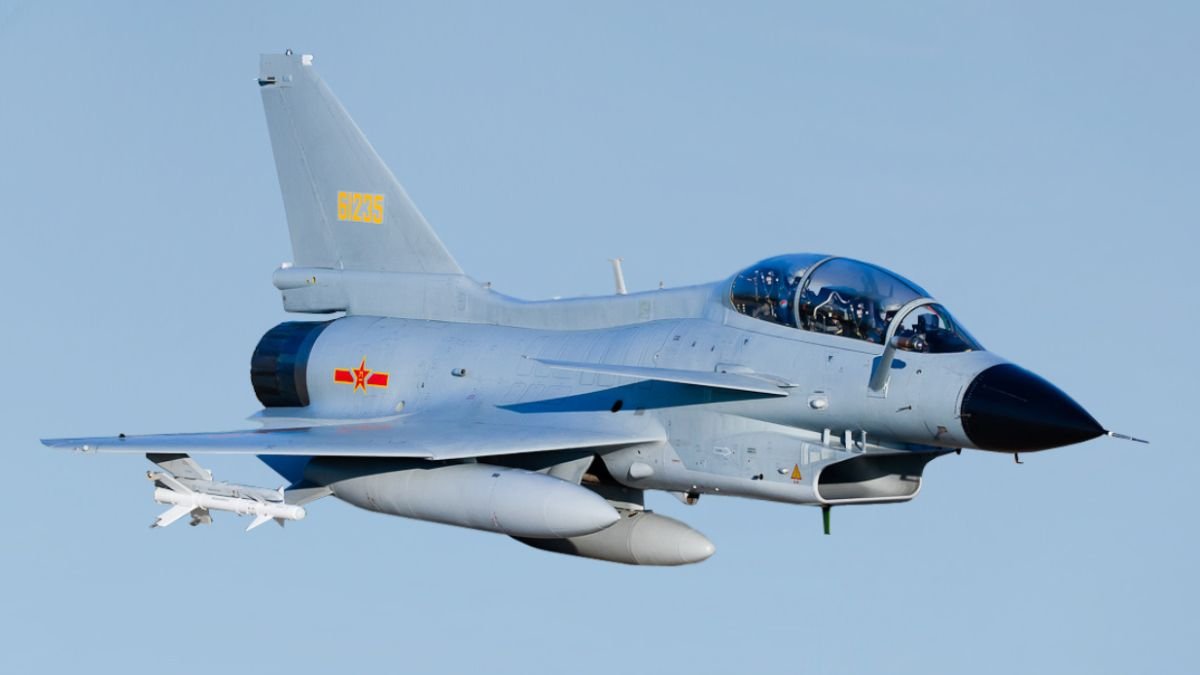
Pakistan’s air force employed J-10CE fighters and CM-400AKG hypersonic air-to-surface missiles supplied by China during the conflict, providing the first combat test of these systems against a peer-capable adversary with access to advanced Western air defense systems.
Pakistani J-10CE fighters were credited with engagements against Indian aircraft using PL-15 beyond-visual-range missiles, with the conflict generating extensive debate among defense analysts about the relative performance of Chinese versus Western systems in actual combat conditions.
Because neither China nor Pakistan has released comprehensive operational data, and India has likewise disclosed only limited information, many assessments remain provisional. Analysts therefore continue to distinguish between confirmed battlefield observations and broader conclusions regarding the overall performance of Chinese military technology.
The employment of Chinese weapons systems in a real conflict between nuclear-armed states provided intelligence of significant analytical value to militaries studying Chinese military capability — particularly regarding the PL-15’s operational performance characteristics and the J-10CE’s effectiveness against Indian Rafale and Su-30MKI fighters.
The Observer Research Foundation’s 2025 analysis of Chinese military modernization provides an Indian strategic assessment of how China’s evolving force structure, weapons integration, and operational concepts are influencing regional military balances following Operation Sindoor.
The Operation Sindoor data is being studied by American, Indian, Taiwanese, and other military establishments specifically because it provides open-source evidence of Chinese weapons systems’ performance in actual combat rather than in Chinese-controlled exercises. The conclusions drawn from that data will shape threat assessments, force development priorities, and operational planning across the Indo-Pacific.
For the PLA, Operation Sindoor validated the combat credibility of its export systems — and by extension provided some confidence in the capabilities of the domestic variants that are generally more advanced than export versions.
The PLA’s Institutional Reforms Have Not Resolved All Capability Gaps
The comprehensive restructuring of the PLA that Xi Jinping initiated from 2015 onward — establishing the five theatre commands, creating the Rocket Force and Strategic Support Force as separate services, and most recently disbanding the Strategic Support Force and establishing the Information Support Force in April 2024 — has been the most significant organizational reform of the Chinese military since the founding of the People’s Republic.
These reforms reflect a genuine attempt to transform a force built around individual service bureaucracies toward an integrated joint warfare capability.
The reforms have not been without friction.
Extensive anti-corruption investigations across the Rocket Force and defense industrial base — which resulted in the dismissal or investigation of multiple senior Rocket Force commanders and executives of major defense contractors between 2023 and 2025 — introduced institutional disruption at a critical period of capability development.
War on the Rocks analysed the Pentagon’s 2025 China Military Power Report. It concluded that despite leadership purges, corruption investigations, and institutional disruption, China’s military modernization continues to advance toward its long-term capability goals.
The Pentagon’s 2025 report characterized these disruptions as phase-bound interruptions that have not fundamentally derailed China’s modernization momentum, but they have introduced uncertainty about the operational readiness of specific capabilities and about the integrity of quality control processes.
The CMC revised the PLA’s basic laws and code of conduct — the Common Regulations — in February 2025 for the first time since 2018, reflecting both the lessons of the Ukraine war and the organisational lessons learned from the anti-corruption investigations.
The revisions emphasise combat readiness, discipline, and the integration of joint operations across service boundaries — suggesting that PLA leadership remains aware that the force’s doctrinal ambition outpaces its operational integration in some areas.
As explored in JADC2 Explained: How the US Military’s Joint Command Network Works, achieving genuine joint warfighting capability requires not just modern equipment but the command architecture, doctrine, and training that integrates equipment across service boundaries — a challenge the American military itself has spent decades attempting to resolve.
China’s Military-Civil Fusion Is Accelerating Capability Development
The Military-Civil Fusion strategy — the systematic integration of China’s civilian technology sector into military research, development, and production — represents one of the most consequential and least fully understood dimensions of Chinese military modernization.
Where Western military procurement systems maintain relatively clear separations between civilian and defense industrial activities, China’s Military-Civil Fusion framework explicitly requires civilian technology companies, universities, and research institutions to make their capabilities available to the military and to orient their research priorities toward military applications.
The practical consequence is that China’s military benefits from the full dynamism of its civilian technology sector in ways that no Western military procurement system can replicate.
Huawei’s 5G technology has direct military applications in battlefield communications.
Chinese AI companies, including Baidu, Alibaba, and Tencent, have been directed to make their AI capabilities available for military applications under the Military-Civil Fusion framework.
Chinese semiconductor development, quantum computing research, and hypersonic propulsion research all benefit from civilian research infrastructure that is formally obligated to support military applications.
War on the Rocks documented in April 2026 how Military-Civil Fusion operates through an institutional framework that systematically channels commercially successful technologies into military applications, reducing the separation between civilian innovation and defense capability development.
The 15th Five-Year Plan’s AI-Plus initiative extends this logic into the next generation of military technology development.
By embedding AI across every dimension of PLA operations — logistics, intelligence analysis, targeting, command support, and autonomous systems — China is attempting to achieve the kind of decision-speed advantage that JADC2 seeks for American forces, but through a development pathway that integrates civilian AI development into military applications faster than any Western procurement system can match.
As discussed in Electronic Warfare in Space: Jamming, Spoofing, and Satellite Signal Warfare Explained, AI’s role in military operations extends from combat systems to the electronic warfare and space domain awareness capabilities that underpin all other military functions.
Conclusion
China’s military modernization in 2026 represents the most significant transformation of military power in the post-Cold War era. The PLA has moved from a large, largely conventional force with limited power projection capability to a sophisticated joint force with credible capability across naval, air, missile, space, cyber, and electronic warfare domains simultaneously.
The pace of that transformation — driven by a doubling of the defense budget, systematic Military-Civil Fusion, the 2027 centennial deadline, and Xi Jinping’s personal authority over the entire enterprise — is without precedent in modern military history for a force of this scale.
The gaps that remain are real. The PLA has not fought a significant conflict since 1979. Its joint warfare capability at the operational level remains untested at scale. The anti-corruption investigations have introduced uncertainty about the reliability of some capabilities.
The strategic depth of its logistics infrastructure for sustained high-intensity operations has not been validated. But as Admiral Paparo assessed in May 2025, the trajectory is the central concern — not the current balance but the direction of travel. China’s chances of prevailing in a conflict were improving as its capabilities expanded.
The 2027 centennial will mark a milestone on that trajectory, not its endpoint.
The significance of China’s modernization therefore lies less in any individual platform than in the cumulative interaction between industrial capacity, organizational reform, technological integration, and long-term strategic planning. It is this sustained convergence of capabilities that increasingly distinguishes the PLA from many militaries whose modernization programs remain fragmented.
The military dimension of the US-China competition examined in Strategic and Geopolitical Intelligence: Understanding the New Global Power Balance is being decided not by any single weapon system or single program but by the cumulative effect of a sustained, systematic, and strategically coherent military modernization effort that has been building for over a decade and shows no signs of slowing.
Although China and Russia increasingly cooperate strategically, their approaches to military modernization differ substantially in organization, industrial capacity, and long-term force development, as explored further in Russia’s Military Space Program: Doctrine, Systems, and Strategic Intent.
The question for American military planning is not whether China has become a peer competitor. It already has. The question is whether the response to that competition can be structured and resourced at the pace the trajectory demands.
Frequently Asked Questions
What is China’s 2027 Centennial Military Building Goal and why does it matter?
China’s 2027 Centennial Military Building Goal requires the PLA to complete mechanization of its forces, achieve major progress in informatization — integrating digital information systems into military operations — and begin the intelligentisation process of embedding artificial intelligence across military functions, all by 2027, the centennial of the PLA’s founding. The goal matters strategically because it has been consistently interpreted by American intelligence assessments as including readiness for Taiwan contingencies — not a commitment to use force in 2027 but the development of credible capability to do so successfully if the political decision is made. The December 2025 Justice Mission 2025 exercises, which rehearsed a full Taiwan blockade scenario, represent the most visible expression of military preparations toward this milestone.
How has China’s navy grown and why is it strategically significant?
The People’s Liberation Army Navy has become the world’s largest by hull count, surpassing the United States Navy in total vessels in 2020. It now operates the Type 055 Renhai-class cruiser — assessed as the most capable surface combatant in the Indo-Pacific outside the US Navy — alongside a rapidly expanding carrier program that includes the Fujian, China’s first carrier with electromagnetic catapult launch systems, formally commissioned into service in November 2025. A fourth carrier, the Type 004, was under visible construction at Dalian by May 2026 and is assessed as likely nuclear-powered, part of a Pentagon-projected trajectory toward a nine-carrier PLAN fleet by 2035. The PLAN’s ballistic missile submarine force, built around the Jin-class Type 094 submarines carrying JL-3 missiles capable of targeting the US from the South China Sea, provides China with its first credible sea-based nuclear second-strike capability. Together, these developments give China the ability to contest American naval dominance in the Western Pacific in ways that were not credible a decade ago.
What did Operation Sindoor reveal about Chinese military equipment performance?
Operation Sindoor — India’s military strikes against terrorist infrastructure in Pakistan in May 2025 and Pakistan’s military response — provided the first real combat assessment of Chinese weapons systems against a peer-capable adversary. Pakistan employed J-10CE fighters and PL-15 beyond-visual-range missiles of Chinese origin, providing the first open-source combat data on the performance of these systems in actual engagements rather than Chinese-controlled exercises. The conflict generated extensive analysis among defense establishments studying Chinese military capability, particularly regarding PL-15 missile performance and J-10CE effectiveness against advanced Indian fighters. For the PLA, Operation Sindoor validated the combat credibility of its export systems and, by extension, provided some confidence in the domestic variants that are generally more capable than export versions.
What is China’s Military-Civil Fusion strategy and how does it accelerate military development?
Military-Civil Fusion is China’s strategy for systematically integrating its civilian technology sector into military research, development, and production. Under the framework, civilian technology companies, universities, and research institutions are required to make their capabilities available to the military and orient research priorities toward military applications. This gives the PLA access to the full dynamism of China’s civilian technology sector — including leading AI companies, semiconductor developers, and quantum computing researchers — in ways that Western military procurement systems that maintain clear civilian-defense separations cannot replicate. China’s 15th Five-Year Plan for 2026 to 2030 deepens this integration through the AI-Plus initiative, which seeks to embed artificial intelligence across every dimension of PLA operations from logistics to targeting to autonomous systems.
How does China’s nuclear build-up change strategic stability?
China’s nuclear arsenal is expanding at an unprecedented rate. The Pentagon’s 2025 report assessed that China’s operational nuclear warhead stockpile exceeded 600 warheads as of mid-2024 and is projected to grow to approximately 1,000 by 2030 and 1,500 by 2035 — a trajectory that would produce a Chinese nuclear arsenal roughly equivalent to the current American deployed strategic force within a decade. China is building this force across all three legs of a nuclear triad — land-based ICBMs, ballistic missile submarines, and an emerging stealth bomber capability through the H-20. This expansion fundamentally changes the nuclear calculus in the Indo-Pacific by eliminating the numerical asymmetry that previously made extended nuclear deterrence straightforward for American planners, and by creating a three-way nuclear dynamic between the United States, China, and Russia for which no arms control framework currently exists.
Sources and References
U.S. Department of Defense — Annual Report to Congress: Military and Security Developments Involving the People’s Republic of China (December 2025)
War on the Rocks — Latest Pentagon Report: China’s Military Advancing Amid Churn (January 2026)
Observer Research Foundation — Mapping Recent Trends in China’s Military Modernization (September 2025)
War on the Rocks — The Hidden System Turning Chinese Tech Companies into Military Suppliers (April 2026)
The Diplomat — How China’s 15th Five-Year Plan Will Reshape Military Innovation (October 2025)
Defense Security Monitor — Analysis of China’s 15th Five-Year Plan and Military Modernization (January 2026)
International Institute for Strategic Studies (IISS) — The Military Balance (2025)
Center for Strategic and International Studies (CSIS) — Space Threat Assessment 2025 (April 2025)
Congressional Research Service — China Naval Modernization: Implications for US Navy Capabilities (2024)
Stimson Center — China’s Nuclear Expansion and Strategic Stability (2025)
Carnegie Endowment for International Peace — China’s Military Rise: Force Structure and Technology (2025)
Bulletin of the Atomic Scientists — Nuclear Notebook: Chinese Nuclear Forces (2025)
Secure World Foundation — Global Counterspace Capabilities: An Open Source Assessment (2026)
Andrew S. Erickson — Modern Chinese Maritime Forces, 2026 Edition (January 2026)
Asia Times — Type 004: China’s Nuclear Carrier Fast-Forged to Face Down the US (May 2026)
Related Analysis
For analysis of the great power competition framework within which China’s military modernization is the primary material force, read Great Power Competition and the New Global Order.
For analysis of the hypersonic weapons that China’s Rocket Force has fielded as one of its most operationally significant capabilities, read Countries With Operational Hypersonic Missiles: Global Status 2026.
For analysis of the command and control architecture that China is building to integrate its modernized force, read JADC2 Explained: How the US Military’s Joint Command Network Works.
For analysis of the space domain where China’s military modernization intersects with the orbital warfare competition, read What Is Orbital Warfare? How Space Became a Contested Military Domain.
For analysis of the strategic intelligence framework within which China’s military ambition operates, read Strategic and Geopolitical Intelligence: Understanding the New Global Power Balance.
