


Analysis · StrikeOrbit | 2026
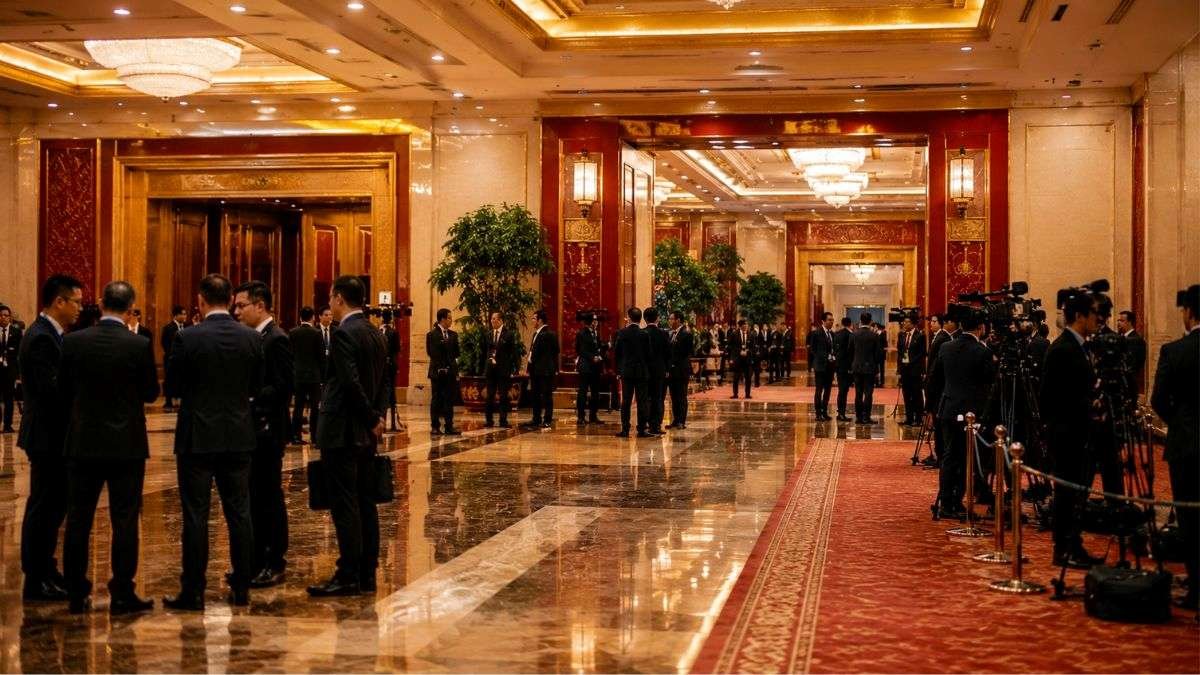
In the space of one week in May 2026, the Great Hall of the People in Beijing hosted two of the most consequential diplomatic encounters of the decade. On 14 and 15 May, United States President Donald Trump and Chinese President Xi Jinping met for their first summit in China since 2017, agreeing on what Xi described as a new vision for building a constructive China-United States relationship of strategic stability.
Days later, Russian President Vladimir Putin arrived at the same venue, telling Xi that not seeing you for one day feels like being apart for three autumns. The symbolism was unmistakable and deliberate.
Three of the world’s most influential military and geopolitical powers conducted their most significant diplomatic interactions of the year in the same building, in the same week, in Beijing — not Washington, not Brussels, not any institution of the Western-designed international order.
The optics were revealing, but the substance was sobering.
The Trump-Xi summit produced no joint communique, no comprehensive trade agreement, no progress on Taiwan, and no joint action on any of the major crises — Iran, Ukraine, the South China Sea — that define the stakes of their competition.
CSIS analysts concluded that the summit revealed how little progress had been made on the most consequential dimensions of US-China competition: AI, cyber operations, export controls, and digital sovereignty.
The East Asia Forum assessed that both sides increasingly recognize that managing competition is preferable to unchecked confrontation. This formulation describes a relationship seeking stability without resolution, coexistence without trust.
This is the defining characteristic of great power competition in 2026. The three major powers are not moving toward war, and they are not moving toward genuine cooperation. They are managing a rivalry whose depth neither side wants to confront and whose consequences neither side can fully control.
As discussed in Strategic and Geopolitical Intelligence: Understanding the New Global Power Balance, the unipolar moment has ended and what follows is not a new stable order but a contested interval in which the rules themselves are being renegotiated. This article examines how that competition is actually working — the mechanisms, the flashpoints, the alliances, and the institutional erosion that together define the global order being built in real time.
The Competition Operates Through Mechanisms That Bypass Traditional Institutions
The great power competition of 2026 is not primarily being waged through the institutions designed to manage it.
Great power vetoes paralyze the United Nations Security Council on every consequential security question.
The World Trade Organization dispute resolution mechanism has been functionally disabled since the United States blocked new Appellate Body appointments.
The G7 and G20 produce communiques that the major parties interpret divergently before the ink dries. The traditional architecture of multilateral governance — built on the assumption that great powers share sufficient interest in managing the international system to accept institutional constraints on their behavior — has proven inadequate for a moment when the powers fundamentally disagree about what the international system should look like.
The competition is instead being waged through mechanisms that the existing institutional architecture was not designed to manage.
Technology controls have become geopolitical weapons: American export restrictions on advanced semiconductors to China, Chinese export controls on critical minerals essential to American defense production, and the progressive decoupling of technology supply chains that had been deeply integrated for three decades.
The military transformation driven by advances in precision strike, autonomous systems, artificial intelligence, and network-centric operations is explored in Military Modernization in the 21st Century: Precision Strike, Autonomy, and Network-Centric Warfare.
Infrastructure investment has become a strategic influence — China’s Belt and Road Initiative has created financial dependencies across more than 140 countries that translate into diplomatic alignment at multilateral forums, while the American response through the Lobito Corridor in Africa, the India-Middle East-Europe Economic Corridor, and the Partnership for Global Infrastructure attempts to offer an alternative without matching China’s deployment speed or capital availability.
Military posturing has replaced formal deterrence communication.
China’s Justice Mission 2025 Taiwan exercises in December 2025 encircling the island with naval and air assets in the most extensive blockade rehearsal in the strait’s history, communicated strategic intent without triggering the formal crisis-management mechanisms that Cold War deterrence relied on.
The US response was an $11 billion arms package to Taiwan in December 2025, with a reported additional $14 billion package under consideration in 2026, communicated counter-intent through transaction rather than treaty. Neither side issued the formal deterrence declarations that would engage the diplomatic mechanisms designed to prevent miscalculation. The competition is conducted at the threshold of formality that allows each side to escalate and respond without triggering the institutional tripwires that might require de-escalation.
The Beijing Summit Defined the Competition’s Current Character
The Trump-Xi summit of May 2026 is the most analytically significant great power diplomatic event of the current period and deserves examination beyond the headlines it generated. What it produced, and what it failed to produce, defines the competition’s character more precisely than any strategic assessment.
What the summit produced: a shared framework described as constructive strategic stability, a formulation that Xi had proposed and that the United States accepted, marking the first time Washington has embraced a Chinese conceptualization of the desired bilateral relationship.
Agreement to hold three additional meetings within the year, including a Xi state visit to the United States in September 2026. A continuation of the October 2025 trade war truce.
A TikTok joint venture finalized in January 2026 — ByteDance retaining a minority stake while a majority-American investor group with Oracle responsible for data security takes control of US operations — cited by both sides as a model for managing technology disputes.
What the summit failed to produce: any progress on Taiwan, which Xi and Trump did not discuss substantively in public formulations.
Any resolution of the most consequential technology disputes — AI governance, export controls on advanced chips, cyber operations, and digital sovereignty standards all remained unresolved. Any joint framework for managing the Iran crisis. Any discussion of Ukraine, which had retreated from the summit agenda despite American efforts to broker a negotiated settlement.
The European Union Institute for Security Studies assessed the summit as tactical stabilization rather than strategic reset — both sides seeking to manage rivalry and preserve fragile trade and technology truces without resolving the underlying structural competition. That assessment is correct. The summit produced what neither side wanted to acknowledge: a managed rivalry without exit, in which the mechanisms of competition continue operating beneath a surface of diplomatic engagement.
The Putin-Xi meeting that followed immediately after the Trump-Xi summit carried different strategic significance.
Putin’s back-to-back scheduling with the Trump visit created what multiple analysts described as the great triangle reversed — the historical dynamic in which the United States sought to prevent China and Russia from aligning has been inverted, with Beijing now hosting both Washington and Moscow in sequence and positioning itself as the indispensable interlocutor for both.
And China, which manages relationships with both Washington and Moscow simultaneously, is a China that can calibrate pressure on either without the commitment costs of formal alignment — strategic flexibility that neither the United States nor Russia currently possesses. China’s position at the center of the great power triangle is one of the most significant structural shifts in international diplomacy in decades.
The Alliance Architectures Are Fracturing and Reforming
The alliance structures through which American power has been projected since the Second World War are under simultaneous strain from within and competition from without. NATO faces the most fundamental credibility challenge in its history from an American administration that has treated the alliance as a burden rather than an asset, demanded financial contributions as a condition of security guarantees, and explicitly prioritized bilateral transactional relationships over collective defense commitments.
President Trump’s renewed focus on controlling Greenland as a geostrategic asset in the Arctic — framed in terms of competition with Russia and China — at the expense of NATO’s institutional cohesion illustrates this transactional reorientation most starkly.
The Indo-Pacific alliance architecture the United States has built — the Quad with India, Japan, and Australia; AUKUS with Australia and the United Kingdom; bilateral defense relationships with South Korea, the Philippines, and others — is more coherent than NATO in some respects because it was built for the specific challenge of Chinese military power projection. But it faces its own coherence problems.
India’s strategic autonomy — examined in detail in India’s Mission Shakti and the ASAT Balance in the Indo-Pacific — prevents the Quad from functioning as a security alliance in the formal sense.
The Philippines’ oscillating posture between American security partnership and Chinese economic engagement creates persistent uncertainty about whether the US-Philippines alliance would hold under the stress of a Taiwan contingency.
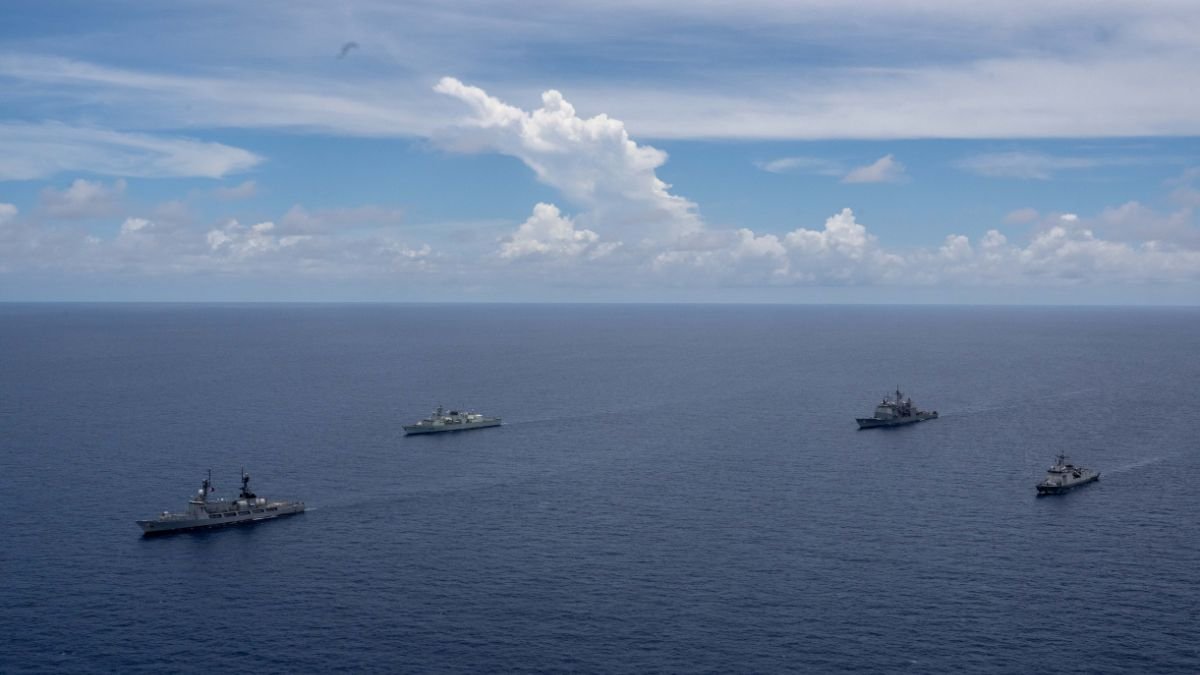
The United States has moved to reduce that uncertainty institutionally: Washington and Manila launched Task Force Philippines in early 2026, a standing joint command specifically built to coordinate deterrence activity in the South China Sea, representing a more concrete operational commitment than the bilateral alliance had previously featured.
Australia’s AUKUS submarine program faces delivery timelines measured in decades, limiting its near-term contribution to deterrence.
China is building its own alternative alliance architecture — not through formal treaty commitments, which Beijing has historically avoided, but through multilateral frameworks that create functional alignment without the institutional constraints of formal alliances.
BRICS expanded to 10 members between 2024 and 2025, with Indonesia and Vietnam as partners.
In January 2026, following the American military intervention in Venezuela that resulted in the capture of President Nicolás Maduro, BRICS countries launched joint naval drills off South Africa with China, Iran, Russia, South Africa, and the UAE sending ships and Brazil, Egypt, Ethiopia, and Indonesia joining as observers — an explicit demonstration of collective military posturing that the grouping had previously avoided.
The European Council on Foreign Relations’ February 2026 policy brief identified the emergence of what it termed an architecture of strategic autonomy among middle powers — states that are actively building capacity to navigate between the major power blocs rather than aligning with either.
Turkey, Saudi Arabia, Indonesia, Vietnam, Brazil, South Africa, and others are simultaneously deepening economic relationships with China, maintaining security relationships with the United States, participating in BRICS frameworks, and preserving diplomatic flexibility. This is not non-alignment in the Cold War sense — it is active hedging that seeks to extract benefits from both sides of the competition while avoiding the costs of choosing.
The Economic Competition Is Reshaping Global Trade Architecture
The economic dimension of great power competition has produced a structural transformation of global trade and investment patterns that is now largely irreversible, regardless of the diplomatic outcomes of individual summits.
The deep economic integration that characterised the three decades after China’s WTO accession in 2001 — in which American and Chinese supply chains were so deeply intertwined that decoupling seemed economically suicidal — has been progressively unwound through a combination of deliberate policy choices and crisis-driven disruptions.
American export controls on advanced semiconductors and chip manufacturing equipment to China, first imposed in October 2022 and tightened through 2024 and 2025, have produced their intended effect of slowing Chinese access to the most advanced computing hardware — while simultaneously accelerating Chinese domestic semiconductor development.
China’s retaliatory export controls on gallium, germanium, graphite, and other critical minerals essential to American defense production have demonstrated that economic interdependence creates vulnerabilities for both sides. The result is not decoupling in the full sense — the two economies remain too deeply intertwined for clean separation — but a progressive bifurcation that creates parallel systems in every domain that matters strategically, from semiconductors to AI to financial infrastructure.
China’s domestic economy faces its own structural challenges that constrain its competitive capacity.
The property sector crisis that began with Evergrande in 2021 has been contained but not resolved — local government debt remains elevated, household wealth tied to property values has declined, and consumer confidence has not recovered to pre-2020 levels.
Youth unemployment reached historically high levels before Chinese authorities revised the publication methodology, highlighting broader structural pressures within the labor market. These domestic constraints do not prevent China from competing strategically — history demonstrates that states can project considerable power internationally even while managing serious domestic economic challenges — but they shape the resource constraints under which Chinese competitive strategy operates.
The war between the United States and Iran, now in its fifth month as of August 2026, has added a further layer to this economic realignment: China has increased its purchases of discounted Russian oil to offset supply disruptions from the Middle East.
Simultaneously reinforcing its leverage over global critical-mineral supply chains and providing Russia with unexpected revenue from an energy market destabilized by a conflict in which Moscow is not even a direct party — a reminder that in 2026, energy, minerals, and trade have become inseparable instruments of the same competition.
The Institutional Erosion and What It Means
The international institutions designed to manage great power competition are all experiencing simultaneous erosion that is partly deliberate and partly inadvertent. Understanding this erosion is essential to understanding why the competition is becoming progressively more dangerous, even as the major powers manage their bilateral relationships with surface-level stability.
The nuclear arms control architecture has effectively collapsed. New START expired in February 2026 with no successor agreement.
Russia suspended its participation before expiry. China has never participated in bilateral nuclear arms control.
The Bulletin of the Atomic Scientists moved the Doomsday Clock to 89 seconds to midnight in January 2026 — the closest to midnight in the clock’s history.
The expiration of New START removes the last treaty limits on the sizes of the major nuclear arsenals, creating conditions for a new nuclear arms race. As explored in Missile Warning Satellites and Early Warning Systems Explained, the satellite infrastructure underpinning nuclear deterrence operates in a threat environment of unprecedented counterspace capability — a combination that has no historical precedent and no established management framework.
The Stimson Center’s Top Ten Global Risks for 2026 identified the collapse of nuclear arms control architecture and the unchecked AI competition as the two most structurally dangerous developments of the current period.
The international humanitarian law framework has been strained by the conflicts in Ukraine, Gaza, Sudan, and the American and Israeli strikes on Iran — each producing credible allegations of violations that the enforcement mechanisms of international law are inadequate to adjudicate.
When the major powers themselves are parties to conflicts in which their conduct is questioned, the deterrence function of international humanitarian law loses credibility.
The technology governance gap is perhaps the most consequential institutional void. Artificial intelligence development is proceeding at a pace that outstrips any existing governance framework.
The AI competition between the United States and China — which the CSIS assessment of the Trump-Xi summit identified as the most consequential unresolved dimension of the bilateral relationship — is occurring without agreed safety standards, without verification mechanisms, and without the kind of strategic stability framework that nuclear arms control, for all its limitations, provided for nuclear weapons.
The military consequences of technological competition in the orbital domain are examined in US Space Force Doctrine vs China’s Space Strategy: Competing Visions of Orbital Power.
Conclusion
Great power competition in 2026 is not a crisis. It is a condition. The major powers are managing their rivalries with sufficient sophistication to avoid direct military conflict while prosecuting those rivalries across every other domain — technology, trade, alliances, institutions, norms, and the physical domains of land, sea, air, space, and cyberspace — with an intensity that the existing international order was not designed to contain.
The Beijing summits of May 2026 illustrated this condition precisely. The great powers can sit at the same table, agree on frameworks for managing their competition, and then continue competing with undiminished intensity in every domain that the framework left unaddressed — which is most of what actually matters. Constructive strategic stability is not stability. It is a label applied to a rivalry that both sides have decided to manage rather than resolve.
The institutional erosion accompanying this competition is the most dangerous long-term development. Institutions do not merely manage crises — they create the shared expectations about consequences that prevent crises from occurring in the first place. As those shared expectations erode, the deterrence they provided erodes with them. The competition is not new.
What makes the current era different is the combination of unprecedented technological capability, the absence of institutional frameworks that previously provided crisis management, and the simultaneous contestation of every domain, including the space domain examined throughout StrikeOrbit‘s orbital warfare cluster, where the legal vacuum described in The Outer Space Treaty and Its Limits in the Age of Orbital Warfare leaves the most consequential military competition without governance.
The question is not whether great powers compete. They always have and always will. The question is whether the mechanisms for managing that competition can be rebuilt fast enough to prevent it from producing the catastrophe that neither side intends, but all are making progressively more likely.
Frequently Asked Questions
What happened at the Trump-Xi Beijing summit in May 2026 and what did it mean strategically?
The Trump-Xi summit of 14 and 15 May 2026 in Beijing produced a shared framework for what Xi described as constructive strategic stability — the first time the United States accepted a Chinese conceptualization of the desired bilateral relationship. Both sides agreed to hold three additional meetings within the year. However, the summit produced no joint communique, no comprehensive trade agreement, no progress on Taiwan, and no resolution of the most consequential technology disputes, including AI governance and export controls. CSIS assessed that the summit revealed how little progress had been made on the core dimensions of US-China competition. The summit represented tactical stabilization rather than strategic resolution — managed rivalry seeking a surface of stability while the underlying competition continues across every domain.
How is China building influence beyond its direct military power?
China is building strategic influence through multiple mechanisms operating below the threshold of formal alliances. The Belt and Road Initiative has created infrastructure and financial dependencies across more than 140 countries, translating into diplomatic alignment. The BRICS grouping, which expanded to ten members between 2024 and 2025, provides a multilateral framework for coordinating with non-Western powers. The Shanghai Cooperation Organization encompasses most of Eurasia’s major economies. The January 2026 BRICS joint naval exercises off South Africa demonstrated that China is also building capacity for collective military posturing beyond its direct bilateral relationships. Most significantly, China’s position as the indispensable interlocutor for both Washington and Moscow gives it strategic flexibility that neither the United States nor Russia currently possesses.
What is the significance of Putin visiting Beijing immediately after Trump in May 2026?
The back-to-back Beijing visits of Trump and Putin — with Xi hosting both in the same week — created what analysts described as the great triangle reversed. The historical strategic dynamic sought by American diplomacy for decades was the opposite: preventing China and Russia from aligning by maintaining better relations with each than they had with each other. In May 2026, Beijing hosted both the American and Russian presidents in sequence, positioning Xi Jinping as the indispensable interlocutor for both sides of the major power competition. A China that manages relationships with both Washington and Moscow simultaneously can calibrate pressure on either without formal alignment commitments — strategic flexibility representing one of the most significant shifts in great power diplomacy in decades.
Why are existing international institutions failing to manage great power competition?
Existing international institutions were designed on the assumption that major powers share sufficient interest in the stability of the international system to accept institutional constraints on their behavior. That assumption has eroded as China and Russia have concluded that the existing system reflects American preferences rather than universal interests, and as the United States under the Trump administration has increasingly treated multilateral institutions as burdens rather than assets. The result is institutional paralysis — the UN Security Council blocked by vetoes, the WTO dispute mechanism disabled, and nuclear arms control architecture collapsed with New START’s expiry in February 2026. The competition is being conducted through mechanisms that existing institutions were not designed to regulate.
What are the greatest risks of current great power competition?
The Bulletin of the Atomic Scientists moved its Doomsday Clock to 89 seconds to midnight in January 2026 — the closest to midnight in the clock’s history — reflecting multiple converging risks. The collapse of nuclear arms control architecture with New START’s expiry removes treaty limits on nuclear arsenals for the first time since the 1970s. The AI competition between the United States and China is proceeding without agreed safety standards or crisis management mechanisms for AI-generated incidents. A larger US-Israeli war against Iran, opened in February 2026 and still ongoing as of August 2026, has introduced new escalation pathways and reshaped global energy and critical-mineral trade in ways that entangle China and Russia even though neither is a direct party to the conflict.
Sources and References
The Soufan Center — State of Play: Great Power Competition in 2026 (January 2026)
Center for Strategic and International Studies (CSIS) — Trump-Xi 2026 Summit Analysis (May 2026)
East Asia Forum — The Xi-Trump Summit Lived Up to Modest Expectations (May 2026)
European Union Institute for Security Studies — Xi and Trump Are Heading for Tactical Stabilization Not a Reset (May 2026)
European Council on Foreign Relations — After the Rupture: Middle Powers and the Construction of New Order (February 2026)
Stimson Center — Top Ten Global Risks for 2026 (February 2026)
Bulletin of the Atomic Scientists — Doomsday Clock Statement (January 2026)
Carnegie Endowment for International Peace — BRICS Expansion and the Future of World Order (March 2025)
International Institute for Strategic Studies (IISS) — The Military Balance (2025)
RAND Corporation — Great Power Competition: Implications for Defense (2024)
Council on Foreign Relations — Media Briefing: Making Sense of the Trump-Xi Summit (June 2026)
Chatham House — The Geopolitics of Technology Competition (2025)
Pressenza — USA, China, and Russia: Three Moves on a Single Chessboard (August 2026)
Related Analysis
For analysis of the strategic and geopolitical intelligence framework within which great power competition operates, read Strategic and Geopolitical Intelligence: Understanding the New Global Power Balance.
For analysis of the space domain where great power competition is most active and least governed, read The Outer Space Treaty and Its Limits in the Age of Orbital Warfare.
For analysis of the missile warning satellite infrastructure on which nuclear deterrence stability in great power competition depends, read Missile Warning Satellites and Early Warning Systems Explained.
For analysis of India’s strategic positioning within the great power competition as an autonomous actor, read India’s Mission Shakti and the ASAT Balance in the Indo-Pacific.
For analysis of the hypersonic weapons that great power competition is driving across multiple arsenals simultaneously, read Hypersonic Weapons and the Emerging Global Strike Balance.
