

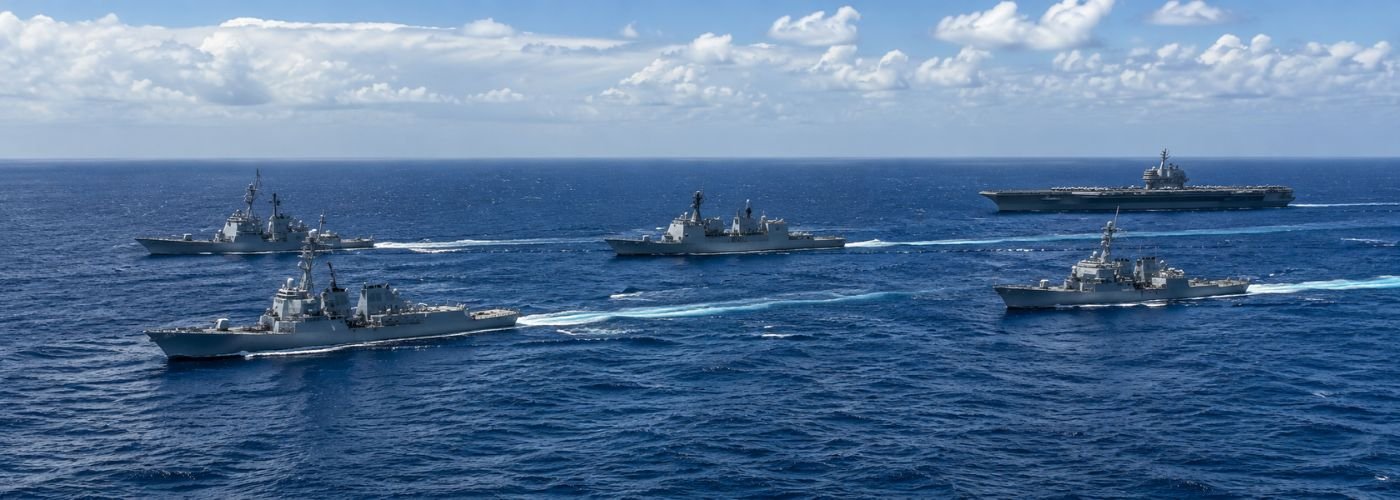

Analysis · StrikeOrbit | 2026
The Indo-Pacific is the most consequential military theatre in the world today. Not because it is currently at war — it is not — but because it contains the highest concentration of military capabilities in competition, the most densely contested maritime geography, and the most significant unresolved flashpoints of any region on Earth.
The Taiwan Strait, the South China Sea, the East China Sea, and the waters of the Korean Peninsula together constitute a zone in which the military decisions made by seven nuclear-armed or near-nuclear states will determine whether the international order of the coming decades is shaped by coercion or constrained by deterrence.
The region also contains some of the world’s most important trade routes, critical semiconductor production capacity, and maritime chokepoints — ensuring that any major conflict here would produce consequences far beyond Asia.
The concentration of economic production, maritime commerce, technological supply chains, and military power within the Indo-Pacific means that regional security can no longer be understood as an Asian issue alone. Decisions taken in this theatre increasingly influence global trade, industrial resilience, energy security, and the wider international balance of power.
The United States 2026 National Defense Strategy, published in January 2026, frames this reality directly. Its commitment to deter China in the Indo-Pacific through strength, not confrontation, explicitly designates Beijing as the pacing challenge — the adversary whose military trajectory defines American force development requirements.
The strategy orders US forces to build, posture, and sustain a strong denial defense along the First Island Chain — the geographic arc running from Japan through Taiwan and the Philippines to Indonesia — as the primary mechanism for preventing Chinese military dominance of the Western Pacific. This strategic logic of deterrence by denial along a geographic barrier is a fundamental shift from the expansive reassurance strategies of the previous decade.
Understanding the Indo-Pacific military balance requires examining not just the capabilities of individual states but the interactions between them — how American forward presence, allied defense investment, Chinese military expansion, and the unresolved political questions that give these military competitions their urgency combine to produce the strategic environment that every actor in the region must navigate.
The military competition unfolding across the Indo-Pacific increasingly extends beyond land, sea, and air into the orbital domain, explored in What Is Orbital Warfare? How Space Became a Contested Military Domain.
As discussedin Great Power Competition and the New Global Order, the US-China competition is the defining strategic contest of the current era. The Indo-Pacific is where that competition has its most immediate military expression.
China’s Military Posture Is Reshaping the Regional Balance
China’s military expansion — examined in depth in China’s Military Modernization: Force Structure, Technology, and Strategic Ambition — has produced a regional military balance that differs fundamentally from that of a decade ago.
This transformation has not simply increased Chinese military capability. It has altered the assumptions upon which regional deterrence, alliance planning, and crisis management were built throughout the post-Cold War period, forcing every regional actor to reassess long-established security strategies.
China’s PLA Eastern and Southern Theatre Commands are now equipped with naval, missile, air, and electronic warfare assets specifically optimised for operations against Taiwan and across the contested maritime zones of the South China Sea and East China Sea.
The geographic concentration of this capability — oriented inward toward the First Island Chain rather than outward toward distant power projection — reflects a deliberate strategic choice to achieve dominance within the first island chain as a precondition for extending influence beyond it.
China’s naval expansion has been the most visible dimension of this shift.
The PLAN now operates the world’s largest navy by hull count, including the Type 055 Renhai-class cruisers that provide the most capable surface air defense in the region outside the US Navy, the Fujian carrier with EMALS catapult systems currently completing sea trials in 2025 and 2026, and a Jin-class ballistic missile submarine force capable of conducting at-sea nuclear deterrent patrols from the South China Sea.
On December 4, 2025, China deployed more than one hundred naval and coast guard vessels across East Asian waters simultaneously — the largest single show of force China has conducted to date — in a demonstration that sent simultaneous signals to Taiwan, Japan, South Korea, and the Philippines about China’s ability to impose presence across multiple maritime zones simultaneously.
The Council on Foreign Relations’ monthly China in the Indo-Pacific tracker documented the December 2025 deployment as the largest single show of force China had conducted to date, extending simultaneously across the South China Sea, western Pacific, and waters near the Senkaku Islands.
China’s missile arsenal provides the most direct military challenge to American power projection.
The DF-21D anti-ship ballistic missile creates a kill zone for American carrier strike groups extending 1,500 kilometres from mainland China — covering the entire Taiwan Strait and most of the South China Sea.
The DF-26, with ranges assessed at 3,000 to 5,000 kilometres, directly threatens Guam — the major American military hub that any Taiwan contingency would depend on for logistics, air support, and command.
The combination of these systems with the hypersonic DF-17 and naval YJ-21 creates a layered precision strike environment in which American forces cannot operate freely at any range inside the second island chain without accepting significant risk from Chinese missile systems.
The broader strategic implications of hypersonic weapons for deterrence, escalation, and global military competition are examined further in Hypersonic Weapons in 2026: The Real Global Strike Balance.
Justice Mission 2025 — the December 2025 exercises that encircled Taiwan with naval and air assets in the most extensive blockade rehearsal in the strait’s history — represented PLA rehearsal of an operational plan, not a demonstration of existing readiness.
The exercises practised preventing external military intervention, cutting communications with the island, and demonstrating the ability to sustain a coercive presence simultaneously across the Taiwan Strait, the South China Sea, and the East China Sea.
Taiwan’s presidential spokesperson noted that Chinese activity during the exercises extended simultaneously into waters near the disputed Japanese-administered Senkaku Islands — indicating that a Taiwan contingency would not be geographically contained to the strait alone.
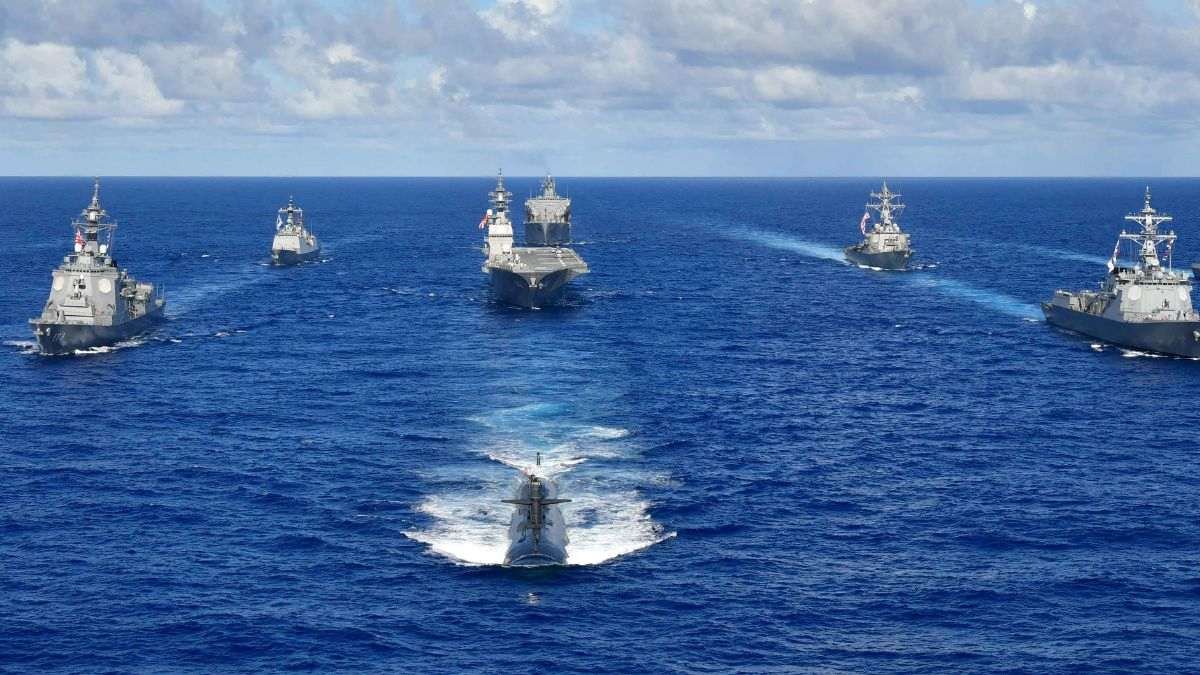
American Military Posture Is Adapting to the Denial Environment
The United States maintains the most capable military force in the Indo-Pacific — approximately 375,000 military and civilian personnel assigned to US Indo-Pacific Command’s area of responsibility, with 53,490 forward-deployed in Japan, 45,528 in Hawaii, 23,642 in South Korea, and 6,986 in Guam as of September 2025.
The Congressional Research Service’s February 2026 Defense Primer on US Indo-Pacific Command provides the authoritative open-source breakdown of American forward military presence, access arrangements, and force posture across the command’s area of responsibility.
The US operates or has access to over 66 military sites across the region, providing a forward posture that no other military can replicate across the theatre’s geographic scale. But the character of American military advantage in the Indo-Pacific is being contested in ways that raw numbers do not capture.
The Chinese anti-access and area-denial architecture — DF-21D, DF-26, DF-17, integrated air defense, submarine operations, and the electronic warfare capabilities examined in Electronic Warfare in Space: Jamming, Spoofing, and Satellite Signal Warfare Explained — creates a threat environment in which American carrier strike groups and air power cannot operate within the first island chain without accepting risk profiles that have no Cold War precedent. American military superiority at the theatre level remains real.
The result is not the disappearance of American military superiority but a narrowing of the operational freedom with which that superiority can be exercised inside China’s expanding anti-access envelope. The distinction is important because it reflects a shift from uncontested access to contested deterrence rather than a simple reversal of military advantage.
American military dominance within the first island chain’s contested zones is no longer assumed.
The Pacific Deterrence Initiative channels billions into infrastructure, readiness, logistics, and resilience of bases west of the International Date Line.
The 2026 NDS emphasis on deterrence by denial — using distributed forces, precision long-range fires, and allied contributions to impose unacceptable costs on Chinese military operations rather than matching Chinese capabilities platform-for-platform — reflects a strategic adaptation to this environment.
The deployment of Marine Littoral Regiments to the Philippines and Japan, the positioning of High Mobility Artillery Rocket Systems across the first island chain, and the development of stand-in forces designed to operate within the Chinese threat envelope represent the operational expression of this doctrinal shift.
Maintaining this distributed force structure depends heavily on resilient command-and-control networks, explored in JADC2 Explained: The US Military’s Joint Command Network.
These changes reflect a wider transformation in modern military doctrine, precision strike, and network-centric operations examined in Military Modernization in the 21st Century: Precision Strike, Autonomy, and Network-Centric Warfare.
The 2026 NDS’s requirement that allies take primary responsibility for their own defense while the United States prioritises China deterrence introduces genuine alliance management tension.
The strategy’s Americans First framing — demanding 5 percent GDP defense spending from allies as a condition of continued engagement — risks exactly the credibility erosion it claims to prevent. If allied governments doubt American willingness to intervene in a Taiwan contingency, the deterrence architecture built on allied contributions is undermined at its foundation.
This tension defines the most consequential management challenge in American Indo-Pacific strategy in 2026.
Japan Has Undergone the Most Significant Military Transformation of Any American Ally
Japan’s military transformation since its December 2022 National Security Strategy is the most significant change in its defense posture since the end of the Second World War.
The decision to acquire strike capabilities, double defense spending to 2 percent of GDP, and develop the legal and doctrinal framework for offensive military operations against adversary missile launch facilities represents a fundamental departure from the exclusively defensive posture that Japan maintained for seven decades.
Japan’s FY2026 main defense budget has reached ¥9.04 trillion — approximately $58 billion — with total security-related spending at roughly ¥10.6 trillion, approximately 1.9 percent of GDP.
The 2 percent threshold, long treated as constitutionally and politically sensitive, has effectively been reached ahead of the original 2027 schedule.
The Takaichi government signalled at the April 2026 LDP convention that constitutional revision is imminent, with a proposal targeted for 2027, which would formally remove the constitutional constraints on Japanese offensive military capability that have defined its security policy since 1947.
Pacific Forum’s May 2026 analysis of Japan’s military normalization identified the China-Taiwan trilemma as the primary structural driver — Japan must simultaneously deter China, prepare for Taiwan contingencies, and hedge against US commitment uncertainty within a compressed timeline of political and constitutional change.
The strategic driver of Japan’s military normalisation is what Pacific Forum analysts describe as a China-Taiwan trilemma: Japan must simultaneously deter China from aggression against Taiwan, prepare for military contingencies involving Taiwan, given Japan’s proximity, and hedge against uncertainty about American commitment, all without provoking the escalation that would make the situation worse.
The acquisition of Tomahawk cruise missiles, the development of an indigenous hypersonic weapon, and the expansion of JSDF interoperability with US forces in the southwest island chain all reflect operational preparation for precisely the Taiwan contingency scenarios that Japanese officials decline to discuss publicly.
In April 2026, Tokyo announced a fundamental overhaul of its defense export rules, easing restrictions that had constrained Japan’s ability to sell military equipment abroad for decades — a shift that both strengthens the industrial base underpinning Japan’s own rearmament and opens new defense-cooperation pathways with partners such as Australia, whose navy selected an upgraded version of Japan’s Mogami-class frigate as its next general-purpose warship.
Japan’s contribution to American deterrence in the Indo-Pacific extends beyond its own forces.
The US-Japan alliance’s combined military posture — with 53,490 American troops forward-deployed in Japan, Japanese basing infrastructure supporting American operations, and growing interoperability between US and JSDF systems — constitutes the most operationally significant bilateral military relationship in the region.
Japan’s willingness to support allied operations in a Taiwan contingency, and the extent of that support, is the single most consequential variable in American deterrence planning for the scenario.
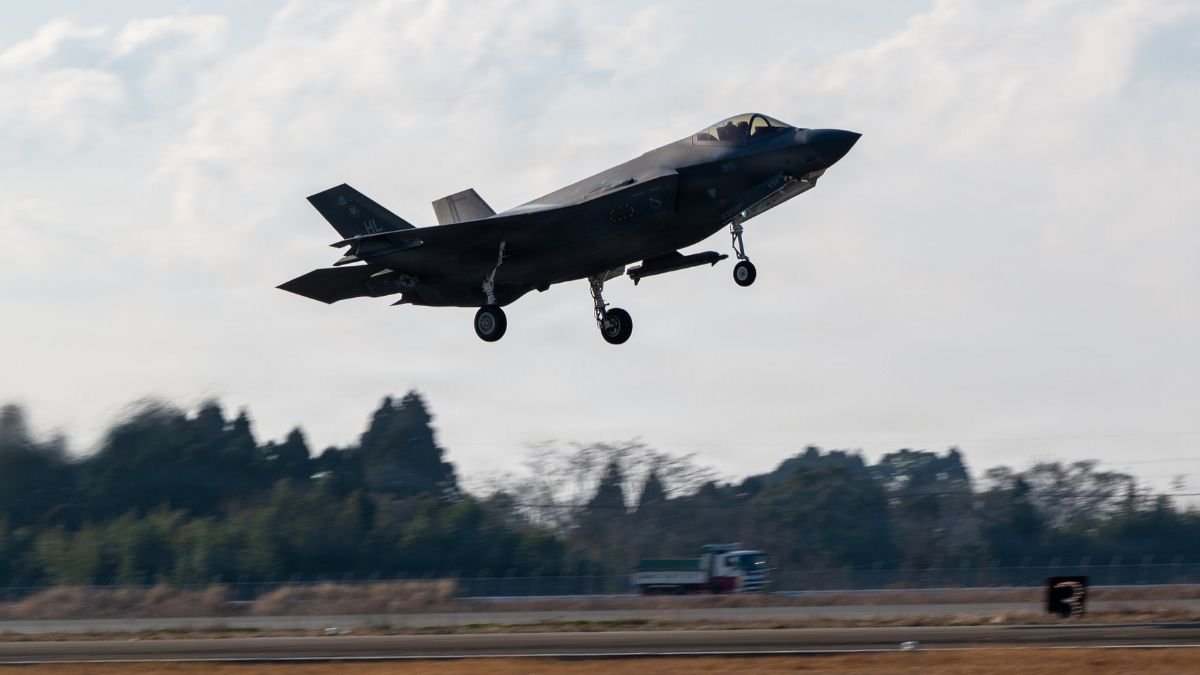
Australia, South Korea, the Philippines, and India Are All Adjusting Postures
The broader Indo-Pacific alliance and partner architecture is undergoing simultaneous adjustment as every regional power recalculates its security requirements in light of China’s military expansion.
Australia’s AUKUS commitment — acquiring nuclear-powered attack submarines through a partnership with the United States and United Kingdom — represents the most strategically significant Australian defense decision in generations.
The submarines will provide Australia with an undersea strike capability that fundamentally changes its ability to contribute to allied deterrence operations across the Indo-Pacific’s maritime spaces. The delivery timeline — with the first Australian-crewed Virginia-class submarine not expected until the early 2030s — creates a near-term capability gap that Australian conventional forces, enhanced US access arrangements, and increased defense spending are designed to partially address.
South Korea faces a distinct strategic challenge from Japan, Australia, or the Philippines — the combination of a nuclear-armed North Korea, 23,642 American troops stationed on its territory, and increasing pressure from both Washington and Beijing to define its position in a potential Taiwan contingency.
South Korea’s announcement of plans to raise its defense budget to 3.5 percent of GDP by 2035, combined with its stated interest in developing indigenous nuclear-powered attack submarines, reflects a security calculus driven primarily by the North Korean nuclear threat.
But the Lee administration’s proposal to transfer wartime operational control from the United States to South Korea introduces complexity into the American-led alliance architecture at a moment when cohesion is strategically critical.
The Philippines has become the most consequential front-line ally in the South China Sea competition. The Marcos administration’s decision to expand American military access, allow US forces to use bases facing Taiwan, and increase defense spending by more than 10 percent for the third consecutive year in 2026 has created the most significant enhancement of American military positioning in the Western Pacific since the Cold War.
The Munich Security Conference’s 2026 report on the Indo-Pacific documented this regional rearmament as the most significant collective defense investment response to a single adversary since NATO’s Cold War build-up — with Japan, South Korea, Taiwan, the Philippines, and Australia all simultaneously increasing defense budgets and deepening alliance commitments.
Balikatan 2026 — the annual Philippines-United States combined military exercise — prompted the PLAN to conduct two major deployments in the South China Sea and West Pacific in direct response, illustrating how the deepening US-Philippines alliance is reshaping Chinese military operational calculus in real time.
India’s position in the Indo-Pacific military balance is unique — a state with the world’s largest population, the fifth-largest economy, and a declared nuclear capability that participates in the Quad security dialogue while maintaining the strategic autonomy examined in India’s Mission Shakti and the ASAT Balance in the Indo-Pacific.
India’s 2020 Galwan Valley border clash with China and the subsequent military standoff along the Line of Actual Control have been the primary drivers of India’s military modernization — ensuring that its bilateral defense relationship with the United States, while deepening, remains subordinate to its own strategic assessment rather than American coalition management preferences.
Japan and the Philippines deepened their own bilateral security relationship further in late May 2026, announcing a joint initiative to formally negotiate the maritime boundary of their overlapping exclusive economic zones — a move Beijing answered with a mixture of coercive signaling and legal argumentation, according to regional defense reporting, illustrating how China now treats even bilateral boundary diplomacy between two of its neighbors as something to actively contest rather than ignore.
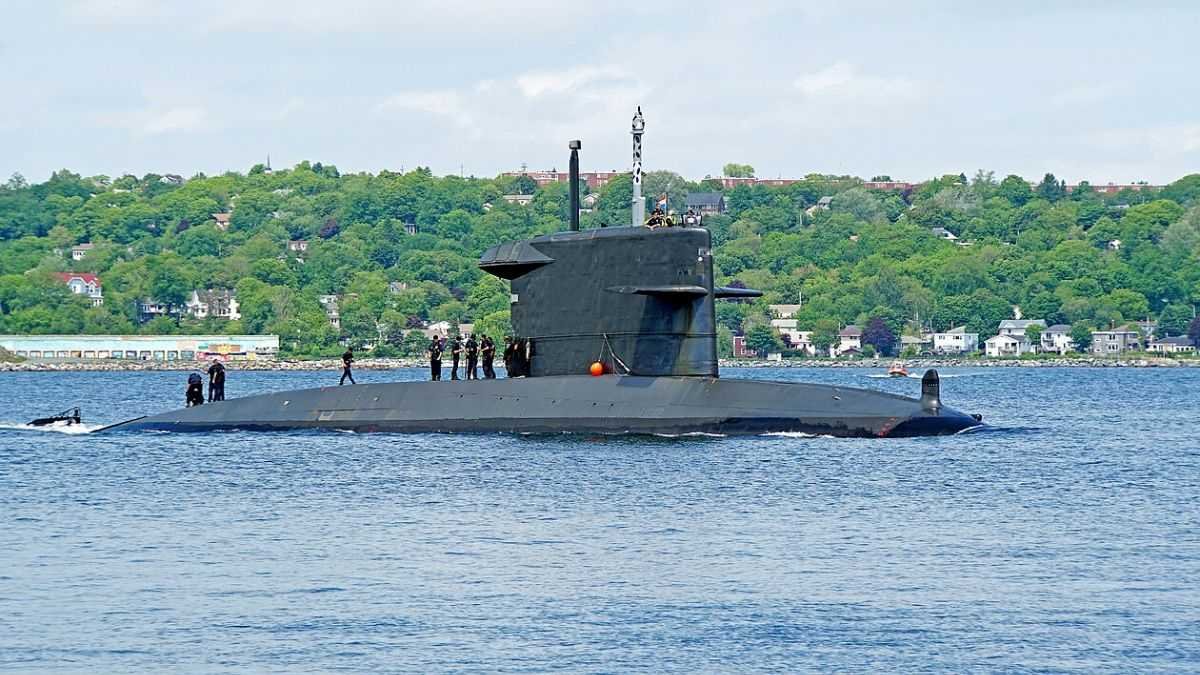
Taiwan Is the Central Flashpoint
Taiwan is simultaneously the most strategically consequential flashpoint in the Indo-Pacific and the most deliberately ambiguous element of American strategic communication.
The United States maintains strategic ambiguity about whether it would intervene militarily in a Chinese attack on Taiwan — neither confirming nor denying the commitment — while providing substantial military support through arms sales, training, and intelligence sharing.
The December 2025 $11.1 billion arms package approved by the Trump administration, the ongoing $40 billion special defense budget debate in Taiwan’s legislature, and Admiral Paparo’s May 2025 assessment that China’s chances of prevailing in a conflict were improving reflect the simultaneous reality of sustained American commitment and genuine concern about the trajectory.
The American Enterprise Institute’s China-Taiwan Update for May 2026 documented that the PLAN conducted two major deployments in the South China Sea and West Pacific in direct response to Balikatan 2026 exercises, confirming that the deepening US-Philippines alliance is reshaping Chinese military operational calculus in real time.
Taiwan’s own defense investment reflects an acute assessment of its vulnerability. Taiwan Semiconductor Manufacturing Company’s dominance of advanced chip manufacturing — producing over 90 percent of the world’s most advanced chips — creates an economic deterrence dimension that extends the Taiwan question well beyond the military balance.
A Chinese military action that disrupted TSMC production would trigger a global economic shock of unprecedented severity, creating a deterrence dynamic that supplements but cannot substitute for military deterrence.
The Taiwan military balance involves asymmetries that neither side fully resolves through investment.
China possesses the geographic proximity, missile strike depth, and naval mass to impose enormous costs on any defense of the island.
Taiwan, the United States, and Japan together possess the precision strike, undersea, air, and space capabilities to impose unacceptable costs on a Chinese invasion force.
Neither side has a clean military solution. The deterrence operates through mutual cost imposition — neither side is confident of winning quickly enough to prevent the costs of conflict from being catastrophic. That mutual uncertainty is the foundation on which stability rests in the absence of an agreed political resolution.
The Balance Will Be Decided by Factors That Military Capability Alone Cannot Resolve
The Indo-Pacific military balance in 2026 is not determined by any single capability comparison. It is determined by the interaction of military posture, alliance cohesion, political will, economic coercion, strategic communication, and the shared expectations about costs that constitute deterrence.
China’s military modernisation has made the balance more competitive. American adaptation, allied investment, and the deepening of regional security partnerships have partially offset that shift. Neither side has achieved the decisive advantage that would make military action rational.
What makes the current balance genuinely unstable is not the military balance itself but the political questions it serves. Taiwan’s political status is unresolved and cannot be permanently resolved by military deterrence alone.
The South China Sea’s maritime boundaries are contested across multiple bilateral relationships without an agreed legal resolution. North Korea’s nuclear programme continues to advance outside any arms control framework.
The question of Japanese constitutional revision, South Korean strategic autonomy, and Philippine alliance durability all introduce variables that military capability inventories cannot capture.
The Indo-Pacific military balance will not be decided by who builds the most missiles, deploys the most ships, or fields the most advanced fighter aircraft. It will be decided by whether the combination of military deterrence and political management is sufficient to prevent the unresolved political questions from triggering the military conflict that every actor in the region knows would be catastrophic for all of them.
The Indo-Pacific has therefore become more than a regional security theatre. It increasingly functions as the principal testing ground for twenty-first-century deterrence, alliance cohesion, military technology, economic resilience, and geopolitical competition. The strategic lessons emerging from this region are already influencing defense planning well beyond Asia.
Conclusion
The Indo-Pacific military balance in 2026 represents the most consequential strategic competition in the world — a region in which the trajectory of Chinese military expansion, American strategic adaptation, allied defense investment, and unresolved political flashpoints are all moving simultaneously and in ways that interact unpredictably.
China’s military has become a genuine peer competitor within the first island chain. The American-led alliance architecture remains more capable than any adversary coalition but faces credibility challenges that capability alone cannot resolve.
Many of the alliance adaptation challenges examined in the Indo-Pacific are mirrored in Europe, where The Future of NATO: Adaptation, Deterrence, and Alliance Transformation explores how military alliances are evolving to meet twenty-first-century strategic competition.
The military dimension of this balance is inseparable from the space and technology competition examined throughout StrikeOrbit’s analysis. The satellite communications that JADC2 depends on, the hypersonic missiles that compress Indo-Pacific strike timelines, the ASAT capabilities that can degrade the space infrastructure underpinning allied operations, the electronic warfare competition over GPS and satellite communications — all of these are not separate from the Indo-Pacific military balance. They are its infrastructure.
Deterrence in the Indo-Pacific is not a static condition to be maintained. It is a dynamic equilibrium being renegotiated daily through military deployments, political signals, economic pressure, and technological competition.
The stability of that equilibrium — and whether it holds long enough for the political questions to find resolution — is the most consequential strategic question of the current decade.
Frequently Asked Questions
What is the current state of the Indo-Pacific military balance between the US and China?
The Indo-Pacific military balance in 2026 is more competitive than at any point since the end of the Cold War. China’s PLA has become a genuine peer competitor within the first island chain, with anti-ship ballistic missiles threatening American carrier strike groups at ranges exceeding 1,500 kilometres, the world’s largest navy by hull count, and missile systems capable of reaching Guam. The United States maintains overall theatre superiority with 375,000 personnel assigned to Indo-Pacific Command, over 66 military access sites, and advanced air, undersea, and space capabilities. However American military dominance within the first island chain’s most contested zones is no longer assumed — China’s anti-access capabilities have created a threat environment with no Cold War precedent.
Why is Japan’s military transformation strategically significant?
Japan has undergone the most significant military transformation of any American ally in generations. Since its December 2022 National Security Strategy, Japan has committed to doubling defense spending to 2 percent of GDP — with FY2026 spending reaching approximately $58 billion — acquiring offensive strike capabilities including Tomahawk cruise missiles, and developing the legal framework for operations against adversary launch facilities. The Takaichi government signalled at the April 2026 LDP convention that constitutional revision is imminent for 2027. This transformation is driven by the China-Taiwan trilemma: Japan must simultaneously deter China, prepare for Taiwan contingencies, and hedge against US commitment uncertainty — all without provoking escalation.
What is AUKUS and why does it matter for the Indo-Pacific balance?
AUKUS is a trilateral security partnership between Australia, the United Kingdom, and the United States announced in September 2021. Its most strategically significant component is Australia’s acquisition of nuclear-powered attack submarines through American and British technology transfer and collaboration. Nuclear-powered submarines provide capabilities — range, endurance, stealth, and strike — that conventional submarines cannot match, giving Australia the ability to contribute to deterrence operations across the broader Indo-Pacific rather than only in its immediate maritime approaches. The delivery timeline extends to the early 2030s, creating a near-term capability gap, but AUKUS represents the most consequential enhancement of Australian military capability and the most significant deepening of the Indo-Pacific alliance architecture since the Cold War.
How does Taiwan fit into the Indo-Pacific military balance?
Taiwan is the central flashpoint of the Indo-Pacific military balance. China regards Taiwan’s reunification as a core national interest and has not renounced the use of force. The United States maintains strategic ambiguity about military intervention while providing substantial arms and support. Taiwan Semiconductor Manufacturing Company produces over 90 percent of the world’s most advanced chips, creating an economic deterrence dimension that extends the Taiwan question beyond military balance alone. China’s Justice Mission 2025 exercises in December 2025 rehearsed a full blockade scenario. Neither side has a clean military solution — China can impose enormous costs on any defense of the island, while Taiwan, the US, and Japan together can impose unacceptable costs on a Chinese invasion. Mutual cost imposition is the foundation of current stability.
How are regional allies responding to China’s military expansion?
Regional allies are responding with the most sustained defense investment in the post-Cold War era. Japan has effectively reached 2 percent of GDP in defense spending ahead of schedule and is pursuing constitutional revision for 2027. South Korea is planning to raise its defense budget to 3.5 percent of GDP by 2035 and is developing indigenous nuclear-powered submarines. Taiwan’s legislature debated a $40 billion special defense budget in 2026. The Philippines has increased defense spending by more than 10 percent for three consecutive years and expanded American military access significantly. Australia is committed to the AUKUS submarine acquisition. The Munich Security Conference’s 2026 Indo-Pacific report documented this regional rearmament as the most significant collective defense investment response to a single adversary since NATO’s Cold War build-up. Japan eased decades-old restrictions on defense exports in April 2026, and Tokyo and Manila opened formal talks on their overlapping maritime boundary in May 2026, both signs of an alliance architecture deepening in ways that go beyond simple budget increases.
Sources and References
US Department of Defense — 2026 National Defense Strategy (January 2026)
Council on Foreign Relations — China in the Indo-Pacific: December 2025 (April 2026)
AEI China Taiwan Update — May 1, 2026 (May 2026)
Pacific Forum — Rearming Japan: Ambition, Constraints, and Limits (May 2026)
Munich Security Conference — Munich Security Report 2026: Indo-Pacific (February 2026)
Congressional Research Service — Defense Primer: US Indo-Pacific Command (February 2026)
International Institute for Strategic Studies (IISS) — The Military Balance (2025)
Center for Strategic and International Studies (CSIS) — Pacific Forum Indo-Pacific Security Assessment (2025)
RAND Corporation — The Indo-Pacific Military Balance: Implications for US Strategy (2025)
Lowy Institute — Asia Power Index (2025)
Australian Strategic Policy Institute (ASPI) — Indo-Pacific Military Trends (2025)
Carnegie Endowment for International Peace — Taiwan Strait Military Balance Assessment (2025)
IISS — Japan and Australia in the Indo-Pacific (April 2026)
Indo-Pacific Defense FORUM — Japan, Philippines Move to Delimit Maritime Boundary; China Responds with Coercion, Lawfare (July 2026)
Related Analysis
For analysis of China’s military modernization programme that is driving the Indo-Pacific balance shift described in this article, read China’s Military Modernization: Force Structure, Technology, and Strategic Ambition.
For analysis of the great power competition framework within which the Indo-Pacific military balance operates, read Great Power Competition and the New Global Order.
For analysis of India’s strategic positioning within the Indo-Pacific balance as an autonomous actor, read India’s Mission Shakti and the ASAT Balance in the Indo-Pacific.
For analysis of the electronic warfare dimension of Indo-Pacific military competition, read Electronic Warfare in Space: Jamming, Spoofing, and Satellite Signal Warfare Explained.
For analysis of the hypersonic weapons reshaping Indo-Pacific strike timelines, read Hypersonic Weapons and the Emerging Global Strike Balance.
