



Analysis · StrikeOrbit | 2026
On 19 May 2026, Lithuania’s capital came to a standstill. A drone forced Vilnius into shelters, shut down its airport, and cleared parliament — the first such alert in the city since 2022. The drone was not Russian. It was Ukrainian, bound for a Russian target, and it had been deliberately steered off course by Russian electronic warfare systems operating from Kaliningrad.
Days later, a Russian drone struck an apartment block in Galați, Romania, wounding two civilians — likely the first casualties on NATO soil since the invasion began. Lithuania’s defense minister called it the new reality of what the Baltic states face. He was not exaggerating.
The electromagnetic spectrum, invisible and largely unregulated, has become a battlespace in which a war between two countries now routinely produces casualties and crises in nations that are not parties to it.
This is not collateral damage in the conventional sense. It is the direct, predictable consequence of a category of warfare that most people cannot see and most governments are only now beginning to organize around.
Electronic warfare — the contest for control of the electromagnetic spectrum through jamming, spoofing, deception, and signals exploitation — has moved from a supporting capability to what multiple militaries now describe as a core pillar of modern conflict.
Three years of full-scale war in Ukraine have produced the most intensive, continuously evolving electronic warfare environment in the history of armed conflict, and its effects are no longer confined to the battlefield that produced them.
As analyzed in Electronic Warfare in Space: Jamming, Spoofing, and Satellite Signal Warfare Explained, the orbital dimension of this contest already threatens the satellite infrastructure underpinning modern military operations.
This article examines the broader electromagnetic battlespace — the terrestrial, airborne, and naval dimensions of a contest that is reshaping how militaries fight, how they are organized, and how civilians far from any declared war now find themselves exposed to its effects.
The Electromagnetic Spectrum Has Become a Contested Domain in Its Own Right
For most of military history, the electromagnetic spectrum was infrastructure — the invisible medium through which radar saw, radios spoke, and navigation systems located. It was not itself a battlespace to be fought over, denied, or dominated. That assumption has collapsed.
Modern militaries increasingly treat the electromagnetic spectrum as a dimension equal to terrain, airspace, or the maritime domain — one that can be controlled, denied, contested, and lost, with direct consequences for every other domain of warfare that depends on it.
This conceptual shift is more significant than a change in terminology. It reflects the recognition that military success increasingly depends not only on controlling physical terrain but also on controlling the invisible information pathways that connect modern sensors, decision-makers, and precision weapons into a functioning combat system.
The reason is structural. Precision strike, networked command and control, GPS-guided munitions, drone operations, satellite communications, and air defense radar all depend on reliable, undisrupted access to specific bands of the electromagnetic spectrum.
Electronic warfare has become equally important for enabling and disrupting the precision-strike systems examined in Hypersonic Weapons in 2026: The Real Global Strike Balance.
These interconnected capabilities form the foundation of modern military operations, explored in Military Modernization in the 21st Century: Precision Strike, Autonomy, and Network-Centric Warfare, where precision strike and network-centric doctrine are examined in greater detail.
A force that loses spectrum access does not merely lose one capability — it loses the connective tissue that makes its other capabilities function as an integrated system. This is precisely why electronic warfare has become so consequential in Ukraine: it does not need to destroy a drone, a radio, or a guided munition to defeat it. It only needs to corrupt the signal that the system depends on, and the weapon defeats itself.
Modern command-and-control architectures such as the US military’s Joint All-Domain Command and Control concept depend on exactly this type of resilient connectivity, discussed in JADC2 Explained: The US Military’s Joint Command Network.
Electronic warfare divides into three core functions, and understanding the distinction matters for understanding how the contest actually unfolds.
Electronic attack — commonly understood as jamming — overwhelms a receiver with noise until it can no longer extract a usable signal, the electromagnetic equivalent of shouting over a conversation until it cannot be heard.
Electronic support involves sensing the environment for adversary signals, the listening and detection function that identifies what an enemy is transmitting and where. Electronic protection guards friendly systems against exactly these same techniques being used against them.
A military force capable of all three simultaneously possesses what doctrine calls electromagnetic spectrum dominance — the ability to use the spectrum freely while denying that same freedom to an adversary. No military currently possesses this dominance uncontested. What exists instead, as Ukraine has demonstrated for three years running, is a continuous, adaptive contest in which advantage shifts in days rather than years.
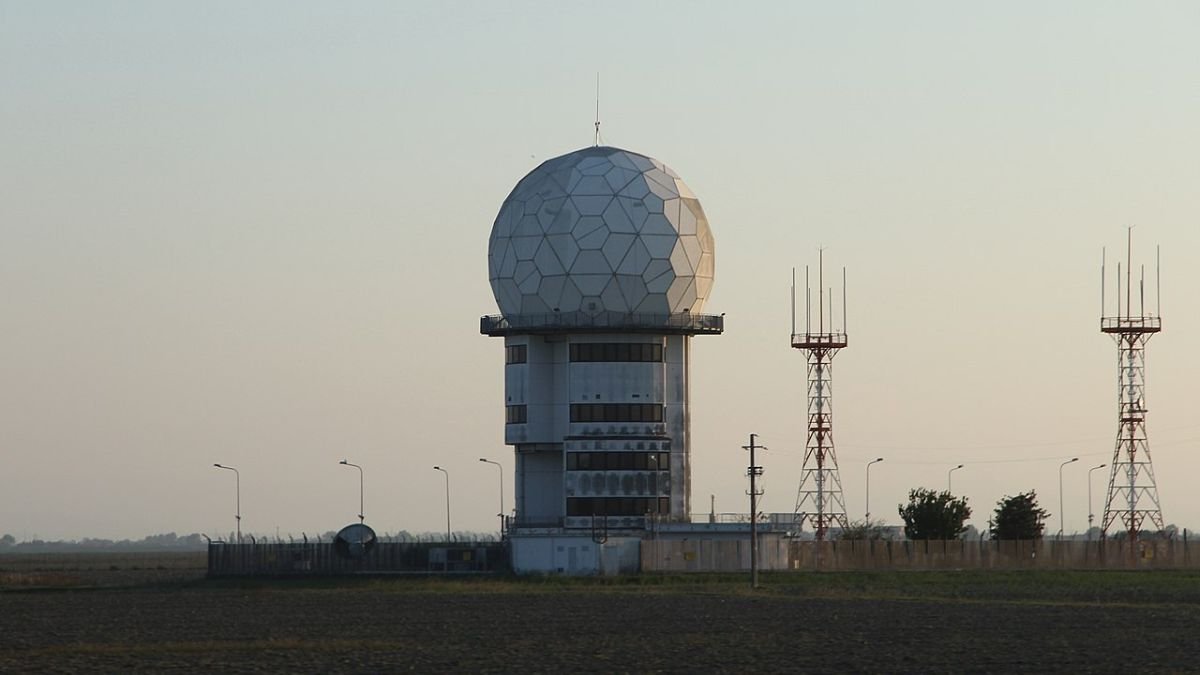
Ukraine Has Become the Most Intensive Electronic Warfare Laboratory in History
Russia entered its full-scale invasion of Ukraine in February 2022 with more tactical electronic warfare capability than any military had deployed in decades — purpose-built, layered systems designed to create overlapping zones of electromagnetic denial across the entire front.
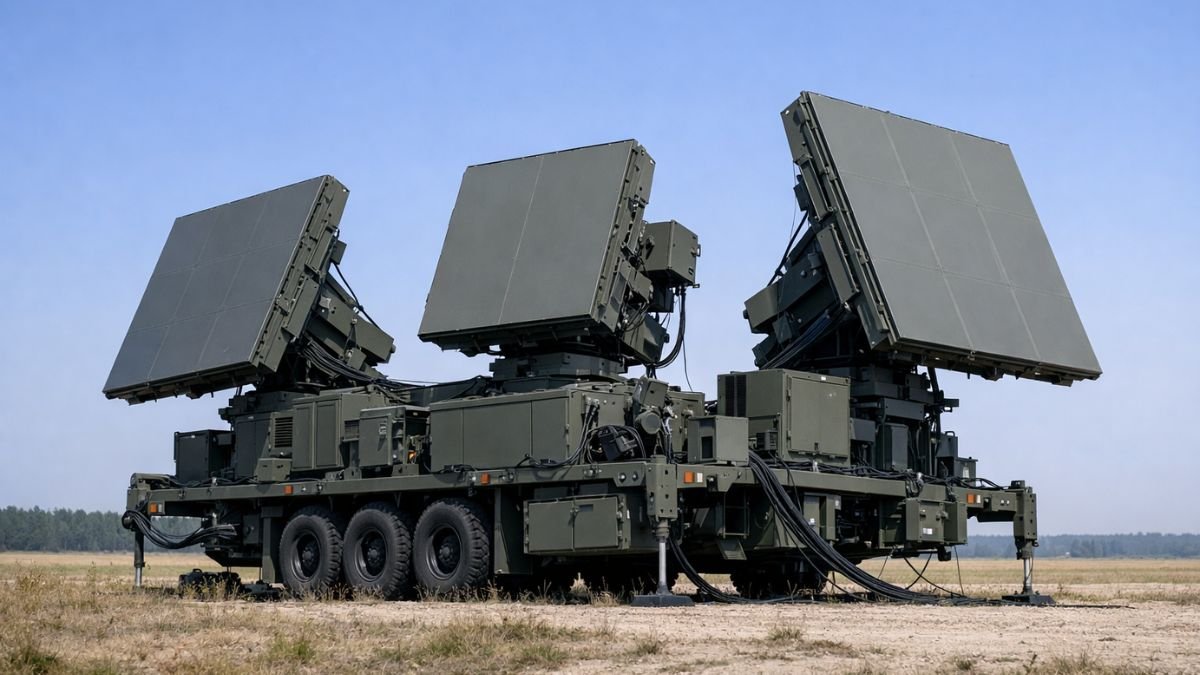
The Krasukha-4, mounted on a heavy truck chassis, is among the most capable of these systems, a broadband jammer operating across the frequency bands used by airborne radar and satellite communications, reportedly capable of affecting signals as far as low Earth orbit.
For a period in 2024, the drone advantage that had defined Ukraine’s war effort was being systematically degraded — GPS signals vanished, drone video feeds dissolved into static, and precision-guided munitions drifted off course by hundreds of meters under the densest electromagnetic denial environment any military had encountered.
Ukraine’s response did not attempt to out-power Russian jamming with stronger signals. It eliminated the vulnerability.
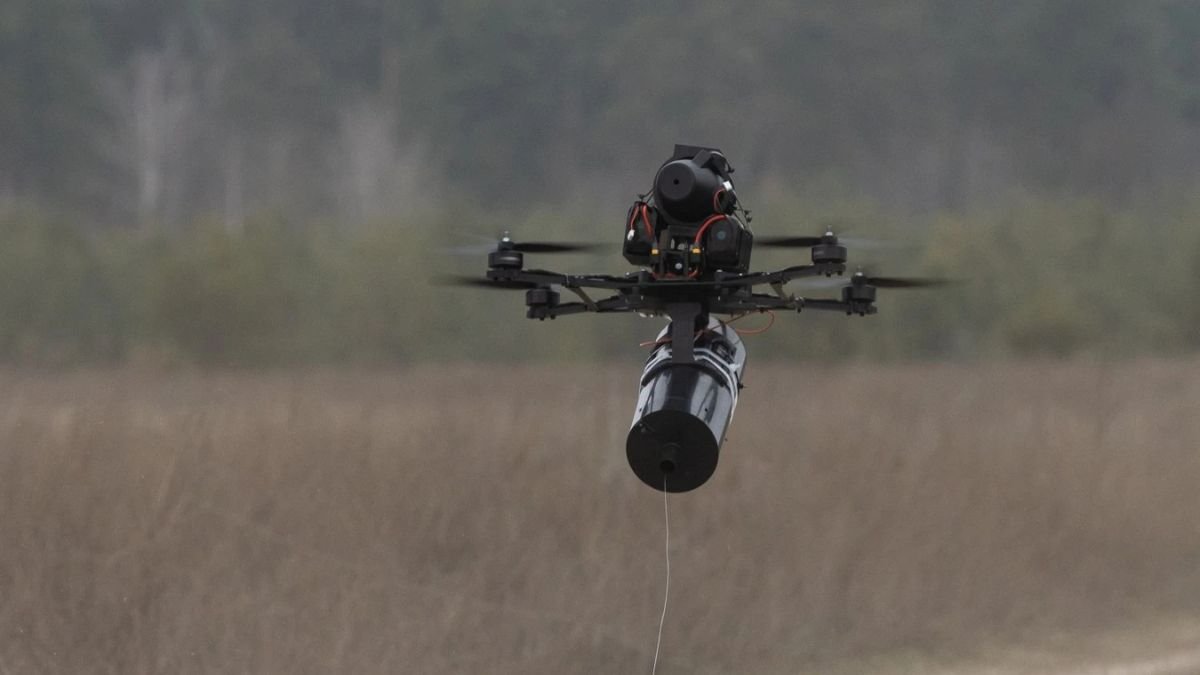
Fibre-optic guided drones — carrying a spool of hair-thin optical fibre that unspools behind the aircraft as it flies, transmitting control signals and video as pulses of light rather than radio waves — fly through the densest jamming environment on earth as though it does not exist.
There is no radio frequency for an electronic warfare system to detect, jam, or spoof.
The concept itself was not new — fibre-optic guidance has equipped anti-tank missiles since the 1980s — but applying it to mass-produced, low-cost first-person-view drones changed the equation entirely.
A fibre-optic spool adds less than $100 to a drone that already costs a few hundred dollars, in exchange for complete immunity to radio-frequency jamming, at the cost of range currently limited to roughly 10 to 20 kilometers by the physical length of fibre a small aircraft can carry.
Ukraine’s indigenous radio control systems — adaptations of civilian frequency-hopping protocols paired with custom firmware — have proven remarkably resistant even where fibre-optic links are not practical, providing real-time jamming diagnostics, dynamic frequency reconfiguration, and automatic channel switching built on low-cost commercial components.
Notably, Russian electronic warfare has proven far more effective at broadband noise jamming than at the more sophisticated technique of systematic spoofing against these adaptive systems — meaning brute-force denial has not broken Ukraine’s small-drone ecosystem even as more targeted deception techniques have proven harder to counter elsewhere.
The lesson driving Ukrainian doctrine is unambiguous: the side that adapts fastest, not the side with the most expensive equipment, maintains the advantage in a contest that resets in days rather than years.
The rapid evolution of autonomous and semi-autonomous drone systems operating within contested electromagnetic environments is explored further in Autonomous Weapons and the Ethics of Lethal Autonomy.
GPS Spoofing Has Become a Weapon That Crosses Borders Without Crossing Them
The most strategically dangerous evolution of this contest is the deliberate use of GPS spoofing to redirect an adversary’s own weapons against third parties — a technique that has transformed a bilateral war into a source of repeated crisis for NATO member states that are not party to it.
Spoofing differs fundamentally from jamming. Where jamming overwhelms a receiver with noise until it cannot fix a position, spoofing transmits a stronger, counterfeit signal that the receiver accepts as genuine, feeding the target system a false location it has no means of independently verifying.
Russian electronic warfare units operating from Kaliningrad — Russia’s heavily militarised exclave wedged between Poland and Lithuania — have been identified as the source of systematic GPS spoofing that steers Ukrainian long-range strike drones off their intended routes and toward Baltic and Finnish airspace.
Defense News documented the May 2026 Vilnius crisis in detail, confirming that Lithuanian officials directly attributed the drone’s diversion to deliberate Russian electronic warfare rather than navigational error.
The drones most exposed are Ukraine’s long-range models bound for Russian oil-export terminals on the Gulf of Finland, whose routes hug the Baltic coastline where Russian electromagnetic density is greatest.
When such a drone loses its true position fix, it drifts into the airspace of NATO member states — and Russia, rather than disputing the pattern, has used the resulting incursions as a propaganda tool, framing the Baltic states as complicit in Ukrainian attacks despite Ukraine’s insistence that all of its targets lie inside Russian territory.
The disruption extends well beyond military drones.
The same Kaliningrad-based systems have created persistent navigation problems across civilian aviation and maritime traffic throughout the Baltic Sea — and in September 2025, the aircraft carrying European Commission President Ursula von der Leyen had its satellite navigation jammed during approach for landing in Bulgaria.
The European Union has since moved to sanction the unit directly responsible: the 841st Separate Electronic Warfare Center, along with two of its senior officers, was added to the EU’s sanctions list for its role in jamming and spoofing GNSS signals across the Baltic region — one of the first instances of the bloc formally sanctioning a specific named military electronic warfare unit rather than responding to Russian jamming only through statements and diplomatic protest.
A British military aircraft carrying the UK Defense Secretary was struck by Russian electronic interference during a flight from Estonia, with GPS disabled for the entire three-hour journey. These are not isolated incidents.
Independent reporting has documented dozens of GPS interference events across Europe tied to Russian jamming since the invasion began, and the pattern accelerates whenever Ukrainian drones move toward Russian targets.
The escalation has begun producing the first allied casualties of the conflict on NATO soil, and the European defense industry is racing to respond — Lithuanian firm Tactical Photonics unveiled a precision laser-targeting payload at the Eurosatory exhibition in 2026 specifically because laser designation, unlike GPS and radio-link guidance, requires no satellite signal that jamming or spoofing can corrupt.
The trend has continued to intensify through 2026. A long-term monitoring station on the Danish island of Bornholm recorded 30 separate jamming and spoofing incidents in 2026 alone, compared with 16 across all of 2025 and just 11 in 2024, and individual incidents have grown longer as well as more frequent.
On 29 July 2026, a large section of the Baltic Sea lost reliable satellite navigation for an entire day, with at least one commercial vessel’s GPS showing it inside Russian territorial waters at Kaliningrad while it was in fact sailing openly off the Polish coast near Gdańsk.

Major Militaries Are Rebuilding Electronic Warfare Capability After Decades of Neglect
The United States Army’s experience in Ukraine, observed both directly and through intelligence sharing, has driven the most significant restructuring of American electronic warfare capability since the Cold War.
The Army divested much of its tactical EW capability after the Soviet collapse, on the assumption that electromagnetic dominance was a permanent American advantage that required no sustained investment. That assumption has been abandoned.
In March 2025, the Army published a comprehensive EW Strategy designed to institutionalize enduring electronic warfare capabilities across the force in support of joint operations, and the fiscal year 2026 budget request reflects that strategic reversal directly.
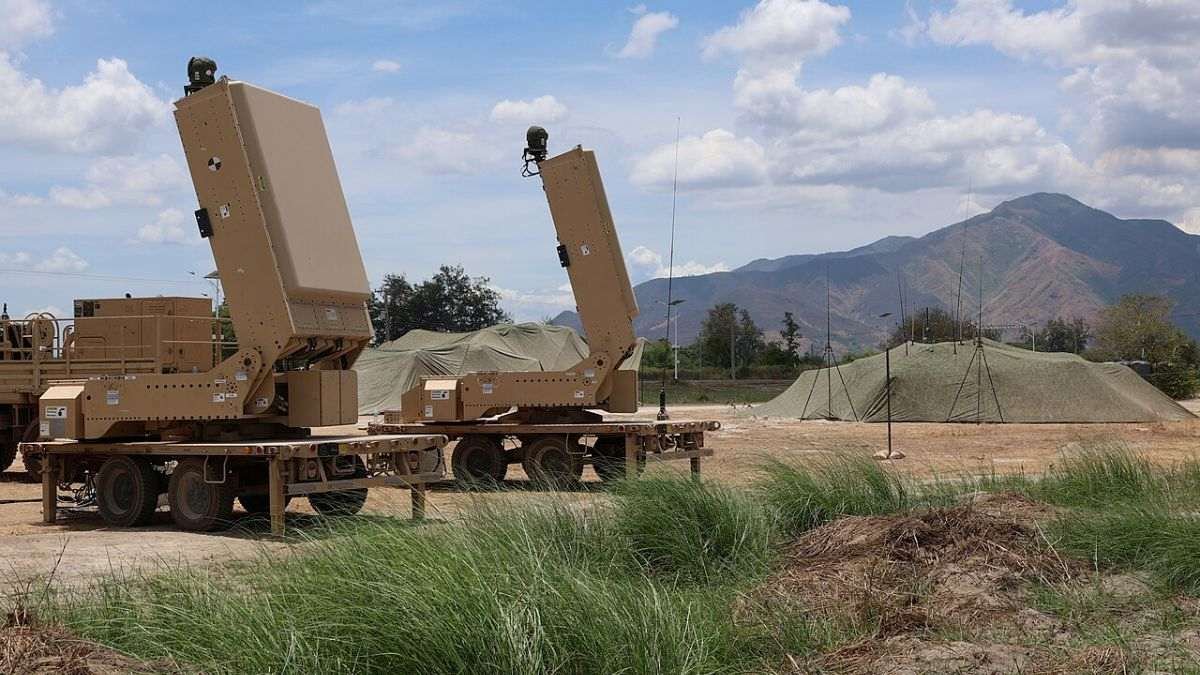
The Terrestrial Layer System program is being fielded as the primary electronic warfare and signals intelligence system for Brigade Combat Teams, with full fielding targeted for fiscal year 2028, following a rapid prototyping effort that yielded insights into lightweight, modular architectures now informing the transition to a manpack configuration carried directly by soldiers.
The Multifunction Electronic Warfare-Air Large program has shifted toward leveraging commercial and government off-the-shelf components to deliver incremental capability faster.
Army officials have been candid that years of ground-up development under traditional acquisition processes produced systems that frequently failed to meet requirements by the time they were finally fielded. The new approach explicitly accepts fielding something less than fully capable now, rather than a fully capable system fielded too late to matter.
A new Modular Electromagnetic Spectrum System effort, requesting $9.1 million in fiscal year 2026 research funding, is designed to provide force protection through what the Army terms radio frequency technical effects — its own classified countermeasure suite for protecting friendly systems and units from adversary jamming during manoeuvre.
The acquisition reform driving these changes reflects an institutional admission rather than a routine modernisation cycle.
A January 2026 memo on Army electromagnetic spectrum operations concept of operations stated plainly that the Army cannot sense, locate, attack, and protect across the electromagnetic spectrum — a consequence of capabilities historically spread across different warfighting functions rather than designed as the cohesive, modular, and scalable technology base that current threats demand.
AFCEA International reported that Army leadership has begun describing electromagnetic warfare as a core competency at the highest levels of the service, a marked shift from its post-Cold War treatment as a niche specialist function.
Military officials have been explicit that in the dynamic environment Ukraine has demonstrated, the electronic warfare contest unfolds in days and hours rather than the weeks and months that characterized Cold War-era jamming competitions — and an acquisition system built for multi-year development cycles cannot keep pace with an adversary capability that can be reconfigured overnight.
Directed Energy and High-Power Microwave Systems Are Entering the Electronic Warfare Arsenal
Beyond jamming and spoofing, a newer category of electromagnetic capability has moved from experimental to operationally relevant: high-power microwave systems capable of disabling electronic systems over wide areas through energy effects rather than signal deception.
The Leonidas system, developed by the American company Epirus, emits a microwave beam capable of disabling electronics across a wide footprint — a capability assessed as effective against drone swarms, sensors, and even small ground or maritime vehicles, representing a categorically different counter-drone tool than the kinetic interceptors and jamming systems that have dominated counter-unmanned aircraft system development to date.
The strategic logic driving interest in directed energy and high-power microwave systems is economic as much as technical.
The drone swarms increasingly characteristic of modern conflict — dozens or hundreds of low-cost unmanned systems launched simultaneously — cannot be cost-effectively defeated by interceptor missiles costing many times more than the targets they destroy.
A high-power microwave system that can disable multiple drones simultaneously across a wide area, drawing on electrical power rather than consuming expendable munitions, offers a cost curve that favors the defender rather than the attacker for the first time in the drone era.
This shift in the cost-exchange ratio of counter-drone defense is one of the most consequential developments in electronic warfare’s evolution, because it addresses the central economic vulnerability that has made cheap drone proliferation so destabilising to conventional force structures.
Although these systems remain relatively specialized today, their long-term significance lies in their potential to change the economics of defense. If directed-energy systems continue to mature, future military planners may evaluate defensive capacity not only by interceptor inventories but also by available electrical power, energy storage, and sustained system endurance.
China’s Electronic Warfare Development Reflects Its Broader Military-Civil Fusion Strategy
China’s electronic warfare modernisation follows the same institutional logic examined in China’s Military Modernization: Force Structure, Technology, and Strategic Ambition — systematic integration of civilian technology development into military capability through Military-Civil Fusion, applied specifically to spectrum operations.
China’s Information Support Force, established in April 2024 from the reorganization of the former Strategic Support Force, centralizes electronic warfare, network warfare, and information operations under unified command — a structural choice that contrasts with the United States’ more distributed approach, in which electronic warfare and signals intelligence functions operate under different legal authorities and organizational structures even within the same service branch.
This organizational difference carries genuine operational significance.
American officials have noted directly that electronic warfare and signals intelligence, despite their close technical relationship, function under separate legal authorities that complicate rapid integration — exactly the kind of institutional fragmentation that China’s centralised Information Support Force was designed to avoid.
Whether centralization under a single command produces genuine operational advantage or merely consolidates bureaucratic control remains an open question that only sustained conflict, rather than peacetime structure, can definitively answer — but the institutional choice itself reflects a strategic assessment that spectrum dominance requires unified command authority rather than distributed coordination across separate functional silos.
The Electronic Warfare Contest Has No Stable Endpoint
The most important strategic lesson the Ukraine conflict has produced for electronic warfare is that the contest does not resolve into a stable equilibrium. Every effective jamming technique eventually meets an adaptive countermeasure.
Every adaptive countermeasure eventually meets a refined jamming technique.
Software-defined radios, artificial intelligence-assisted signal processing, and the falling cost of sophisticated electronics have compressed development cycles to the point where a jamming method effective today may be circumvented by tomorrow’s firmware update — and the reverse holds equally true for the jamming side of the contest.
Artificial intelligence is beginning to compress this adaptation cycle further.
The wider military implications of artificial intelligence across command, targeting, logistics, and decision-making are examined in Military AI and the Future of Warfare: Applications, Risks, and US-China Competition.
AI-assisted spectrum sensing can classify and characterize an adversary’s jamming signal in seconds rather than the hours or days that manual signals intelligence analysis previously required, while machine learning-driven frequency-hopping and waveform optimization allow a system to reconfigure its own emissions in response to detected interference without waiting for a human operator to authorize the change.
Neither side in Ukraine has yet deployed fully autonomous cognitive electronic warfare at scale, but defense research programs across the United States, China, and Europe are converging on the same conclusion: the side whose systems can sense, decide, and adapt within the spectrum faster than a human decision cycle allows will hold the advantage as the adaptation cycle that currently resets in days compresses further toward real time.
RAND Corporation’s ongoing electronic warfare research program has examined precisely this dynamic, including the cost-effective integration of uncrewed systems with electronic warfare capability and the spectrum management challenges facing forces operating against technologically sophisticated adversaries.
This dynamic creates a structural risk that extends beyond the immediate tactical contest. Increasing reliance on electronic warfare and electromagnetic protection creates new vulnerabilities of its own — a force that has restructured its operations around assured spectrum access becomes acutely vulnerable to the specific moment that access is denied, in ways that a less spectrum-dependent force would not be.
The drive toward GPS-independent navigation, fibre-optic guidance, and inertial backup systems documented throughout Ukraine’s drone ecosystem reflects an emerging doctrine across multiple militaries: resilience increasingly means designing systems that do not depend on contested infrastructure in the first place, rather than attempting to defend that infrastructure indefinitely against an adversary who only needs to deny it for the critical seconds that a strike requires.
National defense planning is adjusting accordingly. Treating electromagnetic spectrum dominance as a strategic resource on par with airspace or maritime access — rather than as background infrastructure assumed to function — now shapes procurement, doctrine, and training across every major military examined in this analysis.
The force that wins the next major conflict’s opening phase will very likely be the one that has internalized this lesson before the conflict begins, rather than relearning it under fire the way both Russia and Ukraine have been forced to since February 2022.
Conclusion
Electronic warfare has completed a transformation from supporting capability to central pillar of modern conflict within a single decade, and the war in Ukraine has compressed years of doctrinal evolution into a continuous, real-time demonstration that every major military is now studying and adapting to.
The electromagnetic spectrum is no longer infrastructure to be assumed. It is contested terrain, fought over with the same intensity and consequence as physical ground, and the casualties of that contest are no longer confined to declared combatants — as Vilnius, Galați, and the Baltic states have each discovered in their own ways in 2026.
What makes this domain particularly dangerous is its combination of low visibility and high consequence.
A jamming or spoofing attack produces no headline-grabbing explosion at the moment it occurs — only the quiet failure of a system that was assumed to work, with consequences that may not become apparent until a drone strikes the wrong target, a precision munition misses by hundreds of meters, or a civilian aircraft loses navigation during final approach.
The militaries rebuilding their electronic warfare capability in 2026 — the United States Army’s institutional reversal after decades of neglect, China’s centralized Information Support Force, the directed energy systems entering counter-drone arsenals — are responding to a domain that has already proven it can shape the outcome of conflicts and destabilize the peace of nations that never intended to be drawn into them.
The growing importance of electronic warfare also reflects a broader transformation in strategic competition, explored in Strategic & Geopolitical Intelligence: Understanding the New Global Power Balance, where technological competition is examined alongside military and geopolitical change.
Electronic warfare is therefore no longer a specialised capability reserved for dedicated units. It has become one of the enabling foundations of modern military power, influencing everything from tactical drone operations to strategic deterrence, alliance resilience, and national defense planning.
Frequently Asked Questions
What is electronic warfare and why has it become so important in modern conflict?
Electronic warfare is the contest for control of the electromagnetic spectrum through three core functions: electronic attack, which jams or disrupts adversary signals; electronic support, which senses and identifies adversary transmissions; and electronic protection, which defends friendly systems against the same techniques. It has become critical because modern precision strike, drone operations, GPS-guided munitions, satellite communications, and networked command and control all depend on uninterrupted access to specific bands of the electromagnetic spectrum. Disrupting that access defeats a weapon system without needing to physically destroy it, which is why electronic warfare has proven so consequential in Ukraine — Russian jamming systems have at times neutralized drone advantages that conventional air defense could not match.
How is Russia using GPS spoofing to affect countries not involved in the Ukraine war?
Russian electronic warfare units based in Kaliningrad have been systematically spoofing GPS signals to redirect Ukrainian long-range strike drones off their intended flight paths toward Russian targets, causing them to drift into Baltic and Finnish airspace instead. This has triggered serious incidents including a full security alert that closed Vilnius airport and cleared Lithuania’s parliament in May 2026, and a Russian drone strike on a Romanian apartment building that wounded civilians — likely the first NATO-soil casualties of the conflict. The same spoofing systems have disrupted civilian aviation and maritime navigation across the Baltic Sea, affected commercial flights, and even interfered with aircraft carrying senior European and British officials, demonstrating how electronic warfare in one conflict can destabilize neutral and allied territory without any formal escalation of the war itself. The European Union has responded by sanctioning the specific unit believed responsible, the 841st Separate Electronic Warfare Center, and monitoring data shows the problem accelerating rather than stabilizing: a Danish tracking station recorded 30 jamming and spoofing incidents in 2026 alone, compared with 16 in all of 2025.
How has Ukraine adapted to defeat Russian jamming and spoofing?
Ukraine’s most significant adaptation has been the proliferation of fibre-optic guided drones, which transmit control signals and video as pulses of light through a thin optical fibre rather than as radio waves, making them completely immune to radio-frequency jamming and spoofing at the cost of limited range, typically 10 to 20 kilometers. Ukraine has also developed indigenous radio control systems built on adapted commercial frequency-hopping protocols with custom firmware, providing real-time jamming diagnostics and automatic frequency reconfiguration. These low-cost, rapidly iterated solutions have proven more resistant to Russian jamming than expected, demonstrating that adaptive speed rather than expensive hardware determines advantage in a contest that resets in days rather than years.
How is the United States military rebuilding its electronic warfare capability?
After divesting much of its tactical electronic warfare capability following the Cold War, the US Army published a comprehensive Electronic Warfare Strategy in March 2025 to institutionalize enduring capabilities across the force. The fiscal year 2026 budget reflects this reversal through programs including the Terrestrial Layer System, becoming the primary electronic warfare and signals intelligence system for Brigade Combat Teams with full fielding targeted for fiscal year 2028, and the Multifunction Electronic Warfare-Air Large program, which has shifted toward rapidly fielding commercial and government off-the-shelf components rather than pursuing lengthy custom development cycles. A January 2026 Army memo acknowledged directly that the force cannot currently sense, locate, attack, and protect across the electromagnetic spectrum, driving a broader acquisition reform intended to match an adversary capability that can be reconfigured in days rather than years.
What role do directed energy and high-power microwave weapons play in electronic warfare?
High-power microwave systems represent an emerging electronic warfare capability that disables electronic systems through energy effects across a wide area rather than through signal jamming or deception. Systems such as the American Leonidas platform can disable drone swarms, sensors, and small vehicles simultaneously, offering a fundamentally different cost structure than interceptor missiles, which often cost far more than the low-cost drones they are used against. By drawing on electrical power rather than consuming expendable munitions, directed energy systems offer defenders a more favorable cost-exchange ratio against drone swarm threats, addressing one of the central economic vulnerabilities that inexpensive drone proliferation has created for conventional military force structures.
Sources and References
DefenseScoop — Army’s 2026 Budget Request Invests in Electromagnetic Force Protection Capabilities (July 2025)
Defense News — How Russia Is Turning Ukraine’s Drones Against NATO (May 2026)
AFCEA International — Army Signifies Shift to Electromagnetic Warfare With Capability Development (August 2025)
Defense News — US Army Revamping Its Electronic Warfare Acquisition System (February 2026)
Breaking Defense — Army Issues Broad Appeal to Industry for Electromagnetic Spectrum Solutions (February 2026)
CPE-ISW — US Army Electromagnetic Warfare Capabilities Update (July 2025)
GIS Reports Online — Ukraine’s DIY Drones Defy Russian Jamming (May 2026)
Military Machine — How Russia’s Electronic Warfare Blinded Ukrainian Drones, and How Ukraine Fought Back (April 2026)
Militarnyi — Russian Electronic Warfare Units in Kaliningrad Are Redirecting Ukrainian Drones (May 2026)
RAND Corporation — Electronic Warfare Research Program (2025-2026)
International Institute for Strategic Studies (IISS) — The Military Balance (2025)
Center for Strategic and International Studies (CSIS) — Counter-Drone and Directed Energy Systems Assessment (2025)
Council of the European Union — Sanctions Targeting the 841st Separate Electronic Warfare Center (2026)
Militarnyi — A Day Without GPS: Denmark Reports Navigation Disruptions for Ships in Baltic Sea (August 2026)
Related Analysis
For analysis of the orbital dimension of electronic warfare and its threat to satellite infrastructure, read Electronic Warfare in Space: Jamming, Spoofing, and Satellite Signal Warfare Explained.
For analysis of China’s military modernization and the institutional logic behind its Information Support Force, read China’s Military Modernization: Force Structure, Technology, and Strategic Ambition.
For analysis of Russia’s military space program and its electronic warfare capabilities combat-tested in Ukraine, read Russia’s Military Space Program: Doctrine, Systems, and Strategic Intent.
For analysis of the Indo-Pacific military balance where electromagnetic spectrum competition shapes regional deterrence, read The Indo-Pacific Military Balance: US, China, and the Regional Powers.
For analysis of the missile warning satellite infrastructure that electronic warfare increasingly threatens, read Missile Warning Satellites and Early Warning Systems Explained.
