


Analysis · StrikeOrbit | 2026
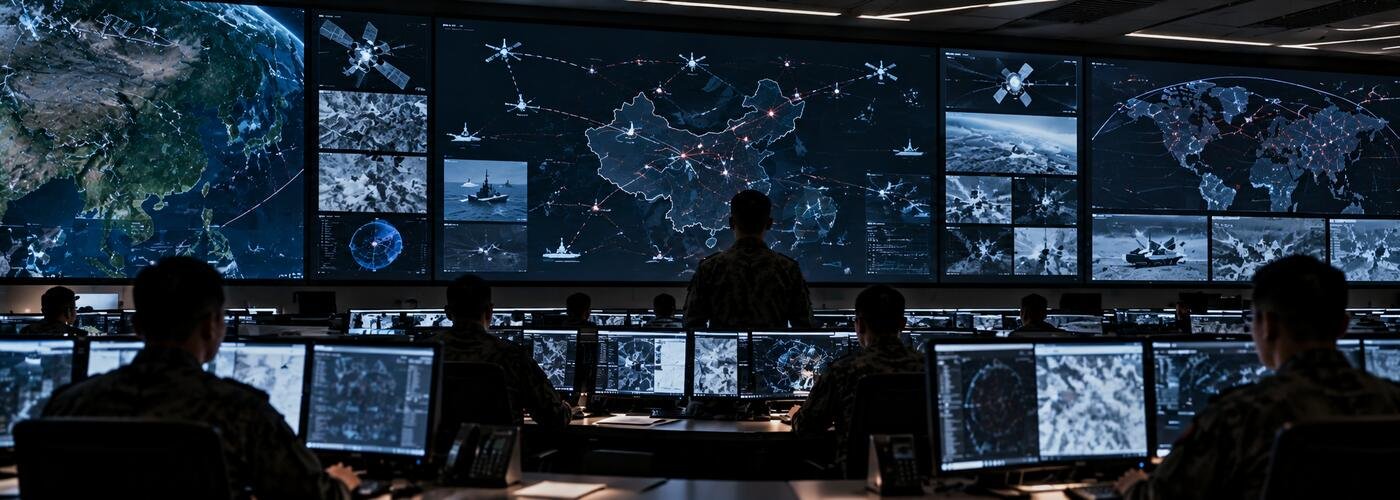
Every major military now assumes that the next serious conflict will not be decided by any single weapon, but by which side can connect its sensors to its shooters faster and more reliably than the other.
The United States has pursued its answer to that problem through the concept known as Joint All-Domain Command and Control.
China has been building a parallel answer under a name that translates as Multi-Domain Precision Warfare, and the institutional apparatus behind it has been substantially rebuilt within the past two years.
Understanding what this concept actually is, what has been built to support it, and how far it has genuinely progressed requires separating three distinct things that are often blurred together: what Chinese military doctrine says should happen, what institutions the PLA has actually created to make that possible, and what real evidence shows the system can currently do.
That distinction is the spine of this article, and it is worth stating plainly before going further, because it is easy to lose. China has the doctrine. China has substantially restructured its institutions around that doctrine. China is exercising the resulting architecture at increasing scale.
Whether it can operate reliably under the kind of disruption a real war would inflict on it remains the open question, and the most careful available evidence, including the assessment of the government most directly threatened by this system, still answers that question with real caution rather than confidence.
The comparison to JADC2 is not a loose analogy invented by outside observers.
National Defense Magazine’s own reporting on the topic was headlined simply “China Pursues Its Own Version of JADC2,” and the Jamestown Foundation’s analysis of the PLA’s 2024 reorganization states directly that the new force built to run this network “could be the PLA’s answer to information network competition” with the American system.
The two countries have spent years studying each other’s approaches to networked warfare, producing command architectures shaped in part by mutual competition rather than simple imitation. Analysts at the Mitchell Institute for Aerospace Studies have noted that JADC2 itself grew partly out of the Pentagon’s analysis of how the PLA intended to attack American kill chains in the first place.
As examined in JADC2 Explained: How the US Military’s Joint Command Network Works, the American version depends on connecting sensors and weapons across every service and domain into one continuous decision loop.
China’s version pursues the same objective from the opposite side of the same competition, and the institutional history behind it explains both what has genuinely changed and what remains, honestly, unproven.
The Doctrine: Why the PLA Built Multi-Domain Precision Warfare
The Pentagon’s annual China Military Power Report first identified Multi-Domain Precision Warfare as a distinct PLA operational concept around 2021, describing it as a system intended to use big data and artificial intelligence to rapidly identify vulnerabilities in an adversary’s operational system, then combine joint forces across domains to strike those vulnerabilities before they can be corrected. That framing is deliberate.
The PLA is not simply trying to build a bigger, better-connected version of its existing force. It is trying to build a system specifically designed to find and exploit the seams between American services and domains that the United States has spent decades trying to close.
This objective sits alongside a related but distinct concept that Western analysts often discuss in the same breath: systems destruction warfare, sometimes rendered as systems confrontation warfare. Where Multi-Domain Precision Warfare describes the network the PLA is building to connect its own forces, systems destruction warfare describes the offensive doctrine that network is meant to enable.
US Army Training and Doctrine Command materials examining this concept, published as recently as mid-2025, describe the PLA’s intent explicitly: neutralize the enemy’s ability to fight by targeting its most critical operational systems, focusing first on command and control to paralyze decision-making, rather than attriting combat units one at a time.
Neither concept appeared overnight. What has changed substantially, and recently, is the institutional structure built to make the doctrine real.

The Institutions: The Information Support Force Is the Backbone of the Effort
On April 19, 2024, Xi Jinping presided over the dissolution of the PLA’s Strategic Support Force and the establishment of three new organizations in its place: an Aerospace Force, a Cyberspace Force, and an Information Support Force.
The Aerospace Force and Cyberspace Force were formed from the Strategic Support Force’s existing Space Systems Department and Network Systems Department, both of which already held deputy-theater-command grade before the reform and were simply redesignated as standalone forces under new names. The Information Support Force followed a different and more consequential path.
Detailed reconstruction of the reorganization published through the Jamestown Foundation traces the ISF to the former Information Communications Base, a lower-ranking corps-grade organization within the old Strategic Support Force that was elevated two full grade levels to deputy-theater-command status as part of the reform, a jump neither of the other two new forces required.
Independent analysis from the International Institute for Strategic Studies and the Center for Naval Analyses describes the ISF as a new organization built around a distinct mandate to coordinate the construction and application of the network information system across the entire PLA, though the precise internal composition of the force has not been made fully transparent.
That different institutional path is significant: rather than simply redesignating an existing deputy-theater-command department, the PLA elevated the former Information Communications Base into a new force at deputy-theater-command grade, giving the network-information mission a substantially higher institutional position.
The ISF sits at deputy-theater-command grade, reporting directly to the Central Military Commission rather than to any individual service, a structural choice that mirrors the logic behind JADC2’s own attempt to sit above individual American service bureaucracies rather than being owned by any one of them.
Much of what is publicly known about the ISF’s internal training and technical maturity comes through PLA Daily and other state media channels.
That matters for how the rest of this article should be read. State media accounts of ISF exercises describing small teams embedding into air, naval, and ground units for real-time information support are evidence of stated intent and institutional effort. They are not independent confirmation that the underlying system performs reliably, because the PLA both designs and reports on its own exercises.
The Institutions, Continued: Five Theater Commands Anchor the Operational Layer
The PLA’s joint command structure runs through five theater commands, each responsible for a specific geographic area and each reporting directly to the Central Military Commission under Xi’s chairmanship.
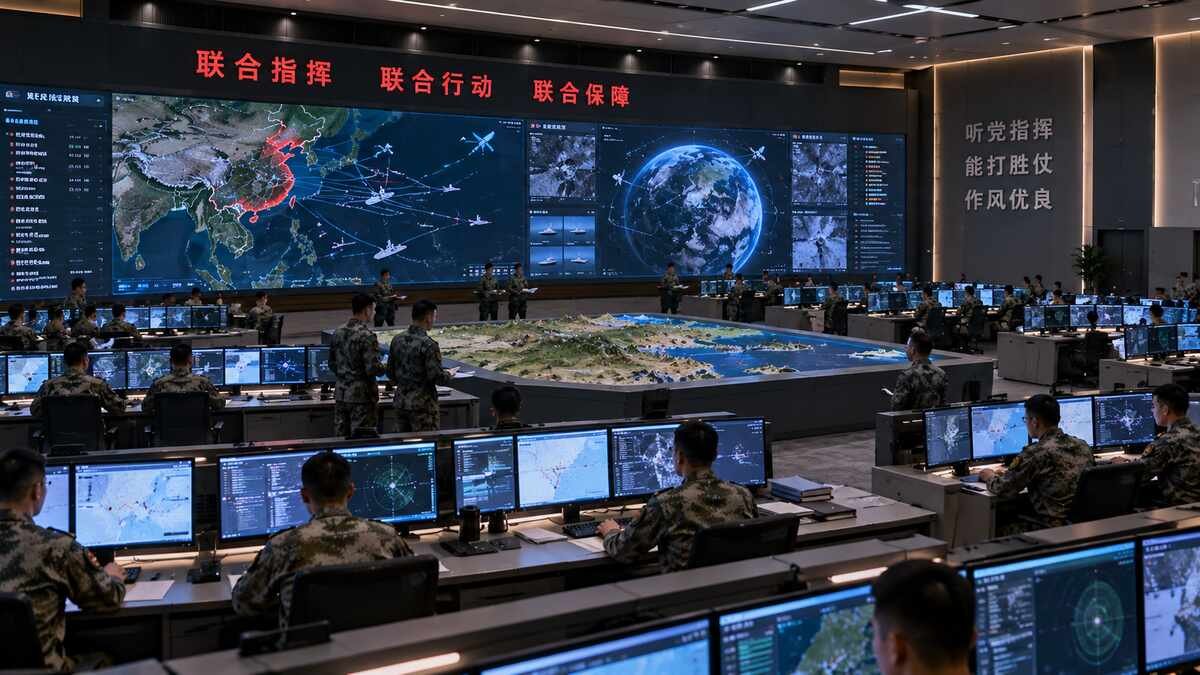
Briefing materials prepared for the National Defense University’s Keystone program describe a chain running from the CMC’s Joint Staff Department down through each theater command’s own Joint Operations Command Center, which in turn coordinates the service component headquarters assigned to that theater.
This is the operational-level machinery Multi-Domain Precision Warfare is meant to run through in practice, and it represents a genuine structural break from the PLA’s pre-reform organization, in which individual services controlled far more of their own operational planning independently.
The Eastern Theater Command, responsible for the Taiwan Strait, has become the clearest real-world test case for how this structure actually performs.
Independent defense analysts who track PLA exercise activity closely, including retired Australian Major General Mick Ryan, have noted that recent large-scale training events around Taiwan have been explicitly designed to test the capacity of the Eastern Theater Command’s commanders, staff, and overall joint command and control, not merely to demonstrate individual weapons or platforms. That framing matters, because it tells us what the PLA itself believes still needs proving.
How the Architecture Is Meant to Work, From Sensor to Strike
Stripped of doctrine and organizational charts, what Multi-Domain Precision Warfare is actually trying to build is a working sequence that any modern precision-strike system has to complete: detect a target, identify what it is, transmit that data, fuse it with information from other sensors, decide what to do about it, assign the right weapon to the task, strike, and assess whether the strike worked. Mapping the PLA’s own reforms onto that sequence makes the abstract architecture concrete.
Detection and identification depend on the PLA’s space-based and airborne intelligence, surveillance, and reconnaissance capabilities, including those associated with the Aerospace Force, feeding into the same network information system the ISF is building to carry that data across the force.
Transmission and fusion depend on resilient, redundant communications, which is precisely why Taiwan’s own 2026 defense assessment flagged something new in this year’s PLA planning: for the first time, Chinese military space planners are moving to deploy the Guowang and Qianfan low Earth orbit communications constellations and to field a fourth generation of BeiDou navigation satellites, explicitly to prevent PLA communications and navigation from being disrupted by Taiwan or the United States after a landing.
That single detail, drawn from a government with every incentive to track this precisely, tells you more about the PLA’s own assessment of its network vulnerabilities than any Chinese statement of confidence would.
As examined in Satellite Constellations and Military Communications in Modern Warfare, a command network is only as reliable as the space and communications layer underneath it, and China’s own 2026 planning suggests that Beijing regards the resilience of that layer as a significant vulnerability in a contested operation.

The decision and strike phases involve the theater Joint Operations Command Centers coordinating joint forces and, where appropriate, assigning effects to units such as PLA Rocket Force missile brigades, which field the DF-17 and DF-26 systems already covered in Countries With Operational Hypersonic Missiles: Global Status 2026.
Assessment, the final step, depends on the same ISR and communications loop feeding back in the other direction. Every link in that chain is a place where jamming, cyberattack, or simple institutional friction between services can break the sequence, which is exactly why demonstrated performance under contested conditions, not the existence of the architecture on paper, is the right measure of how far this has actually progressed. The sequence’s speed is set by its slowest link, not its fastest one.
Recent Training Events Are Testing the System Faster Than Outside Observers Can Verify It
Two major PLA training events in 2025 illustrate how directly this architecture is now being tested under realistic conditions. Strait Thunder 2025A, conducted around Taiwan on April 1 and 2, 2025, was announced by the PLA Eastern Theater Command as a rehearsal for a blockade of Taiwan.
The Jamestown Foundation’s close reading of the PLA’s original Chinese-language announcements found that Beijing officially termed the activity a drill rather than an exercise, a distinction that carries real weight in PLA terminology, where drills are understood as narrower, more loosely connected training events and exercises as larger, more complex, and more confrontational undertakings.
That distinction matters here specifically because it complicates any claim that Strait Thunder 2025A alone proves large-scale joint command integration. By the PLA’s own classification, as read by the analysts closest to the original text, it tested pieces of the system rather than the whole of it.
Justice Mission 2025, conducted in late December 2025, followed Strait Thunder 2025A and represented a larger-scale rehearsal involving forces operating around Taiwan, part of an escalating pattern of activity that began after Taiwanese President Lai Ching-te’s inauguration in May 2024.
According to tracking by the Institute for the Study of War and the American Enterprise Institute’s joint Taiwan project, the December exercise encircled Taiwan with naval and air assets across a wider and more interconnected set of zones than any prior iteration, a pattern the project’s analysts read as evidence that the PLA is continuing to refine its operational planning through successive rehearsals.
What these training events can and cannot tell an outside observer is worth being precise about. They demonstrate that the PLA is deliberately stress-testing components of its joint command structure under conditions that resemble the early phase of a real contingency, with each successive event more interconnected than the last.
They do not, on their own, demonstrate that the underlying network performs reliably once an adversary is actively trying to break it, because a military that designs, controls, and later reports favorably on its own training cannot fully substitute for that kind of adversarial pressure.

The Demonstrated Capability: Taiwan’s Own Assessment Offers a Grounded Measure
Taiwan’s Ministry of National Defense submitted its 2026 report on Chinese military power to the Legislative Yuan on September 1, and its findings are more precisely scoped and more cautious than either American threat assessments or Chinese state media coverage of the same training events tend to be.
The report identifies joint island-landing capability as an increasingly explicit PLA priority, but it also states plainly that PLA capability in conducting such operations remains inadequate at this stage.
According to independent reporting by outlets including Focus Taiwan and the Taipei Times, the ministry describes a joint island-landing campaign as one of the most complex military actions the PLA faces, requiring simultaneous multi-point landings, sustained air superiority, sea control, and continuous logistics throughput—capabilities the ministry assesses the PLA cannot yet reliably bring together for such an operation.
That specific finding is about amphibious operations rather than the network architecture in isolation, and the two should not be collapsed into one claim. But a joint island-landing campaign is precisely the kind of operation that cannot succeed without exactly the cross-domain command integration this article has been describing, which is why the ministry’s caution on the former is directly relevant to any honest assessment of the latter.
Chieh Chung, an analyst at Taiwan’s government-funded Institute for National Defense and Security Research who has reviewed the report, separately estimated that the relevant PLA programs could reach completion in stages running from roughly 2030 to 2035. That figure is his own analytical judgment offered in commentary on the report, not a conclusion stated by the ministry itself, and it is worth keeping that distinction clear rather than treating an analyst’s estimate as an official finding.
Taiwan’s assessment carries particular weight for two reasons. It comes from the government with the most direct incentive to take PLA capability seriously and the least incentive to either exaggerate it for budgetary purposes or dismiss it for political comfort. And it lines up with a caution that has appeared consistently in independent academic work on PLA doctrine.
Research published through Air University’s China Aerospace Studies Institute has noted that the PLA has not, even in its own doctrinal writing, formally defined some of the key terms underpinning all-domain operations in the way American doctrine has, and concluded that PLA theorists advocating for concepts aligned with joint all-domain command and control still face what the assessment described as a considerably long road before achieving genuine cross-domain synergy at the operational level.
Taken together, this is one of the more grounded pictures currently available of where the PLA’s ambition and its actual capability diverge.
Japan’s Own Reform Shows This Is a Global Pattern, Not a Two-Country Race
It would be a mistake to read the comparison between JADC2 and Multi-Domain Precision Warfare as though only two militaries in the world are wrestling with this problem.
Japan’s Self-Defense Forces established their own unified Joint Operations Command in March 2025, consolidating authority over all three service branches, along with command over units operating in the space and cyber domains, under a single organization for the first time in the country’s postwar history.
Japan’s Ministry of Defense has been explicit that this reform reflects the same underlying logic behind both JADC2 and Multi-Domain Precision Warfare: a conventional military organized around separate services can no longer respond fast enough against an adversary capable of coordinating pressure across every domain at once.
That a US treaty ally facing direct and daily pressure from PLA activity around its own territory reached this conclusion independently is meaningful evidence of how seriously the underlying military problem is being taken well beyond Washington and Beijing. It is a reminder that unified cross-domain command has become a structural requirement of modern military competition generally, not a bilateral rivalry that happens to involve two specific countries.
The Comparison to JADC2 Has Real Limits Worth Taking Seriously
The parallel between Multi-Domain Precision Warfare and JADC2 is useful precisely because it is not exact, and collapsing the two into a single story risks the kind of mirror-imaging that has misled Western analysts about Chinese military capability before.
The American military has spent decades conducting sustained combat operations across multiple theaters, giving the planners and institutions developing JADC2 a deep and continuously updated body of real operational experience to draw on.
The PLA, as the Center for Naval Analyses has noted plainly, has fought no significant conflict since a brief border war with Vietnam in 1979. Neither Multi-Domain Precision Warfare nor the Information Support Force has been tested in actual combat.
Confidence built entirely through training a military that designs, controls, and reports on itself is a genuinely different category of evidence than confidence built through real operational failure and correction under fire.
There is a second limit worth naming honestly, and it connects directly to why every claim in this article has been weighed against independent verification rather than accepted at face value.
Much of what the outside world knows about the ISF’s performance and technical maturity flows through Chinese state media channels with an explicit institutional interest in projecting confidence, both to domestic audiences and to Taiwan specifically as a coercive signal.
As covered in China’s Military Modernization: Force Structure, Technology, and Strategic Ambition, this same dynamic runs across nearly every dimension of PLA development, from its own account of extensive anti-corruption investigations within the Rocket Force to its stated modernization timelines.
None of this means Chinese claims should be dismissed outright. It means every claim needs to be weighed against independent assessment before it is treated as settled, and on the specific question of whether the PLA’s cross-domain command architecture actually works under contested conditions, the most careful independent assessments available, including Taiwan’s own, still describe a system under construction rather than one that has arrived.
Conclusion
Separating doctrine, institutions, and demonstrated capability gives an honest answer to a question that is usually asked too bluntly. China has the doctrine: Multi-Domain Precision Warfare has been a defined PLA operational concept for roughly half a decade.
China has substantially rebuilt its institutions around that doctrine: the Information Support Force did not exist before April 2024, and its creation reflects a real, structural commitment rather than a rebranding exercise.
China is exercising the resulting architecture at increasing scale and complexity, as the Strait Thunder and Justice Mission training events through 2025 demonstrate. What remains genuinely uncertain is whether that architecture can perform reliably once an adversary is actively trying to break it, and the most careful independent judgment currently available, from the government most directly exposed to the answer, still describes a gap between ambition and demonstrated performance rather than a system that has closed it.
What makes this worth tracking closely is not whether China has copied an American concept. It is that two militaries, and now a third in Japan, have converged on the same conclusion about what modern command and control requires. The country that closes the gap between doctrine and demonstrated capability first will hold a real, structural advantage in any future contingency where the ability to see, decide, and strike faster than an opponent decides the outcome before either side’s individual weapons matter at all.
Frequently Asked Questions
What is Multi-Domain Precision Warfare and how is it different from JADC2?
Multi-Domain Precision Warfare is the PLA’s operational concept for connecting sensors, data, and strike forces across every military domain into a single coordinated system, built around what Chinese doctrine calls the network information system. It shares the same underlying objective as America’s Joint All-Domain Command and Control, using artificial intelligence and shared data networks to compress the time between identifying a target and striking it, and Pentagon assessments have explicitly noted the close conceptual overlap between the two. The meaningful difference lies less in the stated concept than in the operational history behind it, since JADC2 has been shaped by decades of real American combat experience across multiple theaters, while Multi-Domain Precision Warfare has been developed and tested almost entirely through PLA training activity rather than actual conflict.
What is the PLA’s Information Support Force and why was it created?
The Information Support Force was established on April 19, 2024, when the PLA dissolved its Strategic Support Force and split its functions into three new organizations reporting directly to the Central Military Commission. Unlike the Aerospace Force and Cyberspace Force, which carried forward established missions from existing departments, the ISF was built from the former Information Communications Base, a lower-ranking organization elevated two full grade levels to deputy-theater-command status. Independent analysis from the International Institute for Strategic Studies and the Center for Naval Analyses describes its mission as coordinating the network information system that underpins joint operations across the PLA’s five theater commands, making it the clearest structural evidence that Beijing regards cross-domain command integration as important enough to warrant a dedicated organization of its own.
How advanced is China’s version of JADC2 compared to the American original?
The honest answer depends heavily on which source is doing the assessing. Chinese state media consistently portrays the system as increasingly capable and central to PLA readiness, while some American commentary frames the gap as smaller than the evidence supports. One of the more carefully scoped available assessments comes from Taiwan’s own Ministry of National Defense, which in its September 2026 report to the Legislative Yuan judged that PLA joint operational capability, including the amphibious operations that depend directly on this command architecture, remains inadequate at present. A Taiwanese defense analyst reviewing that report separately estimated full maturity could arrive in stages between roughly 2030 and 2035, though that specific figure is his own judgment rather than the ministry’s stated conclusion.
Why does China’s lack of recent combat experience matter for this comparison?
The PLA has not fought a significant conflict since a brief border war with Vietnam in 1979, meaning every element of Multi-Domain Precision Warfare and the Information Support Force has been developed, tested, and refined entirely through training activity the PLA itself designs, controls, and reports on, rather than through the kind of real operational failure and correction that has shaped American joint command doctrine over three decades of actual combat. This does not mean the system is weak, but it does mean confidence in its performance rests on a fundamentally different and less tested category of evidence, a distinction that serious independent assessments consistently treat as significant rather than incidental.
Is Japan also building a JADC2-style command system, and why does that matter?
Yes. Japan’s Self-Defense Forces established a unified Joint Operations Command in March 2025, consolidating authority over its army, navy, and air force branches, along with space and cyber units, under a single command structure for the first time in the country’s postwar history. Japan’s Ministry of Defense has framed this reform as driven by the same underlying logic behind both JADC2 and Multi-Domain Precision Warfare: that no modern military organized around separate, loosely coordinated services can respond fast enough to an adversary capable of coordinating pressure across multiple domains at once. That a third major Indo-Pacific power reached this conclusion independently is meaningful evidence that the shift toward unified cross-domain command is a genuine structural trend across modern militaries, not simply a rivalry between Washington and Beijing.
Sources and References
U.S. Department of Defense — Annual Report to Congress: Military and Security Developments Involving the People’s Republic of China (2025)
Jamestown Foundation — A Disturbance in the Force: The Reorganization of PLA Command and Elimination of China’s Strategic Support Force (2024)
Jamestown Foundation — Strait Thunder-2025A Drill Implies Future Increase in PLA Pressure on Taiwan (2025)
International Institute for Strategic Studies — Assessment of China’s Information Support Force (2024)
Center for Naval Analyses — Analysis of the PLA’s 2024 Command Reorganization (2024)
National Defense University — Keystone Briefing Materials on PLA System Destruction Warfare and Joint Command Structure (2024)
U.S. Army Training and Doctrine Command — Materials on PLA Systems Confrontation Warfare (2025)
Air University, China Aerospace Studies Institute — Assessment of Chinese Views on All-Domain Operations (2024)
Institute for the Study of War and American Enterprise Institute — China and Taiwan Update, September 1, 2026
Taiwan Ministry of National Defense — 2026 Report on Chinese Military Power Submitted to the Legislative Yuan (2026)
Focus Taiwan (Central News Agency) — New Report Shows PLA Prioritizing Joint Island-Landing Capabilities: Analyst (2026)
Taipei Times — MND Report Flags PLA Efforts to Boost Taiwan Landing Capabilities (2026)
Japan Ministry of Defense — 2026 Defense White Paper (2026)
Mitchell Institute for Aerospace Studies — Commentary on the Origins of Joint All-Domain Command and Control (2024)
Related Analysis
For analysis of the American command network that Multi-Domain Precision Warfare was built to compete against, read JADC2 Explained: How the US Military’s Joint Command Network Works.
For a broader assessment of the force structure and strategic ambition driving China’s military transformation, read China’s Military Modernization: Force Structure, Technology, and Strategic Ambition.
For analysis of the satellite and communications architecture that any modern command network depends on, read Satellite Constellations and Military Communications in Modern Warfare.
For analysis of the competing space doctrines through which the same US-China rivalry is playing out in orbit, read US Space Force Doctrine vs China’s Space Strategy: Competing Visions of Orbital Power.
For analysis of the broader strategic contest within which China’s command modernization sits, read Great Power Competition and the New Global Order.
