



Analysis · StrikeOrbit | 2026
The boundary between civilian and military space infrastructure has not blurred. Commercial satellites now sit at the centre of that collapse.
The satellite systems that provide communications resilience to frontline forces, deliver near-real-time battlefield imagery to tactical commanders, and supply the positioning data that guides precision munitions are not, in the majority of cases, government-owned military assets.
They are commercial products operated by private companies, serving civilian and military customers alike, subject to corporate governance rather than military command, and governed by legal frameworks not designed for the environments in which they are now used.
This is not a contingency arrangement or a temporary gap-fill. It is the structural reality of how modern military operations depend on space, and it carries strategic implications that neither the states relying on commercial space capabilities nor the companies providing them have fully resolved.
The transformation did not happen by design. It happened because commercial space technology advanced faster than government acquisition cycles could follow.
After all, the economics of large-scale satellite constellation deployment made commercial providers capable of delivering capabilities that government programs could not match in scale or speed, and operational necessity in active conflicts repeatedly demonstrated that commercial systems could provide military-grade functionality at costs and timescales that dedicated military programs could not.
What began as emergency access to commercial capabilities in specific operational contexts has become systematic dependency embedded in military doctrine, acquisition strategy, and operational planning across every major spacefaring power.
This dependency creates strategic risks that are simultaneously operational, legal, and escalatory. States that depend on commercial satellite infrastructure for military operations have built critical military functions on assets they do not control, cannot direct under military command authority, and cannot fully protect.
Adversaries targeting those assets face legal and political calculations that differ fundamentally from targeting dedicated military satellites. And the companies operating commercial constellations in conflict zones face obligations and pressures that corporate governance structures were never designed to manage.
As examined in What Is Orbital Warfare? How Space Became a Contested Military Domain. Space is the domain through which modern warfare runs. The question this article examines is who owns that domain — and what that ownership means when conflict begins.
Commercial Space Capabilities Became Military Infrastructure Through Operational Necessity
The integration of commercial satellite capabilities into military operations is most comprehensively illustrated by the war in Ukraine, but the process began well before February 2022. American military operations in Afghanistan and Iraq demonstrated that commercial satellite imagery could provide tactical intelligence at resolution and timeliness that supplemented and in some cases exceeded dedicated military collection assets.
The National Geospatial-Intelligence Agency formalized commercial imagery procurement in the 2000s through the Commercial Remote Sensing Policy and subsequent commercial imagery contracts that made Planet Labs, Maxar Technologies, and later BlackSky and other providers systemic components of American intelligence workflows rather than occasional supplements.
What changed in Ukraine was the scale, the speed, and the directness of commercial integration into active combat operations. When Ukrainian forces required communications resilience in the opening hours of Russia’s full-scale invasion in February 2022, the Viasat KA-SAT network had just been disrupted by a Russian cyberattack. The fastest available replacement was not a government military satellite system. It was Starlink.
SpaceX deployed terminals within days and provided connectivity that proved more resilient than any alternative available. What began as emergency access became, within months, the communications backbone of Ukrainian military operations — supporting drone targeting, artillery coordination, command communications, and operational planning at a scale and integration depth that made Starlink not merely useful but functionally indispensable.
By 2024 the integration had deepened further. Ukrainian drone operations — the most operationally significant autonomous system deployment in the history of conventional warfare — depended on Starlink for control links, video feeds, and targeting data relay.
Commercial imagery from Planet Labs provided the near-real-time satellite coverage that enabled Ukrainian forces to track Russian force movements, identify high-value targets, and conduct battle damage assessment with a timeliness that organic military collection assets could not match. The data flows from commercial satellites shaped decisions made by Ukrainian commanders at every level of the force, from strategic headquarters to company-level drone operators.
As military operations become increasingly data-driven, the role of artificial intelligence in processing, prioritizing, and exploiting these commercial information streams is explored in Military AI and the Future of Warfare.
As discussed in Drone Warfare and Autonomous Systems in Modern Conflict, the autonomous systems that defined Ukraine’s battlefield effectiveness depended entirely on the commercial space infrastructure providing their connectivity and intelligence.
The United States observed this dynamic and responded with institutional formalization.
The Pentagon’s Commercial Space Integration Strategy, published in 2024, codified what Ukraine had demonstrated informally — that commercial satellite capabilities were not emergency backups but permanent components of American military space architecture.
The document explicitly directed military services to plan for commercial capability integration as a baseline assumption rather than a contingency, and established frameworks for commercial satellite data to be incorporated into classified intelligence workflows, targeting processes, and operational planning across all services.
The command architecture that integrates commercial satellite data into joint military decision-making is examined in JADC2 Explained: How the US Military’s Joint Command Network Works.
The Space Force established the Commercial Space Office to manage these relationships systematically. The National Reconnaissance Office expanded its commercial imagery contracts to include providers across the full spectrum of electro-optical, synthetic aperture radar, and radio frequency collection capabilities.
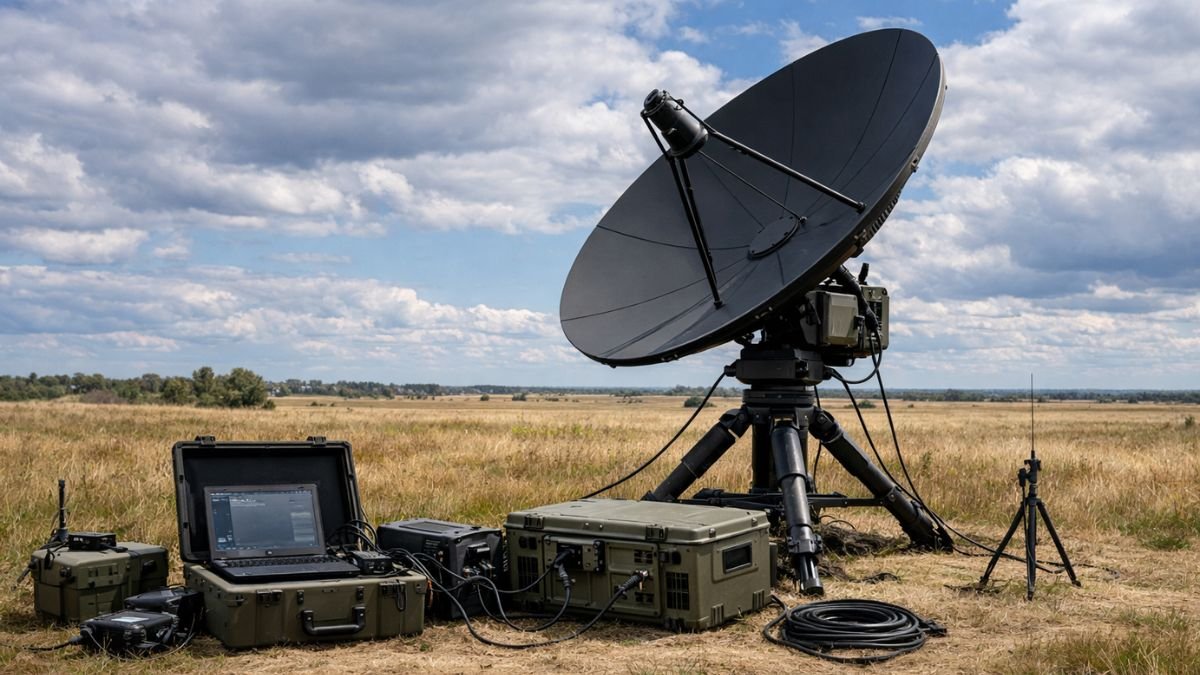
The Scale of Commercial Constellation Deployment Has No Military Equivalent
The strategic significance of commercial satellite infrastructure for military operations derives not simply from the capabilities individual commercial satellites provide but from the scale at which commercial constellations have been deployed — a scale that government military programs cannot replicate and that fundamentally changes the targeting calculus for adversaries attempting to degrade space-enabled military capabilities.
SpaceX’s Starlink constellation, as of 2025, comprises over six thousand operational satellites in low Earth orbit — more satellites than all other operators combined had deployed in the entire history of spacefaring. The sheer number of satellites means that no realistic counterspace campaign could eliminate Starlink’s communications functionality through kinetic means without generating a debris cascade that would render low Earth orbit unusable for all actors.
Electronic warfare against Starlink has proven similarly challenging — Russian attempts to jam Starlink terminals throughout the Ukraine conflict prompted SpaceX to develop and deploy software countermeasures in near-real time, creating a live electronic warfare competition that demonstrated the resilience of software-defined commercial systems against state-level jamming operations.
Planet Labs operates the world’s largest commercial Earth observation constellation, with over two hundred satellites providing daily global imaging coverage at resolutions sufficient for military-grade tactical intelligence.
The constellation’s distributed character means that no single point of failure can eliminate its coverage — destroying individual satellites generates coverage gaps measured in hours rather than days, as orbital mechanics replenish coverage from other constellation members.
Monitoring and protecting these vast commercial constellations depends on continuous orbital tracking and behavioral analysis, explored in Space Situational Awareness: Tracking and Securing the Orbital Domain.
Maxar Technologies operates a smaller but higher-resolution imaging constellation that provides the sub-metre resolution imagery needed for precise targeting and infrastructure assessment. Together, these commercial imaging providers have given Ukrainian forces — and by extension any military with access to commercial imagery — persistent satellite surveillance coverage that previously required dedicated national technical means accessible only to the most capable intelligence services.
The Guowang constellation being deployed by China represents the Chinese state’s equivalent investment, though through different ownership structures. Planned at over twelve thousand satellites, Guowang is nominally commercial but institutionally designed for dual military and civilian use — reflecting China’s deliberate integration of commercial and military space development in ways that blur the ownership distinctions that complicate Western military use of commercial systems.
China is building at scale the commercial-military integration that the United States discovered through operational necessity. As analyzed in US Space Force Doctrine vs China’s Space Strategy: Competing Visions of Orbital Power, the architectural logic of distributed LEO constellations is consistent across both powers even where the governance structures differ fundamentally.
The Pentagon’s 2025 Annual Report to Congress on Chinese Military Power documents China’s rapidly expanding commercial ISR constellation, including over 100 Jilin-1 imaging satellites and the planned G60 Starlink equivalent.

Private Actors Now Influence Military Operations in Ways States Cannot Fully Control
The most strategically novel dimension of commercial satellite dependency is the emergence of private corporate decisions as significant variables in military operations.
When Elon Musk’s SpaceX decided in September 2022 not to activate Starlink coverage over Crimea for a Ukrainian submarine drone attack on the Russian Black Sea Fleet — a decision Musk publicly acknowledged and justified as preventing escalation — a corporate executive made a decision with direct operational consequences for a military operation conducted by a sovereign state.
That decision was made unilaterally, without reference to any government authority, and reflected corporate judgments about escalation risk and business interests rather than military necessity or national security policy.
The Crimea incident illustrated a problem that has no precedent in the history of modern warfare. States have always depended on private defense contractors to manufacture weapons and build infrastructure. But the contractors manufacturing weapons have never had operational control over those weapons once delivered.
Commercial satellite operators retain operational control over their systems throughout their deployment — they can activate or deactivate coverage, adjust frequencies, enable or disable specific capabilities, and make routing decisions that directly affect military operations in real time.
The military forces, depending on commercial satellite infrastructure, have operational dependency without operational control. No military power in history has outsourced so much operational capability to privately controlled infrastructure. This creates a category of strategic risk that existing military doctrine and acquisition frameworks are poorly equipped to manage.
That risk is not only about deliberate corporate decisions. In July 2025, a software failure inside SpaceX’s own network took Starlink offline globally for roughly two and a half hours, and Starshield, the dedicated military network built on the same underlying infrastructure, went down alongside it — a reminder that even where a government owns its own satellites outright, shared technical dependencies on a single commercial provider can produce the same vulnerability as the corporate decision-making the Crimea episode exposed.
A commercial satellite operator facing simultaneous pressure from the government of the country where it is providing military services, the government of the country being attacked, its own national government, its board of directors, and its insurance providers will make decisions based on a complex of corporate, legal, and political considerations that may not align with military operational requirements.
SpaceX’s rapid development of Starshield — a dedicated government and military variant of the Starlink constellation with security features and command authority structures designed for national security applications — represents one response to this problem, but Starshield’s deployment scale remains a fraction of the broader Starlink constellation on which military operations currently depend.
The problem is not limited to communications. Commercial imagery providers face similar pressures. When Planet Labs or Maxar Technologies captures imagery of military operations — friendly or adversary — decisions about who can access that imagery, at what resolution, and under what conditions are made by corporate governance structures.
In Ukraine, commercial imagery providers generally cooperated with Ukrainian and Western government requests for priority tasking and rapid data delivery. But there is no legal requirement for them to do so, no military command authority over their operations, and no guarantee that the same cooperation would be forthcoming in different political or commercial circumstances.

The Legal Framework Governing Space Conflict Was Not Designed for Commercial Military Infrastructure
The legal architecture governing armed conflict was constructed in an era when the distinction between civilian and military infrastructure was architecturally clear. Civilian satellites served civilian purposes.
Military satellites served military purposes. Targeting decisions could be made against that distinction with reasonable confidence. The commercial satellite infrastructure of 2026 makes that distinction operationally meaningless while the legal framework continues to assume it exists.
The law of armed conflict — specifically the principles of distinction, proportionality, and military necessity under the Geneva Conventions and their Additional Protocols — requires that attacks distinguish between civilian objects and military objectives and that incidental civilian harm not be excessive relative to anticipated military advantage.
When a commercial satellite constellation is simultaneously providing communications for tens of thousands of civilian internet users and communications for military forces conducting targeting operations, its legal status as a civilian object or a military objective is genuinely ambiguous.
Destroying it would eliminate a military capability — meeting the definition of a military objective. It would also harm tens of thousands of civilian users globally — potentially meeting the proportionality threshold for prohibition.
The International Committee of the Red Cross maintains the most authoritative analysis of how international humanitarian law applies to new military technologies including dual-use satellite infrastructure.
This ambiguity is not resolved by the Outer Space Treaty, which prohibits weapons of mass destruction in orbit and establishes space as the province of all humanity but says nothing about conventional attacks on commercial satellites.
It is not resolved by the Additional Protocols to the Geneva Conventions, which were negotiated before commercial satellite infrastructure existed on a militarily significant scale. It is not resolved by any subsequent international agreement, because no such agreement has been concluded.
As explored in Anti-Satellite Weapons: Capabilities, Systems, and Strategic Implications, the legal vacuum governing counterspace operations extends to commercial infrastructure in ways that create uncertainty at every level of military and corporate planning.
The practical consequence is that adversaries targeting commercial satellite infrastructure face a different political calculation than adversaries targeting dedicated military systems.
Russia’s attack on the Viasat KA-SAT network at the outset of its invasion of Ukraine was not condemned as an attack on a military target — it was framed as an attack on civilian communications infrastructure, drawing condemnation from the European Union and allied governments on that basis.
The political cost of the attack may have been calibrated against that framing rather than against the military value of the target. Whether that political calculation deterred or shaped subsequent Russian counterspace operations against commercial infrastructure is difficult to assess, but the ambiguity is itself strategically significant.

States Are Responding With Integration Frameworks That Raise New Questions
The response of major military powers to their commercial satellite dependency has not been to reduce it — the operational benefits are too significant and the alternative too expensive — but to formalize, manage, and partially institutionalize it through commercial integration frameworks that acknowledge dependency while attempting to mitigate its risks.
The United States approach, codified in the 2024 Commercial Space Integration Strategy, establishes commercial satellite capabilities as a permanent tier of military space architecture alongside government-operated systems.
The framework includes provisions for commercial satellite operators to receive threat warnings and indications of hostile intent, enabling them to take protective measures that government systems would take automatically.
The strategic importance of resilient warning architectures that provide those threat indications is examined in Missile Warning Satellites and Early Warning Systems Explained.
It includes processes for commercial imagery to be incorporated into classified targeting workflows with appropriate security handling. And it includes contracts and agreements that provide some degree of priority access to commercial capabilities for national security users — though these contracts stop well short of giving military commanders the operational control over commercial systems that they have over dedicated military assets.
China’s approach through the Guowang constellation and parallel military commercial space development reflects a fundamentally different model. The ambiguity between commercial and military functions in Chinese space programs is not a problem to be managed — it is a feature of deliberate design.
Chinese commercial space operators function under regulatory and security frameworks that give state and military authorities significantly greater ability to direct their operations than American corporate governance structures permit. The strategic advantage of this model is that China can deploy commercial-scale constellations with military-accessible functionality while maintaining the legal ambiguity of civilian ownership.
The strategic vulnerability is that the same ambiguity that protects Chinese commercial satellites from being treated as military targets also prevents them from being officially defended as military assets.
France, the United Kingdom, Australia, Japan, and other allied nations are developing national commercial space integration frameworks that parallel the American approach, drawing on lessons from Ukraine and from the shared allied architecture being built through the Combined Space Operations framework.
The United Kingdom has moved furthest of these partners: in 2026, the Ministry of Defense began routing operational military communications through Starshield, SpaceX’s dedicated government and military variant of Starlink, accessed through third-party distributors rather than a direct SpaceX contract — a striking illustration of how deeply allied militaries are now willing to embed themselves in American commercial infrastructure even while publicly downplaying the arrangement.
The European Union’s IRIS² program — a sovereign European LEO communications constellation planned for deployment in the late 2020s — reflects European concerns about dependency on non-European commercial infrastructure for critical military and governmental communications.
The program is operationally designed to provide communications resilience that does not depend on American commercial operators whose decisions are ultimately governed by American corporate and regulatory frameworks.
India has taken a parallel but distinct path, with its 2025 Joint Military Space Doctrine formally designating orbit as a contested domain and embedding space power into national military planning for the first time through the Space Based Surveillance Phase-III program—a planned 52-satellite constellation under the revised Space Policy 2026 that assigns roughly a third of the satellites to private firms including Pixxel, Skyroot,
and Tata Advanced Systems.
This approach mirrors the same distributed, commercially integrated architecture that the United States, the United Kingdom, and China have each converged on, suggesting that reliance on layered commercial-military constellations is becoming the default model for any state seeking resilient space capability, not a choice unique to Washington or Beijing.
The Royal United Services Institute’s Chatham House has examined the cybersecurity and governance challenges that commercial satellite dependency creates for NATO member states and their allied space architectures.
Conclusion
Commercial satellites have become military infrastructure not because any government planned it that way but because operational reality outran both legal frameworks and acquisition strategies.
The scale of commercial constellation deployment, the speed of commercial technology development, and the demonstrated military utility of commercial satellite capabilities in active conflict have created a dependency that is now embedded rather than contingent — embedded in military doctrine, acquisition planning, and operational procedures across every major military power.
The strategic risks that dependency creates are real and largely unresolved. States depend on assets they do not control. Adversaries must calculate against targeting thresholds that the law of armed conflict has not clearly defined for commercial infrastructure. Private corporations make decisions with direct military operational consequences based on corporate rather than military governance frameworks. And the legal architecture governing all of this was built for a world that no longer exists.
Managing these risks requires not the reduction of commercial satellite dependency — which is neither achievable nor desirable given the operational benefits — but the development of legal frameworks, contractual arrangements, and command authority structures that acknowledge commercial infrastructure’s military role and govern it accordingly. That development is underway but well behind the pace at which the dependency has grown.
The gap between what commercial satellites do for military operations and what the legal and governance frameworks covering those operations were designed to handle is the most consequential unresolved challenge in military space policy today.
Frequently Asked Questions
Why have commercial satellites become so important to military operations?
Commercial satellite constellations have become militarily essential because they provide capabilities — persistent global imaging, resilient low-latency communications, and precise positioning data — at a scale and cost that dedicated government military satellite programs cannot match. The economics of deploying hundreds or thousands of small satellites in low Earth orbit have proven viable only for commercial operators serving large civilian markets. Military forces have leveraged these commercially funded constellations because the capabilities they provide are operationally superior in many respects to what dedicated military programs deliver. The war in Ukraine demonstrated this conclusively — Starlink’s communications resilience and Planet Labs’ persistent imagery coverage provided Ukrainian forces with capabilities that no military satellite program could have delivered at that speed and scale.
What happened with Starlink in Ukraine and why does it matter strategically?
Starlink terminals deployed by SpaceX provided Ukrainian forces with resilient satellite communications throughout the conflict after Russia’s cyberattack on the Viasat KA-SAT network disrupted existing communications at the invasion’s outset. By 2024, Starlink had become deeply embedded in Ukrainian military operations, including drone targeting, artillery coordination, and command communications. The strategic significance extends beyond Ukraine — it demonstrated that commercial constellations can provide military-grade communications resilience at operational scale, that corporate decisions about commercial service provision can have direct military operational consequences, and that electronic warfare competition against distributed LEO constellations is fundamentally different from jamming a small number of geostationary military communications satellites.
What legal protections apply to commercial satellites used for military purposes?
This is one of the most consequential unresolved questions in the law of armed conflict. The Outer Space Treaty of 1967 prohibits weapons of mass destruction in orbit but says nothing about conventional attacks on satellites. The Geneva Conventions and their Additional Protocols establish principles of distinction and proportionality that require distinguishing civilian objects from military objectives — but when a commercial satellite simultaneously serves civilian and military functions, its legal status is genuinely ambiguous. No binding international agreement has established clear rules for the targeting of dual-use commercial space infrastructure, meaning that the legal framework governing attacks on commercial satellites in armed conflict remains undefined at precisely the moment when such attacks have become operationally significant.
How does China’s approach to commercial satellites differ from the United States?
The fundamental difference lies in ownership and governance. American commercial satellite operators are private corporations subject to corporate governance, shareholder interests, and regulatory frameworks that give government authorities limited ability to direct their operations. Chinese commercial satellite operators, including those deploying the Guowang constellation, operate under regulatory and security frameworks that give state and military authorities significantly greater ability to direct operations, making the distinction between commercial and military functions in Chinese space programs deliberately ambiguous. China is building commercial-scale constellations with military-accessible functionality by design rather than by necessity, while American military forces have adapted to depend on commercial systems whose governance structures were never designed for military use.
What is the strategic risk of military dependence on commercial satellites?
Military dependence on commercial satellites creates three categories of strategic risk that dedicated military systems do not present. First, operational risk — commercial operators retain control over their systems and can make coverage, frequency, and capability decisions that directly affect military operations based on corporate rather than military governance. Second, legal risk — commercial infrastructure occupies a grey zone in the law of armed conflict where its status as a civilian or military target is unclear, complicating both the defense of friendly commercial assets and the targeting of adversary commercial infrastructure. Third, escalation risk — attacks on commercial satellite infrastructure with global civilian users may generate political costs and escalation pressures that attacks on dedicated military satellites would not, potentially constraining adversary counterspace operations or miscalculating their effects. A July 2025 outage that took both Starlink and the separately marketed Starshield network offline simultaneously for roughly two and a half hours demonstrated that operational risk further: shared technical infrastructure can produce the same vulnerability as a deliberate corporate decision, even for systems marketed as independent.
Sources and References
U.S. Department of Defense — Commercial Space Integration Strategy (2024)
U.S. Space Force — Commercial Space Integration Policy Framework (2024)
U.S. Department of Defense — Annual Report to Congress: Military and Security Developments Involving the People’s Republic of China (2025)
Space Development Agency — Commercial Integration Architecture Documentation (2024)
Congressional Research Service — Commercial Space and National Security: Issues for Congress (2024)
Congressional Research Service — Defense Primer: Military Use of Space (2023)
Centre for Strategic and International Studies (CSIS) — Space Threat Assessment (2025)
Secure World Foundation — Global Counterspace Capabilities: An Open Source Assessment (2024)
International Committee of the Red Cross (ICRC) — International Humanitarian Law and New Technologies (2023)
RAND Corporation — Commercial Space and National Security (2023)
International Institute for Strategic Studies (IISS) — The Military Balance (2025)
Chatham House — Space Security and Commercial Infrastructure: Policy Implications (2024)
United Nations Office for Outer Space Affairs — Outer Space Treaty (1967)
The Defense Post — UK Turns to SpaceX’s Starshield for Military Communications (June 2026)
New Space Economy — The Fragile Architecture of the Space Economy (March 2026)
Observer Research Foundation — 2026: A Turning Point for the Indian Space Program
Related Analysis
For analysis of the foundational orbital warfare context that makes commercial satellite infrastructure a contested military asset, read What Is Orbital Warfare? How Space Became a Contested Military Domain.
For analysis of the anti-satellite weapons that can be used against commercial satellite infrastructure and the legal ambiguity that targeting creates, read Anti-Satellite Weapons: Capabilities, Systems, and Strategic Implications.
For analysis of how the United States and China are building competing space architectures in which commercial constellations play structurally different roles, read US Space Force Doctrine vs China’s Space Strategy: Competing Visions of Orbital Power.
For analysis of the autonomous systems whose operational effectiveness depends on commercial satellite connectivity demonstrated in Ukraine, read Drone Warfare and Autonomous Systems in Modern Conflict.
For analysis of the satellite communications architecture within which commercial constellations now operate as permanent components, read Satellite Constellations and Military Communications in Modern Warfare.
