


Analysis · StrikeOrbit | 2026
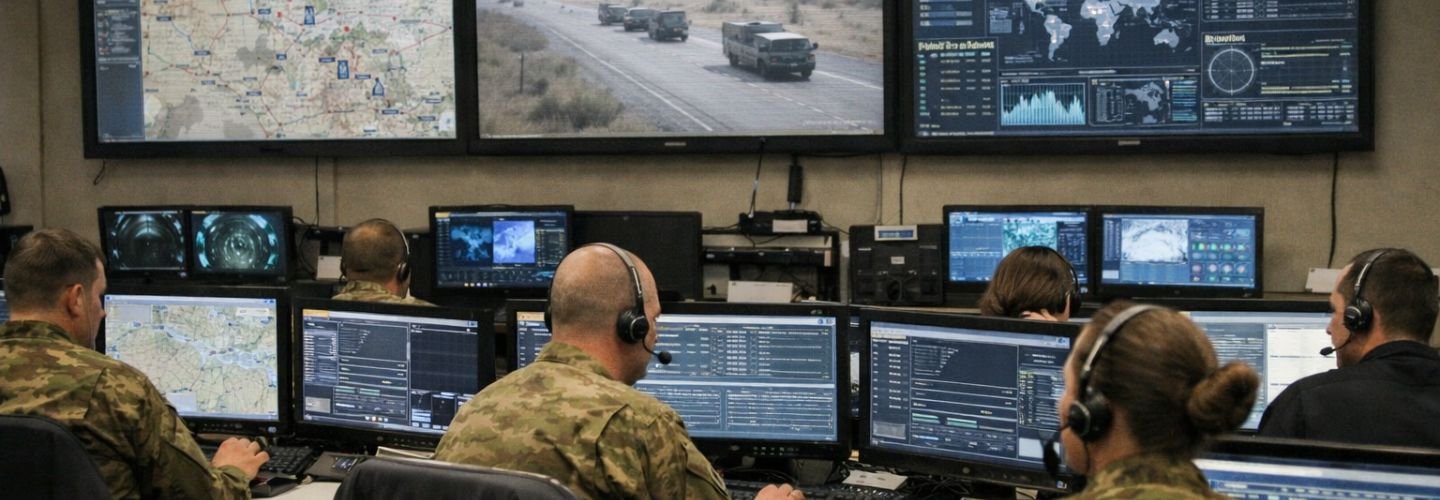
Modern warfare is not decided by the weapon that fires the shot. It is decided by the network that identifies the target, calculates the solution, and transmits the order faster than the adversary can respond. The United States military has understood this for three decades, and the Joint All-Domain Command and Control framework — known as JADC2 — represents its most ambitious attempt to build that network at a scale and speed that no adversary can match.
JADC2 is not a single system, a single programme, or a single piece of hardware. It is a concept, a command model, and an ongoing competition to connect every sensor, every shooter, and every decision-maker across every warfighting domain into one continuous, adaptive data network.
The strategic urgency behind this effort is direct. In the Indo-Pacific — where potential conflict with China would span thousands of kilometres of open ocean, dispersed island chains, and layered anti-access systems — the speed at which American forces can detect, decide, and engage will determine whether deterrence holds or fails.
Command cycles measured in hours cannot compete against adversary engagement timescales measured in minutes. Speed in modern war increasingly depends less on platforms than on the network connecting them. JADC2 is the attempt to close that gap before it becomes decisive.
As examined in Great Power Competition and the New Global Order, the broader strategic competition driving that urgency — between the United States, China, and Russia — shapes every doctrinal and investment decision behind JADC2’s development.
As examined in Satellite Constellations and Military Communications in Modern Warfare, the distributed LEO communications framework now being deployed by the Space Force and commercial operators provides the data transport layer on which JADC2 depends. Understanding JADC2 requires understanding both the concept and the infrastructure beneath it.
JADC2 Emerged From the Limits of Domain-Separated Command Architecture
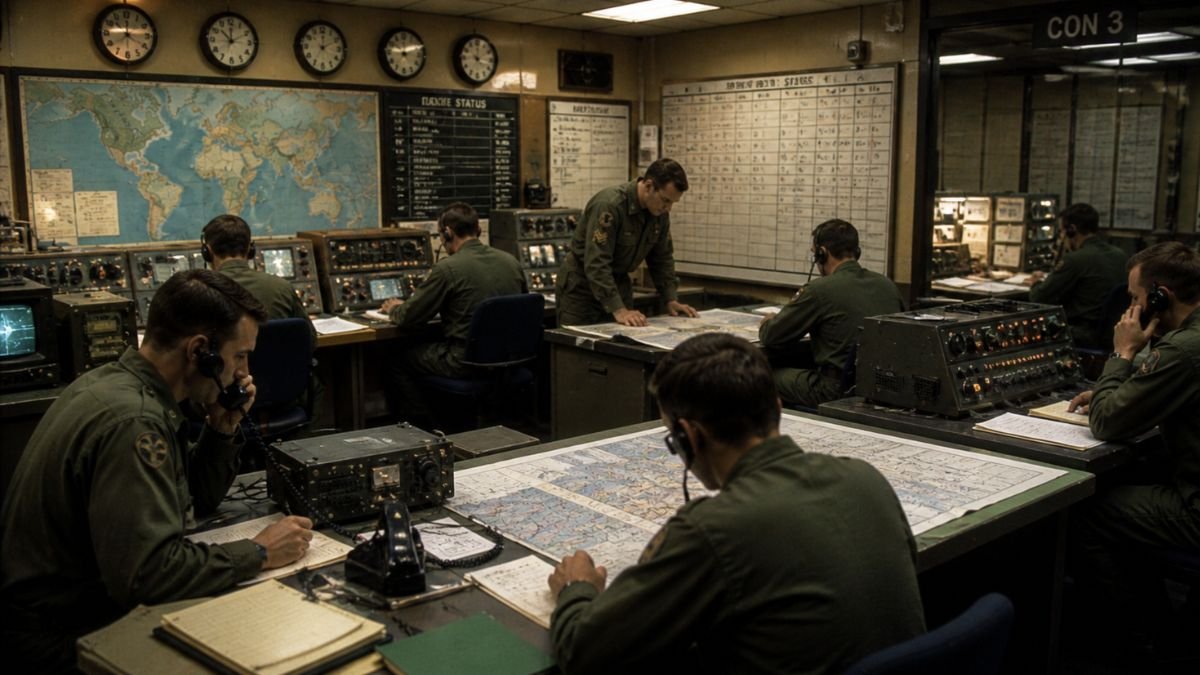
The military command structure that JADC2 is designed to replace was built for a different threat environment. Throughout the Cold War and into the post-Cold War decades, the United States military organized its command and control around individual services — the Army, Navy, Air Force, and Marine Corps each operated largely separate command networks, communications systems, and data formats.
Joint operations were coordinated through liaison officers, shared radio frequencies, and laborious data-sharing protocols requiring human intermediaries at every translation point between service-specific systems.
This had logic in the Cold War context. Threats were largely domain-specific, and the primary operational challenge was coordinating large conventional forces against defined adversary formations. The inefficiencies of inter-service data sharing were real but manageable when the pace of operations was measured in hours and days rather than minutes and seconds.
The Gulf War of 1991 began to expose those inefficiencies. The joint air campaign required unprecedented coordination between the Air Force, Navy, and Marine aviation, with targeting cycles that struggled to integrate intelligence from multiple service-specific collection systems fast enough to engage mobile targets before they moved.
The after-action analysis produced a generation of investment in improved joint intelligence, surveillance, and reconnaissance — but the command and control foundation remained fundamentally service-specific.
The wars in Afghanistan and Iraq accelerated the problem. Counterterrorism operations placed a premium on the ability to detect a target, confirm its identity, obtain authorization, and engage it within a window that could close in minutes. The kill chain — the sequence of steps from detection to engagement — became the central operational metric.
The friction introduced by translating data between service-specific systems was directly measurable in missed opportunities and failed missions.
The pivot came with the recognition that future high-intensity conflict against peer competitors would operate at speeds that made the Cold War-era coordination model not merely inefficient but operationally catastrophic. Chinese and Russian anti-access and area-denial capabilities — layered systems of long-range missiles, electronic warfare, and integrated air defense — operated on engagement timescales measured in minutes.
American command cycles measured in hours could not compete. JADC2 emerged from that recognition as a doctrinal imperative rather than a technological preference. The DoD formally established the Combined Joint All-Domain Command and Control — CJADC2 — effort in 2019 and released its implementation plan in 2022, committing the joint force to the concept across all services and combatant commands.
JADC2 Connects Every Sensor, Shooter, and Decision-Maker Across All Domains
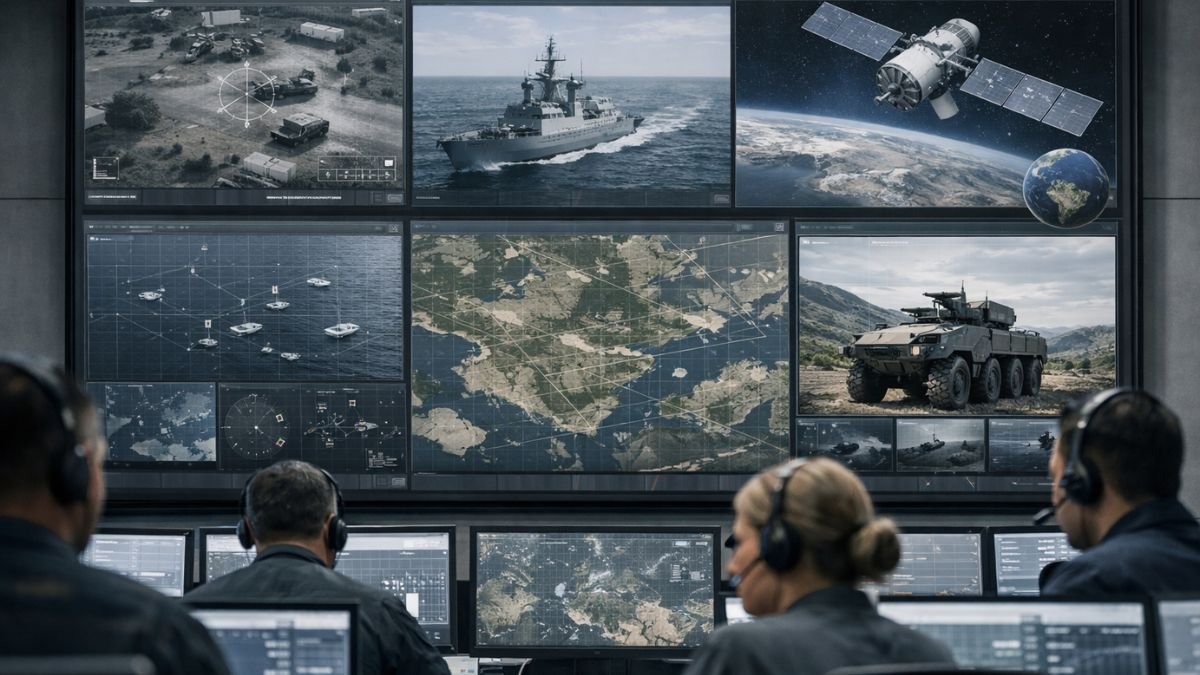
The operational concept at the heart of JADC2 is compressing the kill chain to the minimum achievable timescale. In its most developed form, JADC2 envisions a combat cloud in which a sensor operated by any service in any domain can automatically cue a weapon operated by any other service in any other domain, with human decision-makers inserted at appropriate points rather than at every translation boundary between service systems.
The practical implementation involves several interdependent components. A common data layer provides the technical foundation — a set of standards and protocols allowing systems across services to exchange data in formats each can read and use without human translation.
Rather than creating one universal system, each military service has developed complementary programs designed to operate within the broader JADC2 framework.
The Advanced Battle Management System, or ABMS, is the Air Force’s primary contribution, with a FY2025 budget request of $174 million continuing its development as a system designed to close hundreds of kill chains within relevant timescales in highly contested environments.
Project Overmatch is the Navy’s equivalent, networking surface ships, submarines, aircraft, and unmanned systems into a distributed maritime kill web. The Army’s Project Convergence has demonstrated cross-service engagement integration across multiple iterations.
The 2023 Project Convergence Capstone 4 exercise integrated Army, Air Force, Marine Corps, and allied partner systems into a single kill chain demonstration involving over 300 capabilities from across the joint force. An Army sensor detected a simulated threat, AI systems processed the data and generated a targeting solution, human operators authorised the engagement, and fires were executed in a fraction of the time legacy inter-service coordination would have required.
Project Convergence Capstone 5 was planned for early 2025, continuing the iterative development cycle that has characterized JADC2 experimentation since 2020. In February 2024, Deputy Secretary of Defense Kathleen Hicks announced delivery of the initial CJADC2 minimum viable capability — a software-based system integrating data across services for real-time decision support.
The announcement marked JADC2’s transition from experimental concept to initial operational reality.
CENTCOM has already employed JADC2 capabilities in actual combat conditions, using the network to coordinate responses to drone swarm and missile threats from the Houthis and other regional actors — the first confirmed operational use of JADC2 in combat.
The Chief Digital and Artificial Intelligence Office has run eleven iterations of Global Information Dominance Experiments, or GIDE, through mid-2024 — exercises specifically designed to test AI-driven data integration and decision support across the joint force.
The Open DAGIR data sharing framework, which went live in 2024, provides an open architecture allowing different tools across services to communicate and interoperate without requiring each to be rebuilt from scratch. These are not demonstrations. They are operational infrastructure now being fielded.
The data volumes involved in full-spectrum JADC2 operations exceed what human decision-makers can process at the speeds required. This is where artificial intelligence becomes a structural necessity rather than an optional enhancement. AI systems in the JADC2 network perform sensor fusion, threat classification, course of action recommendation, and resource allocation across connected forces.
Human operators retain decision authority over lethal engagements under current policy, but AI recommendation systems compress the time from detection to human decision from minutes to seconds. As examined in Drone Warfare and Autonomous Systems in Modern Conflict, the autonomous systems proliferating across modern battlefields are both consumers and contributors of the data flows JADC2 is designed to manage.
Space Infrastructure Is the Foundation JADC2 Depends On
JADC2’s operational promises depend entirely on the availability of reliable, high-bandwidth, low-latency communications across all participating forces, regardless of geographic distribution.
A sensor in the Pacific cannot cue a shooter in the Indian Ocean without a communications infrastructure capable of transmitting targeting data between them faster than the engagement window closes. That infrastructure is space-based, and its vulnerability is therefore JADC2’s most fundamental strategic liability.
The Proliferated Warfighter Space Architecture‘s transport layer — the segment of the LEO constellation specifically designed to relay tactical data between users — is explicitly built to support JADC2 connectivity.
With the Space Development Agency’s Tranche 0 and Tranche 1 satellites already in orbit as of 2024 and Tranche 2 deployment underway through 2025, the transport layer is transitioning from experimental to operational. Its distributed design, routing data across hundreds of satellites rather than through a small number of geostationary relay satellites, is built to maintain JADC2 connectivity even under sustained counterspace attack.
The dependence runs deeper than communications. JADC2’s sensor layer relies on space-based ISR to provide the persistent global awareness that populates the common operational picture. Imagery satellites, signals intelligence satellites, and missile warning satellites all feed data into the JADC2 network continuously.
The role of space-based early warning systems within modern command networks is explored in Missile Warning Satellites and Early Warning Systems Explained.
The technologies responsible for continuously tracking satellites and maintaining awareness across the orbital environment are explored in Space Situational Awareness: Tracking and Securing the Orbital Domain.
GPS provides the precise positioning and timing data underpinning the geolocation of both friendly forces and detected threats.
The communications architecture enabling these data flows is examined in Satellite Constellations and Military Communications in Modern Warfare, including why distributed LEO constellations have become fundamental to resilient military networking.
Without reliable GPS, the coordinate data flowing through JADC2’s targeting chains degrades. Without reliable satellite communications, data flows between sensors and shooters are disrupted. Without reliable space-based ISR, the operational picture JADC2 is designed to populate becomes incomplete.
As examined in Anti-Satellite Weapons: Capabilities, Systems, and Strategic Implications, both China and Russia have developed extensive counterspace capabilities specifically designed to target the space infrastructure enabling American military operations. The adversaries most likely to face JADC2 operations are also the adversaries most capable of degrading the space infrastructure JADC2 depends on.
The Space Force’s investment in resilient communications — PWSA, Starshield, laser inter-satellite links, frequency-agile terminals — is therefore not simply a space programme. It is a JADC2 programme. Every satellite added to the transport layer and every alternative routing protocol developed for degraded communications conditions directly support JADC2’s ability to function under the threat conditions for which it is being built.

China and Russia Are Building Competing Integrated Command Networks
JADC2 does not exist in a strategic vacuum. Both China and Russia have recognized the decisive potential of integrated multi-domain command networks and have invested substantially in developing their own versions, shaped by distinct strategic contexts and doctrinal approaches.
China’s equivalent operates under the concept of Multi-Domain Precision Warfare — the integration of PLA ground, naval, air, rocket force, and joint logistics capabilities into a unified command network capable of conducting rapid, precision operations across all domains simultaneously.
The organizational expression was the establishment of the PLA Strategic Support Force in 2015, restructured as the Information Support Force in 2024, consolidating space, cyber, electronic warfare, and information operations under unified command. The structural logic directly mirrors JADC2 — recognizing that space, cyber, and information capabilities are the connective tissue of integrated joint operations rather than separate domain specialties.
China’s BeiDou navigation constellation provides positioning and timing infrastructure for PLA integrated operations independent of GPS. The Guowang LEO communications network — planned at over 12,000 satellites with active deployment underway — provides the data transport layer for PLA joint operations at scale, directly paralleling PWSA’s function in the American command model, a doctrinal comparison examined in full in US Space Force Doctrine vs China’s Space Strategy: Competing Visions of Orbital Power.
China’s wider military transformation driving these command systems is examined in China’s Military Modernization: Force Structure, Technology, and Strategic Ambition.
Any future US-led operation in the Indo-Pacific would depend heavily on allied interoperability with Japan, Australia, South Korea, and NATO partners — an integration challenge that JADC2 planners are beginning to address through zero-trust security demonstrations with partner nations, including Japan, Norway, France, Italy, and New Zealand.
The Royal United Services Institute has examined the command and control challenges allied forces face in integrating with US multi-domain operations frameworks. China faces no equivalent allied interoperability challenge but confronts its own integration problems between PLA service branches with distinct command cultures and legacy systems.
Russia’s approach reflects a different strategic tradition and a more constrained resource base. Russian doctrine emphasizes the reconnaissance-strike complex — the integration of long-range sensors and precision fires into an automated engagement system.
The Unified Tactical Command and Control System represents Russia’s investment in digital joint command, though its development has been significantly slower than American or Chinese programs.
Ukraine has provided the most revealing assessment of Russian integrated command capabilities available. The expected rapid operational tempo of the 2022 invasion failed to materialize. Russian command and control proved far less integrated in practice than doctrine suggested, with coordination failures between ground forces, air support, and fires creating operational inefficiencies that Ukrainian forces exploited consistently throughout the conflict.
As examined in What Is Orbital Warfare? How Space Became a Contested Military Domain, space-based communications and intelligence proved decisive not for Russian operations but for Ukrainian resistance — validating the centrality of space infrastructure to integrated command effectiveness.
JADC2 Creates New Vulnerabilities as Well as New Capabilities
This matters because command speed is only useful if the network delivering it survives first contact with the enemy. The same network that makes JADC2 so operationally powerful also creates vulnerabilities that have no equivalent in the domain-separated command model it replaces. Understanding these vulnerabilities is essential to understanding both the limits of JADC2 and the strategic responses it demands.
The most fundamental is the attack surface a networked system presents. A military operating on a distributed, interconnected data network has more entry points for cyber intrusion than one operating on isolated service-specific systems. Every node in the JADC2 network — every sensor, every command terminal, every communications relay — is a potential target for an adversary with cyber capabilities.
The same connectivity allowing any sensor to cue any shooter also allows an adversary who compromises one node to potentially access data flows across the broader network.
The GAO’s April 2025 report on JADC2 identified a fundamental institutional problem compounding this technical exposure: DoD has not yet established a comprehensive framework to collectively guide its various command and control efforts and investments. Without such a framework, the report found it difficult for DoD to track overall progress or for contributing organizations to understand whether their efforts are moving in the right direction.
Budget competition between services, proprietary contractor designs, and legacy system integration challenges all remain practical constraints that doctrinal commitment to the concept has not resolved. The gap between JADC2’s ambition and its current institutional reality is real and acknowledged at the highest levels of oversight.
The dependence on AI systems for sensor fusion and targeting recommendation introduces a second category of vulnerability. AI systems trained on historical data may perform poorly in novel tactical environments outside their training distribution.
Adversaries who understand the AI components of the JADC2 network can attempt to feed false data — spoofed sensor returns, manipulated positioning signals, deceptive electronic emissions — designed to produce incorrect threat assessments or suboptimal targeting recommendations.
The same AI acceleration of the kill chain JADC2 promises can become an acceleration of error if the data feeding the AI layer is compromised.
The electromagnetic spectrum dependency creates a third vulnerability dimension. Every data flow in the JADC2 network traverses the electromagnetic spectrum at some point — through radio frequency links, satellite uplinks and downlinks, radar emissions, or data link transmissions between platforms.
The broader contest across the electromagnetic spectrum is examined in Electronic Warfare and the Future of the Electromagnetic Battlespace.
Russia’s sustained GPS jamming and spoofing operations across Ukraine demonstrated at an operational scale how electronic warfare can degrade networked military systems. In a conflict against China — which has invested heavily in electronic warfare specifically designed for the frequencies used by American military systems — the electromagnetic attack surface of a fully networked JADC2 command model would be extensive and persistently contested.
The nuclear command and control dimension adds a final layer of strategic complexity. Some communications infrastructure shared between JADC2 and nuclear command systems creates potential for adversaries to interpret JADC2 network activity as indicators of nuclear operations — a complexity that the integration of conventional and nuclear command infrastructure does not resolve and in some respects deepens.
The Future of JADC2 Will Be Defined by AI, Autonomy, and Contested Environments
The development trajectory of JADC2 points toward three converging trends defining its operational character over the next decade — artificial intelligence integration, autonomous system proliferation, and the imperative to function in deliberately degraded communications environments.
The operational and ethical implications of increasingly autonomous combat systems are explored further in Autonomous Weapons and the Ethics of Lethal Autonomy.
Artificial intelligence is moving from a supporting tool to a central operational component, a shift examined more broadly in Military AI and the Future of Warfare: Applications, Risks, and US-China Competition. The GIDE experiment series, which ran eleven iterations through mid-2024 specifically to refine AI-driven data integration and decision support, has produced measurable compression of kill chain timescales at the joint force scale.
The Robotic Combat Vehicle programme and the Collaborative Combat Aircraft programme — both envisioning autonomous or semi-autonomous platforms operating as nodes in the network — will generate data volumes and engagement opportunities at speeds requiring AI processing rather than human review at every step.
The Army’s Integrated Tactical Network Capability Set ’25, currently implementing JADC2 connectivity at the tactical edge, extends AI-assisted decision support to the individual unit level for the first time.
The proliferation of autonomous systems as both sensors and shooters transforms JADC2 from a command and control network into a combat system. When autonomous platforms can receive targeting data, process it locally, and execute engagements with limited human intervention, the network becomes not merely the means of coordination but the primary operational agent.
The speed advantages are real and significant. The risks — autonomous engagement of incorrectly identified targets, cascade escalation from automated responses, adversary manipulation of autonomous decision processes — are equally real and remain incompletely addressed in current doctrine.
The policy and legal frameworks governing autonomous lethal engagement within JADC2 remain one of the most consequential unresolved questions in American military planning.
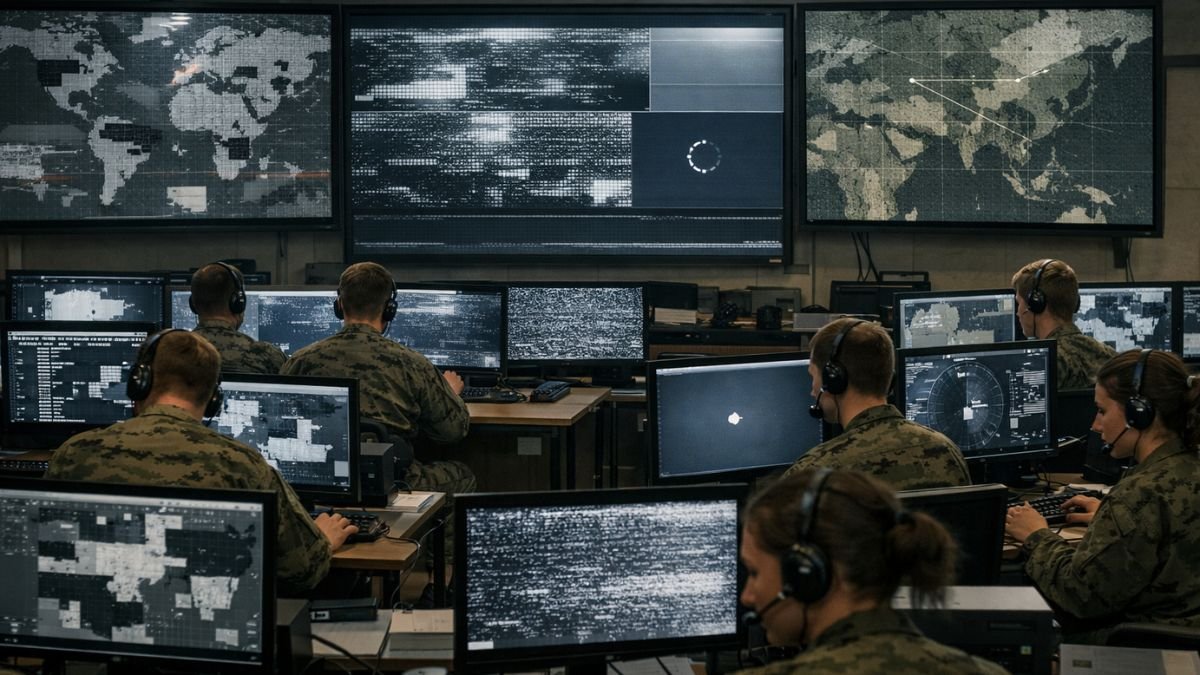
The imperative to function in contested, degraded communications environments is driving investment in mesh networking protocols that reroute data flows around damaged or jammed nodes, AI-driven network management that adapts to changing connectivity in real time, and alternative positioning technologies substituting for GPS when satellite navigation is unavailable.
We are demonstrating zero-trust security across allied partner networks in Japan, Norway, France, Italy, and New Zealand. This addresses the data-centric security requirement identified by the DoD Inspector General and GAO as essential to JADC2’s allied interoperability mission. The Congressional Research Service provides ongoing analysis of JADC2 development and its implications for congressional oversight.
The intersection of these trends defines the operational JADC2 that will exist at the end of this decade. It will be faster, more distributed, more autonomous, and more resilient than the current network. It will also present new challenges for adversaries, new risks for unintended escalation, and new questions about the appropriate role of human judgment in military decisions made at machine speed.
Conclusion
JADC2 represents the United States military’s most ambitious attempt to translate the theoretical advantages of networked warfare into operational reality at the scale and speed that peer competition demands. Its promise — any sensor to any shooter, across any domain, faster than any adversary can respond — reflects a genuine strategic imperative shaped by three decades of operational experience and the recognition that future conflict against China or Russia will be decided at speeds that domain-separated command models cannot support.
The infrastructure making JADC2 possible is inseparable from the space systems examined throughout StrikeOrbit’s Space and Orbital Warfare analysis. The satellite constellations carrying JADC2 data across theatre distances, the navigation systems providing positioning precision for its targeting chains, and the space-based intelligence assets populating its operational picture are simultaneously the foundation of JADC2’s promise and the primary targets of adversary counterspace programs.
Degrading JADC2 by degrading its space infrastructure addresses not a single capability but the connective tissue of American military power across all domains — which is precisely why China and Russia have invested in counterspace capabilities as a strategic priority.
The network is the weapon. But resilience under attack may decide who can use it — and that question remains the most consequential unresolved challenge in American military space and command planning today.
Frequently Asked Questions
What is JADC2 and why does it matter for modern warfare?
JADC2 stands for Joint All-Domain Command and Control. It is the United States military’s framework for connecting sensors, weapons, and decision-makers across all warfighting domains — land, sea, air, space, and cyberspace — into a single integrated data network. Rather than having each military service operate separate command systems requiring manual coordination at every boundary, JADC2 aims to allow any sensor in any domain to automatically cue any available weapon in any other domain, with human decision-makers authorizing engagements at the appropriate point. Its strategic significance is that it compresses the time from threat detection to engagement to speeds that adversaries operating on legacy command models cannot match. In February 2024, the DoD delivered an initial minimum viable capability, and CENTCOM has already employed JADC2 in actual combat conditions.
How does JADC2 relate to space systems and satellites?
JADC2 depends entirely on space infrastructure for its operational effectiveness. The Space Development Agency’s Proliferated Warfighter Space Architecture — with Tranche 0 and Tranche 1 satellites in orbit as of 2024 and Tranche 2 deployment underway — provides the data transport layer carrying JADC2 information flows across theatre and global distances. GPS navigation satellites provide the positioning and timing precision underpinning targeting calculations throughout the network. Space-based intelligence satellites populate the common operational picture that JADC2 decision-makers use. Without reliable space-based communications, navigation, and intelligence, JADC2 cannot function at the speed its architects intend. Counterspace operations — jamming, cyber attacks on satellite infrastructure, and anti-satellite weapons — are in effect direct attacks on JADC2 itself.
What are the main challenges facing JADC2 development?
JADC2 faces challenges across technical, organizational, and strategic dimensions simultaneously. A GAO report published in April 2025 found that DoD has not yet established a comprehensive framework to guide its various command and control investments, making it difficult to track overall progress or measure success across contributing organizations. Technically, achieving interoperability between legacy systems across four services that have operated separate data frameworks for decades requires solving integration problems of enormous complexity. Strategically, the adversaries JADC2 is designed to defeat — China and Russia — have both invested specifically in counterspace and electronic warfare capabilities designed to degrade the space-based infrastructure JADC2 depends on, meaning the network is most vulnerable against the adversaries it most needs to function against.
How are China and Russia responding to JADC2?
China has developed its own integrated multi-domain command network under the concept of Multi-Domain Precision Warfare, with the PLA Information Support Force — established through the 2024 restructuring of the Strategic Support Force — consolidating space, cyber, and electronic warfare under unified command. China has also invested heavily in counterspace capabilities specifically designed to degrade American space infrastructure. Russia has pursued integrated command concepts through its reconnaissance-strike complex doctrine, though operational performance in Ukraine has revealed significant gaps between doctrinal ambition and battlefield reality. Both states view degrading American space-based communications and navigation as a primary means of undermining JADC2 effectiveness before and during conflict.
What role does artificial intelligence play in JADC2?
Artificial intelligence is becoming a structural necessity in JADC2 rather than an optional enhancement. The Chief Digital and Artificial Intelligence Office has run eleven Global Information Dominance Experiments through mid-2024 specifically to refine AI-driven data integration and decision support across the joint force. AI systems perform sensor fusion, threat classification, targeting solution generation, and network resource allocation. Human operators retain decision authority over lethal engagements under current policy, but AI recommendation systems compress the time from detection to human decision from minutes to seconds. The Army’s Integrated Tactical Network Capability Set ’25 is extending AI-assisted decision support to the tactical edge for the first time. As autonomous systems proliferate as nodes within JADC2, the role of AI in operational decision-making will expand significantly, raising unresolved questions about the appropriate boundaries of autonomous engagement authority.
Sources and References
U.S. Department of Defense — Joint All-Domain Command and Control Strategy (2022)
U.S. Department of Defense — JADC2 Implementation Plan (2022)
U.S. Department of Defense — Combined JADC2 Minimum Viable Capability Announcement (February 2024)
U.S. Air Force — FY2025 Posture Statement: Advanced Battle Management System (2024)
U.S. Army — Project Convergence Capstone 4 Summary (2023)
Space Development Agency — Proliferated Warfighter Space Architecture Transport Layer Documentation (2024)
Government Accountability Office — Defense Command and Control: Further Progress Hinges on Establishing a Comprehensive Framework, GAO-25-106454 (April 2025)
Congressional Research Service — Joint All-Domain Command and Control: Background and Issues for Congress (2023)
Congressional Research Service — Defense Primer: Military Use of Space (2023)
Centre for Strategic and International Studies (CSIS) — Space Threat Assessment (2025)
Royal United Services Institute (RUSI) — Joint All-Domain Operations: Considerations for Allied Forces (2022)
RAND Corporation — Operationalising JADC2: Key Considerations for the Joint Force (2023)
International Institute for Strategic Studies (IISS) — The Military Balance (2025)
Related Analysis
For analysis of the satellite constellation infrastructure providing the communications foundation JADC2 depends on, read Satellite Constellations and Military Communications in Modern Warfare.
For analysis of the anti-satellite weapons adversaries are developing to degrade the space infrastructure JADC2 requires, read Anti-Satellite Weapons: Capabilities, Systems, and Strategic Implications.
For analysis of the competing US and Chinese approaches to integrated military space doctrine framing the JADC2 competition, read US Space Force Doctrine vs China’s Space Strategy: Competing Visions of Orbital Power.
For analysis of the autonomous and unmanned systems becoming primary nodes within the JADC2 network as both sensors and shooters, read Drone Warfare and Autonomous Systems in Modern Conflict.
For analysis of the foundational orbital warfare context within which JADC2 operates and on which it depends, read What Is Orbital Warfare? How Space Became a Contested Military Domain.
