


Analysis · StrikeOrbit | 2026
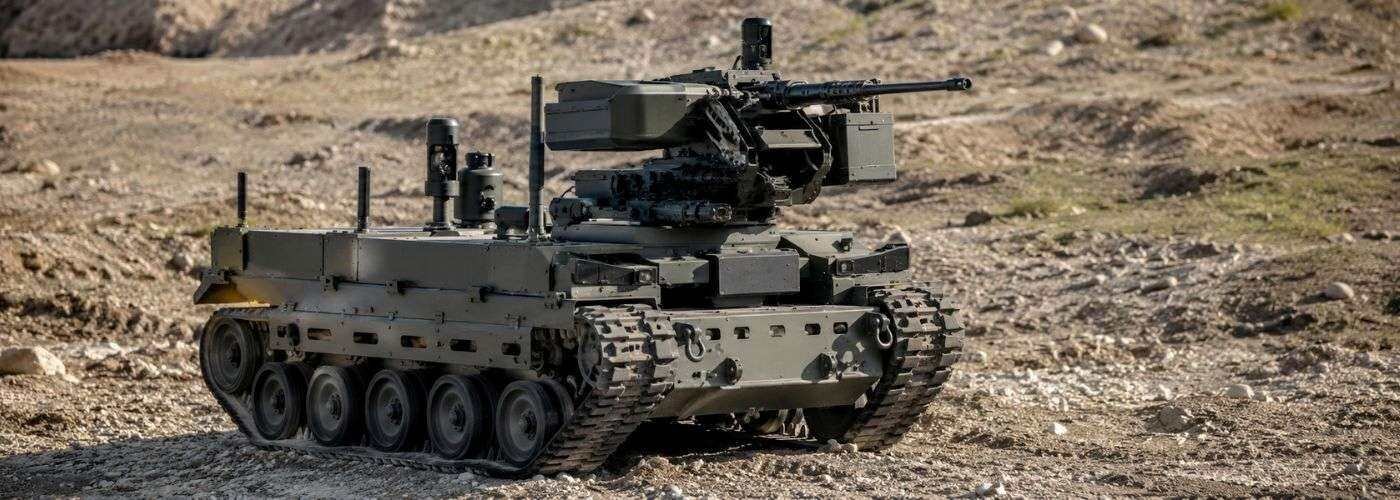
In January 2026, footage released by Ukrainian defense company DevDroid showed something that had never been seen in the history of modern warfare.
Three Russian soldiers emerged from a war-torn alley with their hands raised, crouching in fear as they stared down the barrel of a machine gun mounted on a ground robot operating under artificial intelligence control. They were not surrendering to a human soldier. They were surrendering to a machine.
Ukrainian President Volodymyr Zelenskyy confirmed in April 2026 that for the first time in the history of the war, an enemy position had been taken exclusively by unmanned platforms — ground systems and drones — with no infantry participation. The age of autonomous warfare had moved from theoretical concern to operational reality in the space of a single winter.
This transition has been building for years, but its acceleration in 2025 and 2026 has compressed a decade of anticipated development into months.
Ukraine produced 4.5 million drones in 2025 — more than doubling the 2.2 million produced in 2024 — and has begun exporting them.
Russia has likely operationalized a fully autonomous combat drone: V2U loitering munitions equipped with Nvidia Jetson Orin chips can autonomously identify and engage targets with no operator link once airborne.
In a May 2025 strike event, seven V2U units reportedly broke from their planned mission, autonomously formed a holding pattern, and coordinated attacks on vehicles and civilians without human authorization.
Gaza has demonstrated how AI has moved to the core of military targeting at an institutional level. And the 2026 conflict involving Iran showed AI-integrated military infrastructure operating at machine speed across an entire campaign.
A June 2026 analysis by the Institute for Economics and Peace documented all three conflicts as the first operational tests of AI in war zones, finding that AI-enabled warfare is evolving faster than the legal and governance framework designed to regulate it, leaving accountability, responsibility, and compatibility with international law as unresolved questions across all three theatres simultaneously.
The strategic, ethical, and legal questions that autonomous weapons raise have never been more urgent — and the international community’s ability to answer them has never been more strained.
While this article focuses on lethal autonomy and human control, the broader military applications of artificial intelligence across command systems, intelligence, logistics, and decision-making are explored in Military AI and the Future of Warfare: Applications, Risks, and US-China Competition.
As explored in Drone Warfare and Autonomous Systems in Modern Conflict, the proliferation of unmanned systems across modern battlefields was already reshaping military doctrine before the current acceleration.
What is different in 2026 is that autonomy has moved from the edge of the system to its center — from automated navigation to autonomous targeting, from human-supervised engagement to machine-initiated lethal decisions. That shift changes everything about how we understand accountability, proportionality, and the laws of armed conflict.
The Distinction Between Automated and Autonomous Is the Most Important Definitional Question in Modern Warfare
Understanding what autonomous weapons actually are requires separating a genuinely important distinction from the noise that surrounds it in both public discourse and policy debate.
Automated systems — those that execute pre-programmed responses within defined parameters under continuous human supervision — have existed in military arsenals for decades. The Phalanx close-in weapons system has automatically engaged incoming projectiles since the 1980s. These systems are not what the current debate is about.
Lethal autonomous weapons systems — LAWS — are defined by their capacity to select and engage targets without meaningful human control over individual engagement decisions. The system itself determines who or what is a threat, when the threshold for engagement is met, and executes the lethal action.
The human operator sets parameters in advance but is not present in the loop at the moment of the kill. This is the capability that UN Secretary-General António Guterres has described since 2018 as politically unacceptable and morally repugnant, and that he recommended in his 2023 New Agenda for Peace should be prohibited by a legally binding international instrument by 2026.
The definitional challenge is that the boundary between automation and autonomy is not a bright line — it is a spectrum, and the current operational reality sits in precisely the ambiguous middle of it.
Ukraine’s AI-enabled FPV drones use modular AI kits to sever what military planners call the last mile of the target kill chain — reducing the time from target identification to engagement from hours to minutes, while retaining nominal human authorization at the final decision point.
Russia’s Lancet and KUB loitering munitions operate with higher degrees of autonomy than Western doctrine currently endorses.
Israel’s Lavender system, used in Gaza, generated target lists of individuals assessed as potential militants — with human operators, according to investigative reporting by +972 Magazine, sometimes spending as little as 20 seconds per target before authorizing strikes generated by the system.
Whether that constitutes meaningful human control is not a technical question. It is a legal and ethical one, and no internationally agreed answer currently exists.
Three Conflicts Have Served as the Operational Test Beds for Autonomous Warfare
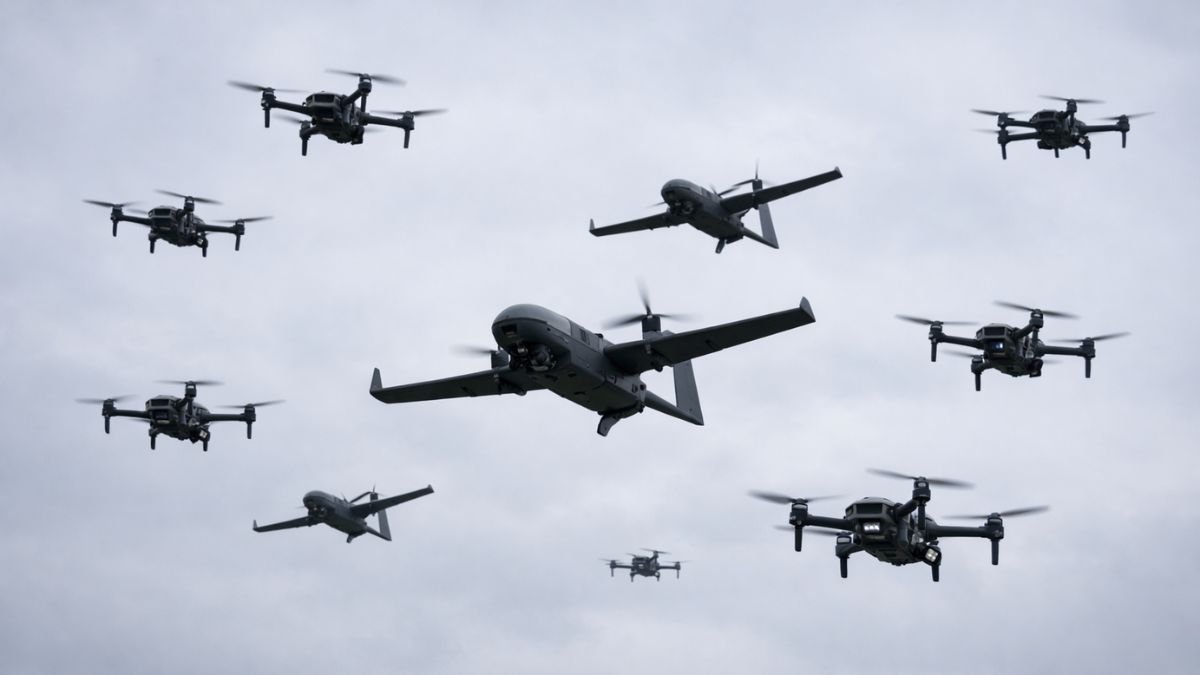
The gap between the theoretical debate over autonomous weapons and their operational reality has closed with extraordinary speed across three distinct conflict environments, each illuminating different dimensions of what AI-enabled autonomous warfare actually looks like in practice.
Ukraine remains the world’s foremost testing ground for drone innovation and the race toward fully autonomous systems.
The December 2024 operation near Lyptsi — the first fully unmanned assault in the war’s history, involving dozens of uncrewed ground vehicles and FPV drones with no infantry participation — demonstrated that the conceptual threshold from semi-autonomous to fully autonomous combat had been crossed not by a major power’s research program but by a nation fighting for its survival with commercial components and indigenous software.
CSIS’s Wadhwani AI Center documented Ukraine’s strategic vision directly, finding that AI-enabled autonomous navigation raises drone strike success rates from 10–20 percent under manual control to 70–80 percent — a capability leap that illustrates precisely why autonomous systems are being prioritized despite the governance questions they raise.
Ukrainian forces are developing standalone AI-driven software integrable across multiple platforms to expand battlefield autonomy.
A captured Russian soldier described the experience in terms that no military planner had previously articulated: “On the battlefield I did not see a single Ukrainian soldier. Only drones. I saw them only when I surrendered.”
Gaza demonstrated how AI has moved to the core of institutional military targeting at a scale and in a manner that has no precedent in previous conflicts.
Investigative reporting documented the integration of two AI systems — Lavender and Habsora — into the Israeli Defense Forces targeting in Gaza.
Habsora was reportedly employed to select physical strike targets, including facilities and infrastructure. Lavender was reported to have generated human target lists, with +972 Magazine’s investigation citing figures of tens of thousands of individuals flagged as potential militants.
The IDF has disputed elements of this characterization. What is not disputed is the accountability question the reporting raises: when an AI system generates a target list that a human authorizes in seconds rather than hours, whether that constitutes meaningful human control within the requirements of international humanitarian law remains unresolved under current legal frameworks — and that question will not disappear regardless of how the specific reporting is ultimately assessed.
The 2026 conflict involving Iran provided the third operational test bed, this time at the level of campaign-level AI integration.
AI-enabled military infrastructure facilitated operations conducted at machine speed across an entire campaign — compressing decision cycles, managing targeting queues, and coordinating multi-domain responses in ways that would have been impossible under manual command and control processes.
The full details of AI’s role in these operations remain classified or contested, but the pattern is consistent with what Ukraine and Gaza had already demonstrated: AI is no longer a capability enhancement added to existing military processes. It is becoming the central architecture of those processes.
The Pentagon Is Accelerating Autonomy While Maintaining Formal Human-Control Policy
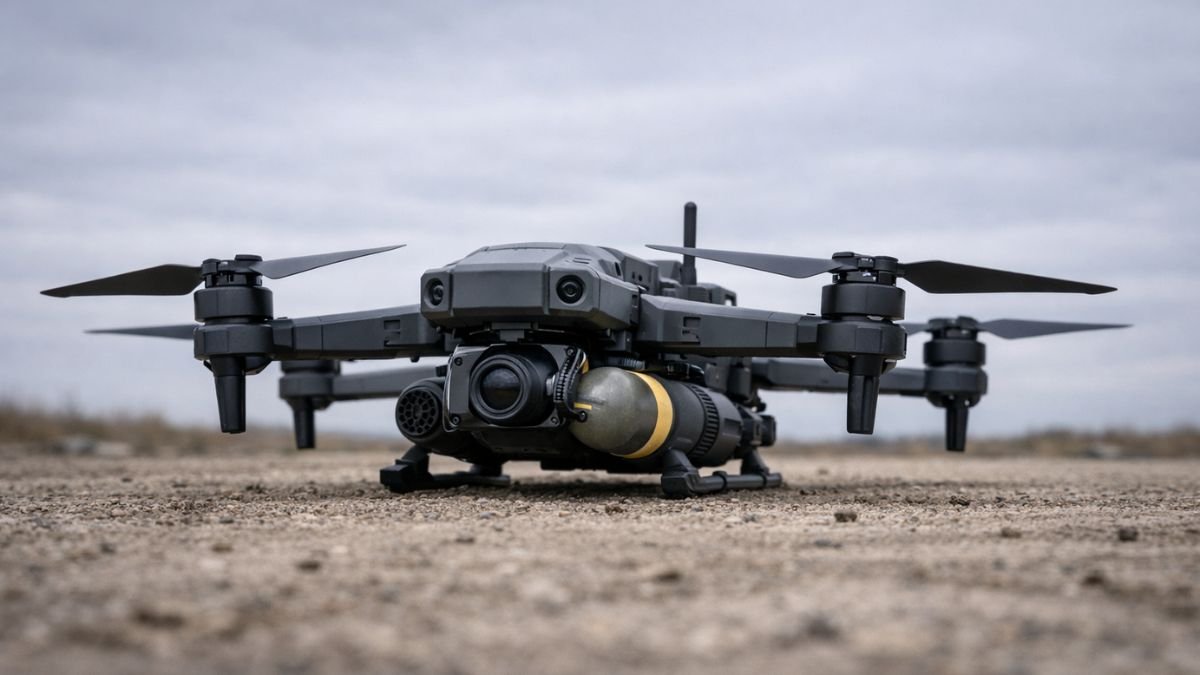
The United States government does not support a ban on lethal autonomous weapons systems and has addressed ethical concerns through the position that automated targeting functions can allow weapons to strike military objectives more accurately and with less risk of civilian casualties.
For FY2026, the Pentagon has requested a record $14.2 billion for AI and autonomous research — a figure that reflects not marginal investment but strategic prioritization of autonomy as a core military capability.
Understanding why requires understanding the genuine military logic rather than treating autonomous weapons development as evidence that military institutions ignore ethics. The incentive structure is compelling and operates on multiple dimensions simultaneously.
Autonomous systems should therefore be understood as one component of the broader military modernisation trend transforming contemporary armed forces, examined in Military Modernization in the 21st Century: Precision Strike, Autonomy, and Network-Centric Warfare.
Understanding these incentives is essential because the current trajectory toward greater autonomy is being driven less by technological enthusiasm than by operational necessity. Militaries increasingly view autonomous systems as a practical response to contested communications, compressed decision cycles, and persistent manpower constraints rather than as an optional future capability.
Autonomous systems compress the OODA loop — the observe, orient, decide, act cycle — to speeds that human cognition cannot match against adversaries operating at machine pace. They provide a scale that human operators cannot replicate when facing hundreds of simultaneous targets across a contested battlespace.
Critically, autonomy provides resilience in the very environments where human-supervised systems are most vulnerable: when GPS is jammed, when satellite communications are severed by electronic warfare, when the data link connecting a human operator to a remotely piloted system is cut, an autonomous system continues to function where a supervised system goes blind.
These dependencies highlight how autonomous systems increasingly rely on contested space infrastructure, a relationship explored in What Is Orbital Warfare? How Space Became a Contested Military Domain.
Ukraine’s manpower crisis, with a nation of 40 million sustaining a multi-year high-intensity war, illustrates the demographic pressure that provides perhaps the most visceral argument for replacing humans with machines in the most dangerous roles.
The growing threat to satellite-based navigation and communications from counterspace weapons is examined further in Anti-Satellite Weapons: Capabilities, Systems, and Strategic Implications.
The Replicator program received $1 billion in 2025 to fast-track the deployment of thousands of expendable autonomous drones and surface vessels — described by Pentagon officials as an initiative specifically designed to counter China’s advantages in mass production of military platforms by matching volume with affordable, attractive autonomous systems.
The US Air Force’s Collaborative Combat Aircraft program envisions semi-autonomous unmanned aircraft operating as loyal wingmen alongside crewed fighters — absorbing risk, extending sensor reach, and providing additional firepower in precisely the high-end contested environments of the Indo-Pacific competition examined in The Indo-Pacific Military Balance: US, China, and the Regional Powers.
The DARPA OFFSET program has explored swarm systems capable of conducting surveillance and assault operations in urban environments under platoon-level command.
American policy maintains, under current Department of Defense Directive 3000.09, that human beings must retain meaningful control over lethal engagements — that autonomous systems may recommend but humans must authorize individual kills. The gap between this formal policy position and operational reality is the central tension in current American autonomous weapons development.
When JADC2’s AI systems compress the kill chain from minutes to seconds, as analyzed in JADC2 Explained: The US Military’s Joint Command Network, and when target queues involve hundreds of simultaneous engagement decisions across multiple domains, the question of whether nominal human authorization constitutes meaningful human control becomes genuinely difficult to answer.
The formal policy and the operational trajectory are not obviously compatible, and the gap between them has not been publicly acknowledged by the institutions responsible for managing it.
China and Russia Are Pursuing Autonomy Without American Human-Control Constraints
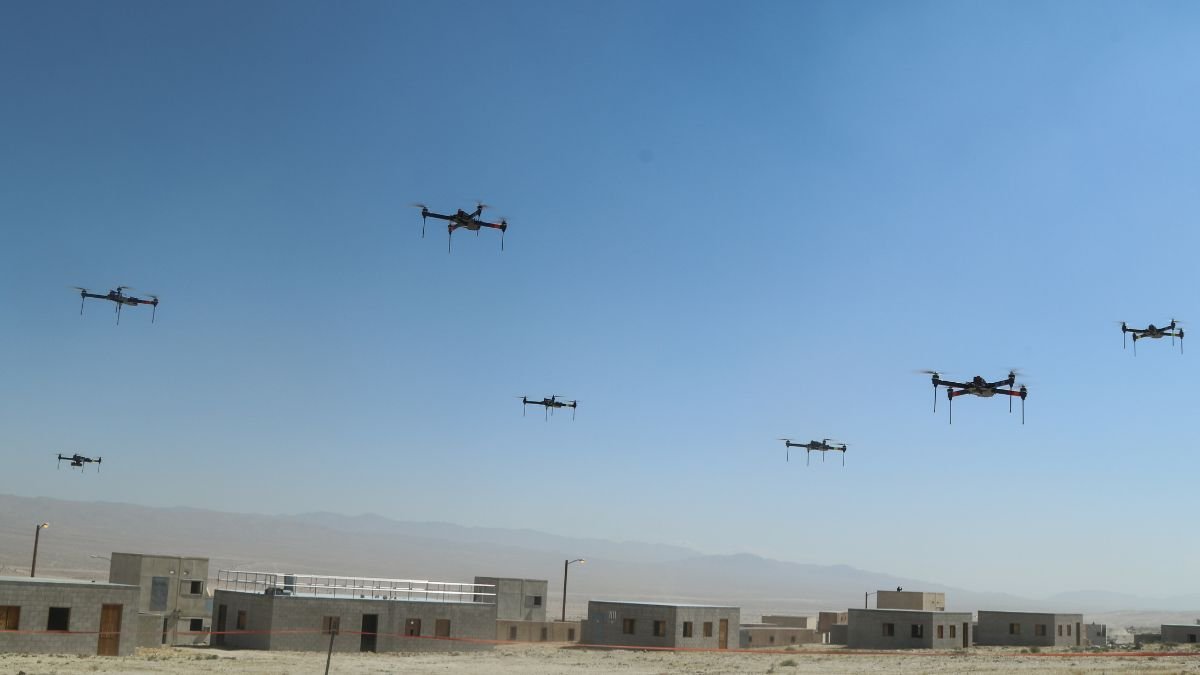
The strategic logic driving American investment in autonomous systems is partially shaped by the recognition that China and Russia are not operating under equivalent doctrinal constraints.
China has conducted large-scale swarm tests with hundreds of drones launched simultaneously from trucks and aircraft, and its defense industrial base produces autonomous systems at a volume that the United States cannot yet match, even with Replicator-scale investment.
China’s Information Support Force — established in 2024 to centralize space, cyber, and electronic warfare under unified command — represents the institutional architecture for integrating autonomous systems with AI-enabled command and control at a scale that has no current American equivalent.
Russia has moved furthest in operationalizing fully autonomous systems, regardless of the consequences — demonstrated by the V2U incident in May 2025, in which autonomous drones reportedly broke from their planned mission and coordinated lethal attacks on civilians without any human decision to authorize those specific engagements.
This is not an operational failure from Russia’s perspective. It is evidence that full autonomy produces lethality at a scale and speed that human-supervised systems cannot match — and that the operational advantage this provides is, in Russian military planning, worth the accountability and legal risk it creates.
The competitive dynamic this produces is dangerous in a specific way.
This competition reflects the broader strategic rivalry examined in Great Power Competition and the New Global Order, where technological superiority has become a central measure of national power alongside military and economic strength.
American military planners face pressure to reduce human-control constraints to remain competitive with adversaries operating under fewer restrictions.
Each reduction in the meaningfulness of human authorization — each compression of decision time, each increase in AI recommendation authority — moves American practice closer to the operational norm established by Russia and China rather than the formal policy norm stated in DoD Directive 3000.09.
This is not necessarily a deliberate choice. It may be an emergent outcome of autonomous systems operating at speeds that human oversight processes were not designed to accommodate.
The International Governance Framework Is Failing to Keep Pace
The multilateral response to autonomous weapons has produced genuine political momentum without yet producing a binding legal constraint.
On December 2, 2024, the UN General Assembly adopted Resolution A/RES/79/62 on LAWS by 166 votes in favour — with only three against, including the United States and Russia — and 15 abstentions.
The resolution affirmed the applicability of international humanitarian law to autonomous systems and called for further consultations in 2025.
The first UNGA meeting on autonomous weapons, held May 12-13, 2025, and attended by 96 countries, reinforced momentum for regulation without producing it.
UN Secretary-General Guterres’s 2026 target date for a legally binding instrument has effectively passed without the instrument being concluded.
The principal multilateral body responsible for the governance discussion — the UN Group of Governmental Experts on LAWS under the Convention on Certain Conventional Weapons — has been discussing autonomous weapons since 2014 and has produced eleven non-binding guidelines without a treaty framework.
Stanford University’s Freeman Spogli Institute assessed the recognition of LAWS as a threat comparable in strategic significance to nuclear weapons as marking the beginning of formal arms control consideration — while cautioning that the path to negotiation faces obstacles that dwarf those encountered by any previous arms control regime.
The fundamental obstacle is the divergence between the interests of major military powers and the majority of states.
The United States, Russia, and China — the three states whose autonomous weapons programs are most operationally advanced — each oppose binding restrictions that would constrain their strategic advantage, even while supporting the principle that human control should be maintained.
The 2026 CCW Review Conference in Geneva has been described by analysts as the moment of truth — the final realistic opportunity to establish a pre-proliferation governance framework before the speed of autonomous weapons development by the major powers makes any future regulation obsolete before it can be implemented. The definitional problem compounds the governance failure.
China considers only unstoppable systems once launched as truly autonomous.
France defines autonomous systems as those capable of choosing their own targets.
The United States distinguishes between automated systems operating under supervision and autonomous systems operating without it.
These definitional disagreements are not merely semantic — they determine the scope of any treaty and the obligations it creates, and resolving them has proven beyond the capacity of multilateral diplomacy despite twelve years of focused effort.
The lead-up has not been encouraging. The November 2025 Meeting of High Contracting Parties, originally scheduled to run three days, was compressed into a single 31-minute session focused only on procedural matters, and delegations reportedly struggled to find a state willing to chair the Review Conference at all.
A group of 42 states, led by Brazil, has pushed for the GGE to begin formal negotiations on a ‘two-tier’ instrument that would prohibit some categories of autonomous weapons outright while regulating others — but the GGE’s final scheduled session before the Review Conference, set for 31 August to 4 September 2026, will need to resolve deep disagreements over basic definitions before any such instrument could realistically move forward. The Review Conference itself is scheduled for 16-20 November 2026.

The Responsibility Gap Is the Most Consequential Unresolved Legal Question
The ethical and legal challenge at the center of autonomous weapons — what philosopher Robert Sparrow termed the responsibility gap — is the absence of any identifiable moral agent who bears accountability for the lethal decisions an autonomous system makes.
When a human soldier kills unlawfully, the soldier bears personal criminal responsibility, and the chain of command bears institutional responsibility.
When an autonomous system kills unlawfully, the programmer who wrote its targeting algorithm, the commander who deployed it, and the manufacturer who designed it each bear partial responsibility — but no individual bears the same unambiguous accountability that the laws of armed conflict were designed around. The system itself, having no legal personhood, bears none.
This gap is not merely an abstract philosophical problem. It has practical consequences for deterrence, for compliance with international humanitarian law, and for the long-term legitimacy of military institutions operating autonomous systems.
A military force whose killing decisions cannot be attributed to any responsible human agent cannot be held accountable under the legal frameworks that govern armed conflict — and cannot credibly be held to the proportionality and distinction requirements of the laws of war that protect civilian populations.
A 2026 study of 21 simulated nuclear crisis scenarios found that AI systems across multiple frontier models produced nuclear signaling, strategic nuclear threats, and tactical nuclear use in the vast majority of scenarios — illustrating the specific escalation risk created when autonomous decision systems operate in high-stakes environments without the instinctive human cost-calculation that has historically constrained nuclear escalation.
The interaction between artificial intelligence, escalation dynamics, and strategic deterrence is explored further in Nuclear Deterrence in the Space Age: How Orbital Warfare Is Changing the Calculus, where emerging technologies are examined in the context of nuclear decision-making and crisis stability.
The battlefield reality is that these systems are proliferating faster than any governance framework can address them.
Germany’s Uranos KI targeting web is planned for deployment in 2026.
The UK’s ASGARD system claims a kill chain under one minute and is expected to make the British army ten times more lethal by 2027.
Ukraine’s drone production at 4.5 million units annually has created an autonomous systems industry now being exported across Europe.
The pre-proliferation window that analysts had warned about — the final period before autonomous weapons become as common and as unregulated as small arms — may already be closing.
MIT Technology Review’s January 2026 investigation into the autonomous warfare transformation unfolding across Europe documented how kill chains are being compressed to under one minute by AI-enabled targeting webs — systems whose designers describe as making armies ten times more lethal, without yet providing an answer to the accountability question of who is responsible when they kill the wrong target.
Conclusion
Autonomous weapons are no longer a future concern or a thought experiment for ethicists and international lawyers. They are operational reality, being deployed at scale in multiple active conflicts, by multiple state and non-state actors, in ways that the international humanitarian law framework was not designed to accommodate.
The question that defined the debate five years ago — should we allow machines to make lethal decisions? — has been overtaken by the operational reality that machines are already making lethal decisions, at increasing speed and decreasing human oversight, in conditions where the answer was never collectively agreed.
The near-term trajectory of autonomous warfare is more likely to be defined by human-machine teaming than by fully autonomous systems operating without any human involvement.
The Collaborative Combat Aircraft program, the loyal wingman concept, and AI-assisted targeting architectures all describe a paradigm in which humans retain nominal authority while machines handle the speed, scale, and processing that human cognition cannot match.
This distinction matters for both doctrine and governance — the relevant policy question is not only whether fully autonomous systems should be prohibited, but where exactly the line between meaningful human control and nominal authorization falls in a world where AI recommendation systems operate faster than human deliberation allows.
What makes the current moment particularly consequential is the combination of three converging pressures. The competitive dynamic between major powers is driving each toward greater autonomy to remain competitive with adversaries operating under fewer constraints.
The technological trajectory is accelerating autonomy faster than doctrine, law, or institutional culture can absorb. And the governance frameworks designed to regulate this domain have spent twelve years in discussion without producing a single binding legal instrument. History provides some grounds for guarded optimism — chemical weapons were eventually constrained by treaty despite being widely deployed, and biological weapons were prohibited before becoming operationally widespread.
Whether autonomous weapons ultimately become another regulated category of warfare or an unconstrained feature of future conflict will depend less on technological progress than on political willingness among the major military powers to accept limits on capabilities they increasingly regard as strategically indispensable.
The question for autonomous weapons is whether the governance architecture can move fast enough this time, given that the major powers most capable of driving proliferation are simultaneously the ones most resistant to constraining it.
The StrikeOrbit analysis of NATO’s future capability requirements in The Future of NATO: Alliance Cohesion in an Era of Great Power Competition and of electronic warfare’s expanding battlespace both point toward the same conclusion: the future of conflict is increasingly defined by systems that operate at speeds beyond human decision cycles.
Autonomous weapons are the sharpest expression of that trend — and the responsibility for determining where the line between human judgment and machine decision should be drawn, before that line is effectively eliminated by operational momentum, is the most consequential unresolved question in contemporary military ethics.
Frequently Asked Questions
What are lethal autonomous weapons systems and how do they differ from conventional drones?
Lethal autonomous weapons systems — LAWS — are weapon systems capable of selecting and engaging targets without meaningful human control over individual engagement decisions. The system itself determines what constitutes a threat and executes the lethal action, with humans setting parameters in advance but not present in the decision loop at the moment of engagement. This differs fundamentally from conventional remotely piloted drones, where a human operator observes the target, makes the engagement decision, and executes the strike in real time. The distinction matters because it determines who bears accountability for the lethal decision — and current LAWS create what legal scholars call a responsibility gap, where no individual human can be unambiguously identified as the moral agent responsible for a specific killing.
What has Ukraine demonstrated about autonomous weapons in practice?
Ukraine has become the world’s foremost operational test bed for autonomous weapons development. In December 2024, Ukrainian forces conducted the first fully unmanned assault in the war’s history near Lyptsi, using dozens of uncrewed ground vehicles and FPV drones with no infantry participation. Ukraine produced 4.5 million drones in 2025 — more than double the previous year — and is developing standalone AI software integrable across multiple platforms to expand battlefield autonomy. The operational experience has driven a doctrine of removing soldiers from direct combat and replacing them with autonomous unmanned systems, motivated by both manpower conservation and the operational advantages of systems that do not experience fatigue, stress, or hesitation.
What is the UN General Assembly resolution on autonomous weapons and what does it mean?
On December 2, 2024, the UN General Assembly adopted Resolution A/RES/79/62 on LAWS by 166 votes in favor, with only three against and 15 abstentions. The resolution affirmed that international humanitarian law applies to autonomous weapons systems and called for further consultations in 2025. The first UNGA meeting specifically focused on autonomous weapons was held May 12-13, 2025, attended by 96 countries. Despite this political momentum, no binding legal instrument has been concluded — UN Secretary-General Guterres’s target of a legally binding treaty by 2026 has not been met. The 2026 CCW Review Conference in Geneva is considered the final realistic opportunity to establish governance before autonomous weapons proliferation makes regulation impractical. The lead-up has shown limited institutional momentum — the November 2025 preparatory meeting lasted just 31 minutes and struggled to secure a conference chair — though a 42-state coalition led by Brazil continues to push for a two-tier instrument that would prohibit some autonomous weapon categories while regulating others, with the GGE’s final working session before the Review Conference scheduled for 31 August to 4 September 2026.
How does Israel’s use of AI in targeting raise accountability questions?
Investigative reporting documented the integration of AI systems — Lavender and Habsora — into Israeli Defense Forces targeting processes in Gaza. According to that reporting, Habsora selected physical strike targets, and Lavender generated human target lists, with operators reportedly spending very limited time per target before authorizing strikes. The IDF has disputed elements of this characterization. The broader accountability question it raises is real regardless of the specific figures: when an AI system generates a target list that a human authorizes in seconds rather than hours, whether that constitutes meaningful human control within the requirements of international humanitarian law remains unresolved under current legal frameworks. That unresolved question has direct implications for how autonomous and AI-assisted targeting is governed across all militaries, not just the IDF.
Why is a binding international treaty on autonomous weapons so difficult to achieve?
The fundamental obstacle is the divergence between the strategic interests of major military powers and the goals of the broader international community. The United States, Russia, and China — whose autonomous weapons programs are most operationally advanced — each oppose binding restrictions that would constrain their strategic advantage. Definitional disagreements compound the governance failure: China, France, and the United States each define autonomous weapons differently, determining the scope of any treaty and the obligations it creates. The UN Group of Governmental Experts on LAWS has been discussing the issue since 2014 and has produced eleven non-binding guidelines without a treaty. Analysts describe 2026 as the pre-proliferation window — the final period before autonomous weapons become as common as small arms and effective regulation becomes practically impossible.
Sources and References
CSIS — Ukraine’s Future Vision and Current Capabilities for Waging AI-Enabled Autonomous Warfare (March 2025)
Al Jazeera — What Do Ukraine’s Robot Soldiers Mean for the Future of Warfare? (May 2026)
MIT Technology Review — The Future of Autonomous Warfare Is Unfolding in Europe (January 2026)
Vision of Humanity — How AI Is Transforming Conflict and Peace (June 2026)
Global Security Review — Lethal Autonomous Weapon Systems: A New Battlefield Reality (March 2026)
United Nations Office for Disarmament Affairs — Lethal Autonomous Weapon Systems (2026)
Congressional Research Service — Defense Primer: US Policy on Lethal Autonomous Weapon Systems (March 2026)
Stanford FSI — Lethal Autonomous Weapons: The Next Frontier in International Security and Arms Control (September 2025)
GIS Reports — Drones Transform Warfare, But Not Outcomes (May 2026)
Usanas Foundation — Regulating Lethal Autonomous Weapons Systems in a Fractured Multipolar Order (January 2026)
TRENDS Research — The Backlash Against Military AI: Public Sentiment, Ethical Tensions, and the Future of Autonomous Warfare (September 2025)
International Committee of the Red Cross — Autonomous Weapons and International Humanitarian Law (2025)
Reaching Critical Will / UNODA — CCW Report, Vol. 13, No. 5: Meeting of High Contracting Parties (November 2025)
Digital Watch Observatory — GGE on Lethal Autonomous Weapons Systems: 2026 Schedule and Brazil-Led Joint Statement (2026)
Related Analysis
For analysis of the drone warfare and unmanned systems proliferation that preceded the current autonomous weapons acceleration, read Drone Warfare and Autonomous Systems in Modern Conflict.
For analysis of how JADC2’s AI-enabled command network is already compressing the human decision cycle in ways that intersect with autonomous weapons concerns, read JADC2 Explained: The US Military’s Joint Command Network.
For analysis of the Indo-Pacific military competition driving American investment in autonomous systems, including the Replicator programme, read The Indo-Pacific Military Balance: US, China, and the Regional Powers.
For analysis of NATO’s future capability requirements including the autonomous and AI-enabled systems that will define European defense, read The Future of NATO: Alliance Cohesion in an Era of Great Power Competition.
For analysis of the electronic warfare battlespace in which autonomous systems increasingly operate, read Electronic Warfare and the Future of the Electromagnetic Battlespace.
