


Analysis · StrikeOrbit | 2026
During the twelve-day conflict between Israel, the United States, and Iran in June 2025, American forces expended a historically large number of THAAD interceptors defending against Iranian ballistic missiles. Estimates of the exact number vary by source.
A study cited by the Congressional Research Service puts the figure at 92 out of an estimated American stockpile of roughly 632. Other reporting, citing U.S. officials, has put the number above 150, close to a quarter of the estimated U.S. THAAD interceptor inventory. Neither figure has been officially confirmed, but both point to the same conclusion: a brief, intense war consumed America’s most advanced terminal missile defenses far faster than peacetime planning had anticipated.
That is not simply a story about Patriot and THAAD missile defense succeeding. Both systems have demonstrated real combat interceptions, but combat has also exposed limits, failures, and logistical costs that no test range can fully capture.
It is a story about what happens when combat-proven technology meets a production base sized for a slower era, and it is the honest starting point for understanding why the Pentagon has spent 2026 signing some of the most aggressive missile defense production contracts in a generation.
As examined in Can Hypersonic Missiles Be Intercepted? Defense Systems, Technology, and the Limits of Current Capability, the technical challenge of stopping an incoming missile is only half the problem American missile defense now faces. The other half, laid bare by real war rather than a test range, is whether enough interceptors exist to keep stopping them, and whether a funded missile actually becomes a delivered, available, deployable one before the next crisis arrives.
How Patriot THAAD Missile Defense Works as a Layered System
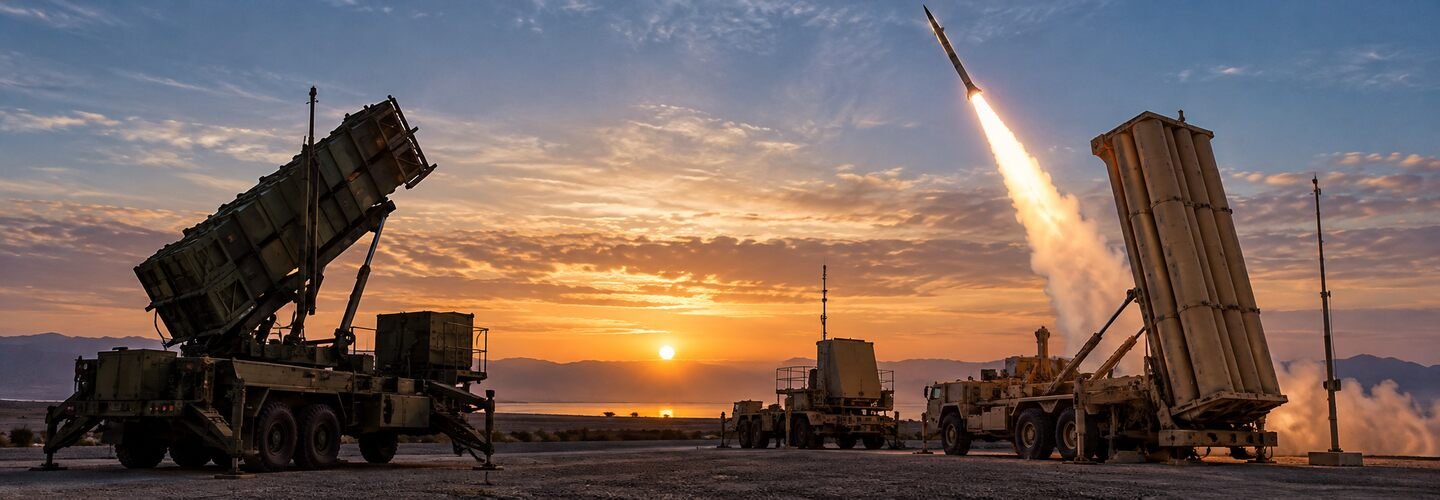
Patriot and THAAD are not competing systems. They are complementary layers built to catch different threats at different altitudes, and understanding the difference matters for understanding why both are now under intense production pressure.
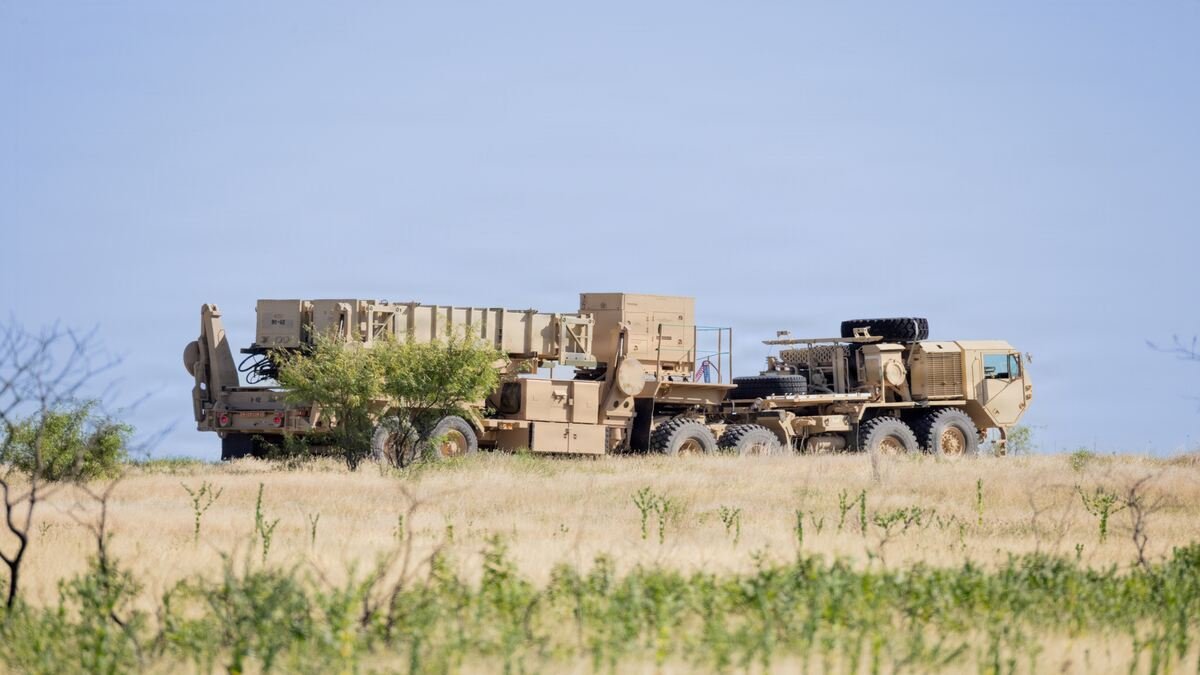
Patriot, built around the PAC-3 Missile Segment Enhancement interceptor manufactured by Lockheed Martin under RTX‘s overall system leadership, engages targets at lower altitudes and shorter ranges, using a hit-to-kill approach that destroys an incoming missile through the force of direct collision rather than an explosive warhead.
An M903 Patriot launcher can carry up to twelve PAC-3 MSE interceptors, and the system also fields the older PAC-2 Guidance Enhanced Missile, which uses blast-fragmentation warheads against aircraft and cruise missiles rather than the newer hit-to-kill approach.
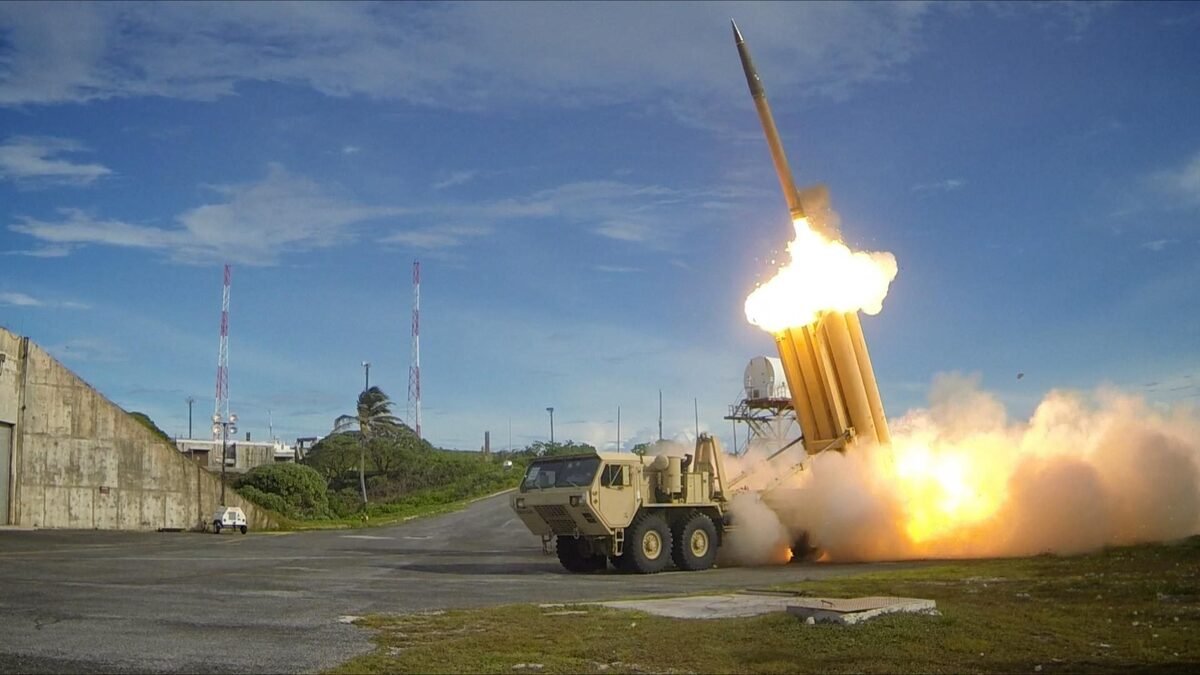
THAAD, the Terminal High Altitude Area Defense system, engages substantially higher and farther from the defended point than Patriot, using the same hit-to-kill principle against ballistic missiles during the terminal phase of flight. That altitude difference is the point.
A ballistic missile that survives THAAD’s high-altitude intercept attempt still has to pass through Patriot’s lower engagement envelope before it reaches its target, giving defenders two independent chances to stop the same threat rather than one.
Lockheed Martin developed both the PAC-3 MSE interceptor and the THAAD system, and the two can also be integrated directly: the THAAD Weapon System can employ PAC-3 MSE interceptors through an M903 Patriot launcher, extending THAAD’s sensor and fire-control architecture to support a lower-tier interceptor and widen the defended battlespace.
That integration was demonstrated in a U.S. missile-defense flight test in 2022, when the THAAD system employed PAC-3 MSE interceptors against a ballistic-missile target.
Combat Has Tested Both Systems and Exposed Their Limits
Patriot’s combat record now spans more than three decades and multiple continents.
Its Gulf War debut in 1991 was initially credited with an extraordinarily high Scud intercept rate, a claim later challenged by post-war congressional and independent physics assessments that found actual performance considerably more uneven than wartime reporting suggested.
That history is worth remembering now, not to relitigate a decades-old controversy, but because it is a useful caution against accepting any single combat claim, then or now, without independent scrutiny.
As examined in Countries With Operational Hypersonic Missiles: Global Status 2026, the Pentagon confirmed in May 2023 that Ukrainian forces had used a Patriot battery to destroy a Russian Kinzhal missile, without characterizing the engagement further.
That single confirmed engagement demonstrated that a Patriot could intercept a Kinzhal under those specific combat conditions; it does not establish universal Patriot performance against hypersonic weapons generally, and no responsible analysis should treat it that way.
THAAD’s combat record is short but has escalated sharply, including both successes and a documented public failure. Its first operational intercept came in January 2022, when a United Arab Emirates battery destroyed a Houthi ballistic missile fired at Abu Dhabi, the system’s first confirmed combat use anywhere in the world.
The United States deployed its own THAAD battery to Israel in October 2024 following that year’s escalation with Iran, and intermittent Houthi missile attacks in the months that followed gave American THAAD crews their own combat engagements, including a first reported combat engagement in December 2024, when the battery launched an interceptor against a Houthi ballistic missile, although the IDF did not publicly specify which defensive system achieved the intercept.
On May 4, 2025, that same defensive layer failed under real conditions: a Houthi ballistic missile struck near Terminal 3 of Ben Gurion Airport after both the American THAAD battery and Israel’s Arrow system attempted and failed to intercept it, injuring six to eight people and temporarily halting airport operations, with Israeli officials citing a possible technical malfunction under investigation.
The Interceptor Shortage Behind the Headlines
The production numbers behind both systems, when examined directly, explain why June 2025 became a genuine strategic warning rather than a one-off news story, though the numbers require care in what they measure.
Reported THAAD production and delivery rates were strikingly low relative to demand, against a stockpile that the Twelve-Day War alone may have depleted by fifteen to twenty-five percent, depending on which expenditure estimate is used. The distinction between production and delivery matters because a missile can be funded, ordered, in production, delivered, and sitting in inventory as genuinely different states, each with its own bottleneck.
That distinction is central to understanding Patriot THAAD missile defense as a sustainable capability rather than simply a collection of interceptors.
The Center for Strategic and International Studies’ Missile Defense Project has separately identified a structural delivery gap for THAAD interceptors ordered as far back as 2021 that will not be fully closed until April 2027, a gap the Pentagon has partially addressed by reprogramming more than $700 million from Israel-related supplemental funding into THAAD procurement.
Patriot’s PAC-3 MSE line has fared somewhat better in delivered output, with Lockheed Martin delivering more than 600 interceptors in 2025, a twenty percent increase over the prior year. But the demand signal the industry is now being asked to meet has grown even faster than that increase.
CSIS’s analysis of the fiscal year 2027 budget request found that requested PAC-3 MSE procurement jumped 839 percent year over year, from 341 missiles to 3,203, with THAAD’s requested procurement rising from 37 to 857 over the same period. A production rate of roughly 600 interceptors a year looks substantial until measured against a single-year procurement request for 3,203 missiles.
The two figures describe different things: a sustained annual output against a one-time budget request, but together they illustrate the scale of the demand signal now being sent to an industrial base that was never designed to surge at that pace.
A Historic Response: Tripling and Quadrupling Production
The Pentagon’s answer to that gap has arrived in a compressed and unusually aggressive burst of contracting activity through 2026, and it is really three distinct things happening at once rather than a single fix.
The first is more finished missiles: in January, the Army finalized a seven-year framework agreement with Lockheed Martin intended to scale PAC-3 MSE production from roughly 600 units annually toward 2,000 by 2030, followed in June by a $35.3 billion multiyear THAAD production contract and in July by a further multiyear PAC-3 award supporting the same ramp.
The second is expanded capacity for the critical components that actually gate final assembly: in July, L3Harris agreed to a framework intended to quadruple THAAD propulsion production, and in early September confirmed a further subcontract from Lockheed Martin covering PAC-3 MSE propulsion under the same seven-year timeline.
By late August, the Department of War, operating under its new secondary designation following a September 2025 executive order, signed parallel seven-year framework agreements with Lockheed Martin and General Dynamics intended to support tripling PAC-3 and quadrupling THAAD production through exactly this kind of expanded subcomponent and supply-chain capacity.
The third and least visible piece is demand predictability itself. Seven-year frameworks are explicitly designed to give suppliers the confidence to invest in labor, tooling, and facilities that a single-year contract cannot justify, which means the real argument embedded in this year’s contracting activity is that the shortage cannot be solved by signing a bigger order alone; it requires reshaping the industrial base that fills that order.
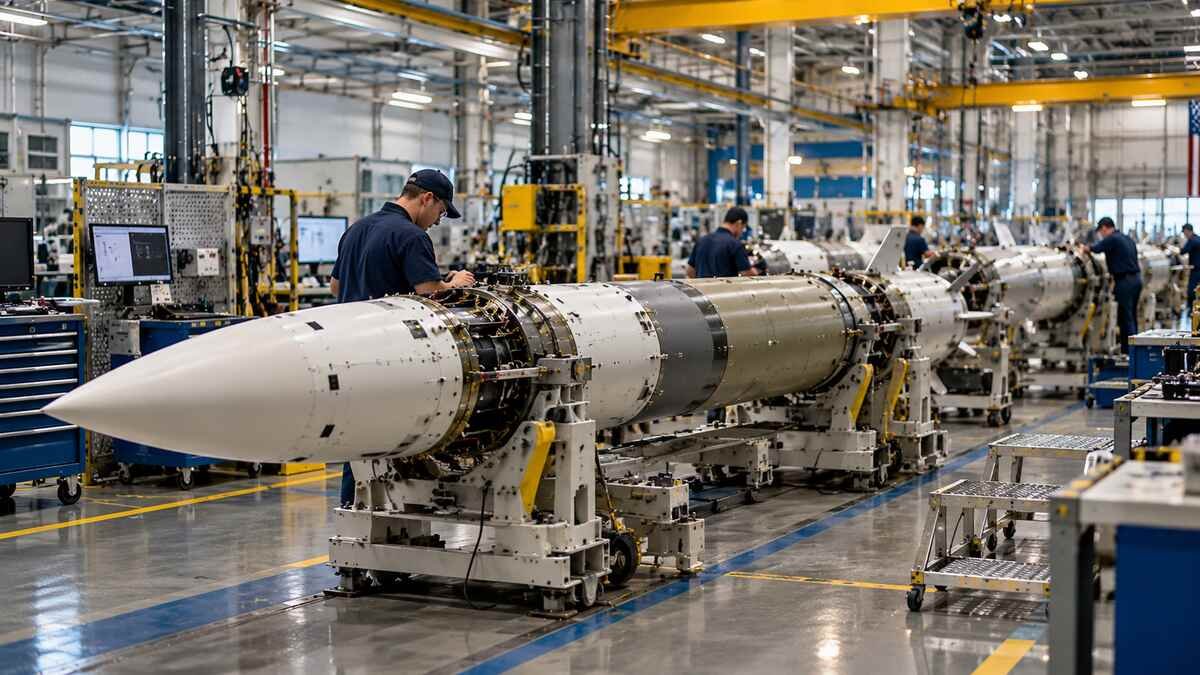
Lockheed has begun construction of a new Munitions Acceleration Center to support the expansion, adding to an existing production footprint spanning fifteen locations across eleven states and roughly 13,000 suppliers.
A new interceptor concept has also entered the picture this year: Lockheed Martin introduced the PAC-3 Adapted Capability Effector at the Farnborough International Airshow in July 2026, describing a new seeker intended to broaden a single interceptor’s ability to engage ballistic missiles, cruise missiles, and aircraft.
Separately, the Navy has begun a $93 million effort announced in April 2026 to integrate PAC-3 MSE into the Aegis Combat System for the first time, extending a land-based Army interceptor onto sea-based platforms and adding further demand to the same production line.
None of these moves will resolve the shortage quickly. Industry analysts have been candid that missiles ordered today, even for systems fully developed and already in production, face multiyear delivery timelines that no amount of contracting urgency can fully compress.
Golden Dome Is Being Built on This Same Foundation
The scale of this production challenge matters beyond Patriot and THAAD themselves, because both systems provide important existing terminal-layer capabilities that Golden Dome, the Trump administration’s initiative to build a nationwide, multilayered missile defense architecture for the American homeland, can build upon.
Established by executive order in January 2025, the initiative received a major initial funding infusion through the 2025 reconciliation process, while the fiscal year 2026 and 2027 budget requests and subsequent program decisions have added further funding and continued to reshape its architecture.
Golden Dome envisions a layered system of systems combining persistent space-based sensors, midcourse interceptors, and a terminal layer built in significant part around existing Patriot and THAAD capacity, eventually augmented by directed energy weapons and, most ambitiously, a proposed space-based interceptor layer intended to engage missiles during the boost phase.
Independent cost estimates for the full program vary enormously, from the administration’s own figure near $175 billion to an American Enterprise Institute estimate as high as $3.6 trillion over twenty years. That gap does not represent competing estimates of one finalized system so much as different assumptions about what Golden Dome would actually include, and it illustrates how unsettled the final architecture remains.
The program has nonetheless shown concrete institutional movement in 2026: a formal architecture blueprint, a command-and-control consortium, and a contracting vehicle that had drawn more than 2,400 contract holders into its pool by January, a figure that represents access to a bidding pool rather than 2,400 companies actively producing missile-defense hardware.
As of August, the U.S. Army had assigned its first air defense unit to a Golden Dome experimentation mission, though the Army has not yet disclosed which interceptor systems that unit will actually operate.
Todd Harrison, the same American Enterprise Institute analyst whose skepticism about American hypersonic weapons timelines appears in America’s Hypersonic Weapons Program: Dark Eagle, Conventional Prompt Strike, and the Gap Between Testing and Operational Capability, has offered a comparably grounded assessment here: orders for Patriot, THAAD, or Aegis interceptors placed today will still not arrive before 2028, even though all three systems are already fully developed and in production.
As examined in Tracking Hypersonic Missiles from Space: The Sensor Architecture Reshaping Missile Defense, the space-based sensor layer, Golden Dome, on which it depends for early warning, faces its own long development timeline, running in parallel to the interceptor shortage rather than solving it.
Allies Are Building Their Own Layers
The interceptor shortage and the layered-defense logic behind Golden Dome are not uniquely American problems, and treating them as such would miss a genuinely global pattern.
Saudi Arabia, which committed to a $15 billion THAAD package under an earlier Trump administration deal, has begun local production of selected THAAD launcher components in Jeddah, a joint effort between the Saudi military and Lockheed Martin that Saudi officials have described as a step toward localizing their own defense industrial base rather than remaining dependent on American production alone.
Taiwan, facing a starkly different but comparably acute threat environment from China, is developing its own multilayered air and missile defense system under the working name T-Dome, though the program remains genuinely in flux; Taiwan’s legislature removed the indigenous Strong Bow interceptor component from the special defense budget during 2026 deliberations, and the outcome of that specific piece of the architecture is not yet settled.
Europe’s response has focused less on replicating Patriot and THAAD than on closing the specific gap those systems were never designed to cover: hypersonic glide vehicles.
The European Defence Fund is backing two distinct efforts rather than one: a Permanent Structured Cooperation project known as TWISTER, aimed at deploying a European-owned satellite constellation to detect and track hypersonic threats independently of American sensors, and a separate Spanish-led interceptor program called EU HYDEF, managed through the European organization OCCAR, which reached a major design milestone in September 2025.
South Korea’s continued reliance on the U.S.-operated THAAD battery at Seongju to counter North Korean missile threats was underscored this year when the U.S. Army showcased its own shorter-range Indirect Fire Protection Capability during the Freedom Shield exercise in the country.
Taken together, the pattern across every region is the same: allied states are not waiting for Golden Dome to resolve America’s own production bottleneck. They are building or localizing their own layers in parallel.
Conclusion
Patriot and THAAD enter the second half of this decade as two of the most extensively combat-tested missile defense systems in the world, with combat providing evidence of both successful interceptions and consequential failures in Ukraine, the United Arab Emirates, and Israel.
That same combat record has produced the clearest evidence yet that American missile defense production was never built for the tempo of the wars it is now being used in.
The scale of the Pentagon’s 2026 response, working simultaneously to increase final missile output, expand critical component capacity, and give industry the multiyear demand predictability to invest in both, is itself an acknowledgment of how serious the gap had become and how many different bottlenecks actually needed fixing at once.
What makes this more than a Patriot and THAAD story is that Golden Dome, the most ambitious American missile defense undertaking since the Strategic Defense Initiative of the 1980s, is being built on top of exactly this foundation. Its most futuristic promises, space-based sensors and boost-phase interceptors still years from any orbital test, depend on a terminal defense layer that is only now, in 2026, catching up to the demand real war has already placed on it.
Whether that foundation can be rebuilt fast enough to support everything being planned on top of it, rather than the other way around, is the question the next several years of contracting activity will actually answer.
Frequently Asked Questions
What is the difference between Patriot and THAAD?
Patriot and THAAD are complementary rather than competing systems, built to intercept threats at different altitudes as part of a layered defense. Patriot, centered on the Lockheed Martin-built PAC-3 Missile Segment Enhancement interceptor, engages targets at lower altitudes and shorter ranges using a direct hit-to-kill approach. THAAD engages much higher and farther out, using the same hit-to-kill principle during the terminal phase of a ballistic missile’s flight, near the edge of space. A missile that survives a THAAD intercept attempt still has to pass through Patriot’s engagement envelope before reaching its target, giving defenders two independent opportunities to stop the same threat, and the two systems can also be directly integrated through a shared launcher.
How many THAAD interceptors were used during the 2025 Israel-Iran war, and did the systems always work?
Reliable estimates of expenditure vary. A study cited by the Congressional Research Service put the figure at 92 interceptors out of an estimated total American stockpile of roughly 632, while other reporting citing U.S. officials has put the number above 150. Neither is officially confirmed. Combat use in 2025 also included at least one documented failure: on May 4, a Houthi ballistic missile struck near Ben Gurion Airport after both the American THAAD battery and Israel’s Arrow system attempted and failed to intercept it, with officials citing a possible technical malfunction under investigation. Combat has demonstrated both real capability and real limits.
Why is the United States tripling Patriot production and quadrupling THAAD production?
Real combat use in Ukraine, the United Arab Emirates, and especially the June 2025 conflict between Israel, the United States, and Iran revealed that interceptor stockpiles could be consumed far faster than the existing industrial base could replace them. Reported THAAD deliveries had fallen to roughly eleven to twelve interceptors annually while the Twelve-Day War alone may have depleted the stockpile by a fifth or more, and requested Patriot procurement jumped more than eightfold year over year in the fiscal year 2027 budget request. In response, the Department of War signed seven-year agreements with Lockheed Martin and General Dynamics in 2026 aimed at expanding both final missile output and the critical component capacity, such as propulsion and seekers, that actually gates production.
What is Golden Dome and how does it relate to Patriot and THAAD?
Golden Dome is the Trump administration’s initiative, established by executive order in January 2025, to build a layered, nationwide missile defense architecture for the American homeland combining space-based sensors, midcourse interceptors, and eventually space-based boost-phase interceptors. Patriot and THAAD provide important existing terminal-layer capabilities the program can build upon, though the final architecture remains unsettled and cost estimates for the full initiative range from roughly $175 billion to as high as $3.6 trillion depending on scope. Analysts have noted that even fully developed, already-in-production systems like Patriot and THAAD face delivery timelines stretching past 2028 at current interceptor shortages, meaning Golden Dome’s most advanced future capabilities are being built on a foundational layer still recovering from the production shortfall exposed by 2025’s fighting.
Which other countries operate or are developing systems like Patriot and THAAD?
THAAD is currently operated by the United States, the United Arab Emirates, which was its first export customer, and South Korea, where a U.S.-operated battery counters North Korean missile threats. Saudi Arabia has begun manufacturing selected THAAD launcher components domestically as part of a broader defense-industrial localization effort. Patriot is fielded across roughly nineteen NATO member states and has been used in active combat by Ukraine against Russian missiles, including a confirmed 2023 interception of a Kinzhal hypersonic missile. Beyond systems built around American technology, Taiwan is developing its own multilayered T-Dome air and missile defense architecture, though key components remain in flux, while the European Union is separately funding two programs, TWISTER and EU HYDEF, specifically aimed at closing Europe’s gap in detecting and intercepting hypersonic missiles.
Sources and References
Congressional Research Service — The Terminal High Altitude Area Defense (THAAD) System, IF12645 (2026)
Congressional Research Service — Defense Primer: The Golden Dome for America, IF13115 (2026)
U.S. Army — Two Systems Become One During Missile Defense Integration Test (2022)
U.S. Department of the Army — PAC-3 MSE Production Framework Agreement Announcement (2026)
Missile Defense Agency — THAAD and PAC-3 MSE Integration Demonstration (2026)
Center for Strategic and International Studies, Missile Defense Project — Analysis of Fiscal Year 2027 Interceptor Procurement Requests (2026)
Breaking Defense — No THAADs ’til 2027: Missile Defense Experts Warn of Interceptor Gap (2025)
Times of Israel — Israel’s Arrow Air Defenses, US THAAD System Both Failed to Intercept Houthi Missile, Sources Say (2025)
Al Jazeera Centre for Studies — Blinding US Eyes in the Middle East (2026)
Jerusalem Post — Saudi Arabia Unveils First THAAD Missile Defense System After $15 Billion Deal (2025)
National Defense Magazine — Pentagon’s Flagship Golden Dome Missile Defense Program Spinning Its Wheels (2026)
Jerusalem Post — Coverage of the May 4, 2025 Ben Gurion Airport Missile Strike (2025)
Lockheed Martin — THAAD Media Kit (2026)
Defense Industry Europe — Lockheed Martin Outlines Advances in THAAD and PAC-3 to Strengthen Global Missile Defense Systems (2026)
Related Analysis
For analysis of the broader challenge of intercepting hypersonic missiles that neither Patriot nor THAAD were originally designed to defeat, read Can Hypersonic Missiles Be Intercepted? Defense Systems, Technology, and the Limits of Current Capability.
For analysis of the space-based sensor architecture that Golden Dome’s early warning capability depends on, read Tracking Hypersonic Missiles from Space: The Sensor Architecture Reshaping Missile Defense.
For analysis of the American offensive hypersonic weapons programs facing comparable production and fielding delays, read America’s Hypersonic Weapons Program: Dark Eagle, Conventional Prompt Strike, and the Gap Between Testing and Operational Capability.
For analysis of the global landscape of hypersonic missile threats these defense systems are built to counter, read Countries With Operational Hypersonic Missiles: Global Status 2026.
For analysis of the early warning satellite architecture that feeds targeting data into systems like Patriot and THAAD, read Missile Warning Satellites and Early Warning Systems Explained.
