



Analysis · StrikeOrbit | 2026
Military power in the 21st century is no longer primarily a question of stockpile size. It is a question of integration — how effectively a state connects its sensors, weapons, and decision-makers into a system that can act faster and more accurately than an adversary. The platforms themselves are not new. The architecture connecting them is.
Three technologies are driving this shift: precision-guided munitions that extend lethal reach while reducing collateral risk; autonomous and unmanned systems that expand operational capacity without proportionally increasing human exposure; and networked command structures that synchronise those capabilities across land, sea, air, space, and cyber domains simultaneously. Each of these developments is easy to understand in isolation. Understanding what they produce together and what risks that combination introduces is where serious analysis is required.
Precision Strike Doctrine Has Redefined the Concept of Military Range
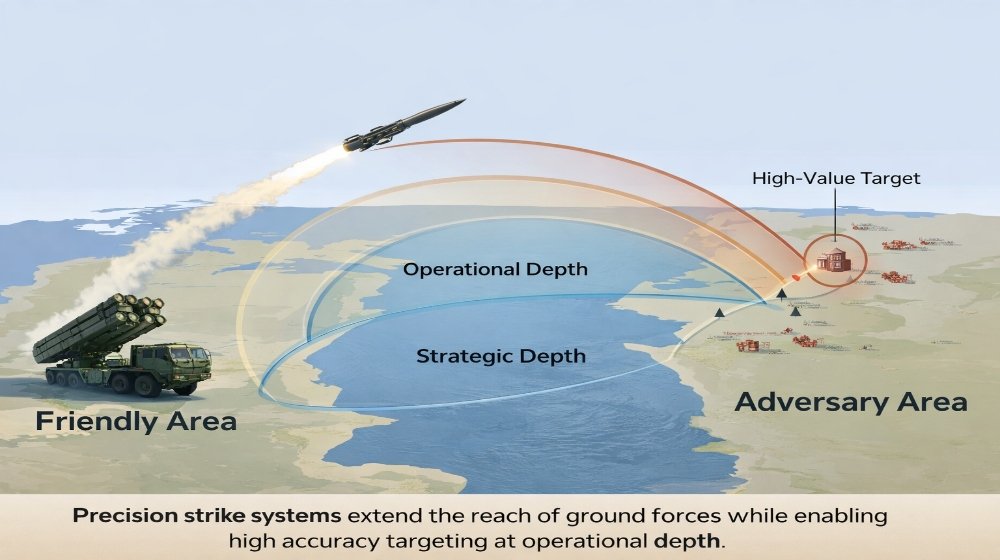
For most of military history, range and accuracy were inversely related. Long-range fires required high volumes to be effective. Precision-guided munitions reversed this relationship.
The U.S. Army’s Precision Strike Missile (PrSM), developed under the Army Modernisation Strategy to replace the Army Tactical Missile System (ATACMS), extends ground-based precision fires to over 500 kilometres. This is not just an incremental improvement; it allows a ground unit to hold targets at operational depth without air support, naval fires, or forward positioning.
Ukraine has demonstrated what this means in practice. Precision munitions have been used to strike logistics depots, bridging equipment, and command infrastructure well behind the contact line. The effect is not simply the destruction of matériel — it is the disruption of tempo. An adversary that cannot move supplies or rotate command cannot sustain offensive pressure, regardless of the size of its force.
China’s counter-positioning is structurally similar. The DF-21D and DF-26 anti-ship ballistic missiles, with the latter having a confirmed range exceeding 4,000 kilometres, are designed to deny U.S. carrier strike groups freedom of manoeuvre in the Pacific. They represent precision doctrine applied to sea-denial rather than land warfare.
The consequence for deterrence is significant. When precision strike systems can threaten high-value targets at strategic distances from ground-based launchers, the line between tactical and strategic operations becomes difficult to maintain. That ambiguity is itself a source of instability.
A deeper examination of precision doctrine and its strategic implications is explored in Precision Strike Weapons and Modern Warfare.
Autonomous Systems Are Operational. The Experimental Phase Has Passed
The debate about autonomous weapons has for years been conducted in the future tense. It should not be. The systems are deployed.
Ukraine provides the clearest evidence. Commercially modified first-person-view (FPV) drones — costing a fraction of a conventional munition — are conducting strike missions. In July 2024, a Ukrainian FPV drone destroyed a Russian Mi-8 helicopter. That is a high-value platform eliminated by a low-cost autonomous system. The cost exchange ratio alone has strategic implications.
At the higher end of capability, the U.S. Army completed a documented autonomous navigation exercise in 2024 in which a surrogate HIMARS launcher completed movement without a driver, using non-emitting sensors for both day and night operation. The platform did not fire. But the exercise confirmed that autonomous logistics support — and its operational extension to fire support — is no longer speculative.
Swarm coordination is the next threshold. U.S. Army testing in 2024 against coordinated drone formations of up to 40 platforms exposed a central problem: point-defence systems designed for individual targets are not structured to defeat simultaneous, distributed attacks at low cost per unit.
The issue is not whether autonomous systems will reshape military operations. They already have. The issue is the rate at which doctrine, rules of engagement, and countermeasure development can keep pace with deployment.
JADC2 Is the Architecture That Makes Precision and Autonomy Strategically Coherent
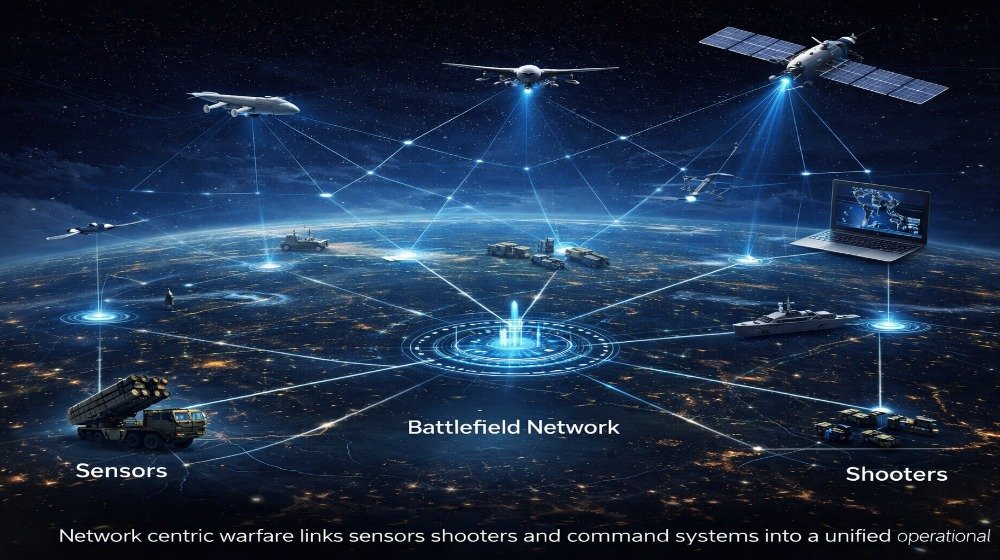
Precision weapons and autonomous platforms generate operational value in proportion to how well information flows between them. That is the logic underpinning Joint All-Domain Command and Control (JADC2) — the U.S. Department of Defence programme designed to link sensors and shooters across all service branches into a single decision network.
The concept is formally articulated in theDoD JADC2 Strategy Summary (2022) to sense, make sense of, and act on information faster than an adversary across all domains simultaneously.
The first live demonstration took place in December 2019. F-22 and F-35 aircraft, a Navy destroyer, Army radar systems, and commercial space sensors were connected in real time to respond to a simulated cruise missile threat. No single platform held the complete picture. The network did.
Each service branch contributes a component: Project Convergence (Army), Project Overmatch (Navy), the Advanced Battle Management System (Air Force), and the National Defence Space Architecture (Space Force). JADC2 functions as the interoperability layer connecting them.
The strategic objective is precise: to act inside the adversary’s decision cycle. If a networked force can complete its sensor-to-shooter sequence faster than the target can respond or relocate, that advantage compounds across every engagement.
The vulnerability is proportional. A system that depends on connectivity can be degraded by attacking the connectivity itself — through cyber intrusion, electronic jamming, or satellite disruption.
Control of the Electromagnetic Spectrum Is a Precondition, Not a Capability
Electronic warfare is not a support function. In a networked force, it is a precondition for every other capability to function as designed.
Russia’s electronic warfare operations in Ukraine degraded GPS-guided munitions and disrupted drone communications with documented operational effects. The conflict demonstrated that even technologically advanced systems perform significantly below their nominal capability in contested electromagnetic environments.
The global military electronic warfare market is projected to reach $44.8 billion by 2032. That figure reflects how heavily states are investing in spectrum dominance as an enabling capability.
Cognitive electronic warfare systems — capable of analysing spectrum conditions in real time and adapting autonomously — represent the current frontier of investment across the United States, China, and Russia.
A force that cannot operate in a contested electromagnetic environment cannot rely on the precision, autonomy, or networking assumed by modern doctrine.
Modernisation Compresses Decision Timelines. That Is a Stability Problem
Faster operations are not inherently safer operations. When sensor-to-shooter cycles compress from hours to minutes — or minutes to seconds in automated engagement scenarios — the time available for leadership to evaluate ambiguous situations narrows accordingly.
The U.S. Army Transformation Initiative (ATI), launched in 2025 under Army Secretary Daniel Driscoll and Chief of Staff General Randy A. George, is a direct institutional response to this challenge.
The initiative merges Army Futures Command with the Training and Doctrine Command (TRADOC), reducing the distance between capability development and operational doctrine. Investment is redirected from legacy heavy armour toward precision fires, autonomous systems, counter-drone capabilities, and secure communications.
The initiative is budget-neutral — modernisation is funded by retiring legacy platforms rather than expanding appropriations. That structural choice reflects a clear judgement: connectivity and precision generate greater deterrence value per dollar than additional armoured mass.
The Legal Framework Has Not Kept Pace with the Technology
Under Article 36 of Additional Protocol I to the Geneva Conventions, states are required to review new weapons to ensure they are capable of distinguishing between combatants and civilians.
The requirement exists. The enforcement mechanism does not.
No binding international treaty currently governs lethal autonomous weapons systems (LAWS). Discussions at the Convention on Certain Conventional Weapons (CCW) have produced analysis but no binding agreement.
When autonomous systems make targeting decisions that result in civilian casualties, existing legal frameworks — built around individual responsibility and command authority — struggle to assign accountability.
The weapons are advancing. The governance is not.
That gap will not resolve itself.
Strategic Advantage Now Depends on Integration, Not Inventory
Military modernisation in the 21st century is fundamentally a systems-integration problem, not a procurement problem.
States that will hold a strategic advantage are not necessarily those with the largest defence budgets or the most advanced individual platforms. They are those that successfully connect precision, autonomy, and networked command into a coherent operational architecture that is fast, resilient, and legally accountable.
The technology is advancing. Doctrine is adapting. The legal framework remains behind. The distance between them is where the real strategic risk now resides.
The broader geopolitical implications of these technological developments are examined in our analysis of Strategic and Geopolitical Intelligence and the New Global Power Balance.
Frequently Asked Questions
What is military modernization in the 21st century?
Military modernization refers to the process by which armed forces adopt advanced technologies, new doctrines, and integrated command systems to improve operational effectiveness in modern warfare. This includes developments such as precision weapons, autonomous systems, and digital battlefield networks.
What is network-centric warfare?
Network-centric warfare is a military concept where sensors, command systems, and weapons are connected through digital networks. This integration allows faster decision-making and more precise targeting across multiple domains, including land, air, sea, space, and cyber.
What role do autonomous systems play in modern warfare?
Autonomous systems such as drones, unmanned vehicles, and AI-assisted platforms expand operational capability while reducing risk to human personnel. These systems can conduct reconnaissance, targeting, logistics, and precision strike missions.
What is JADC2 in modern military strategy?
JADC2 (Joint All-Domain Command and Control) is a U.S. military initiative designed to connect sensors, decision-makers, and weapons across all operational domains. The goal is to enable faster and more coordinated responses on the battlefield.
Sources & References
U.S. Department of Defence — JADC2 Strategy Summary (2022)
Congressional Research Service — Joint All-Domain Command and Control Overview (2024)
U.S. Army Modernisation Strategy — Precision Strike Missile Programme
GAO-23-105495 — DoD and Air Force JADC2 Efforts
ICRC — Autonomous Weapons and International Humanitarian Law (2024)
Small Wars Journal — Autonomous Systems in Modern Conflict (2025)
Arms Control Association — Lethal Autonomous Weapons Systems Fact Sheet (2023)
Related Analysis
For a detailed exploration of how precision-guided weapons are reshaping battlefield dynamics, see Precision Strike Weapons and Modern Warfare.
For a broader strategic perspective on global power competition and security dynamics, read Strategic and Geopolitical Intelligence and the New Global Power Balance.
